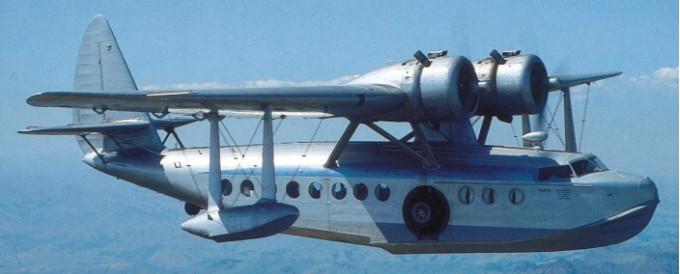
The S-43 was originally designed for a Pan American requirement for a twin-engined amphibian for secondary Latin American routes.
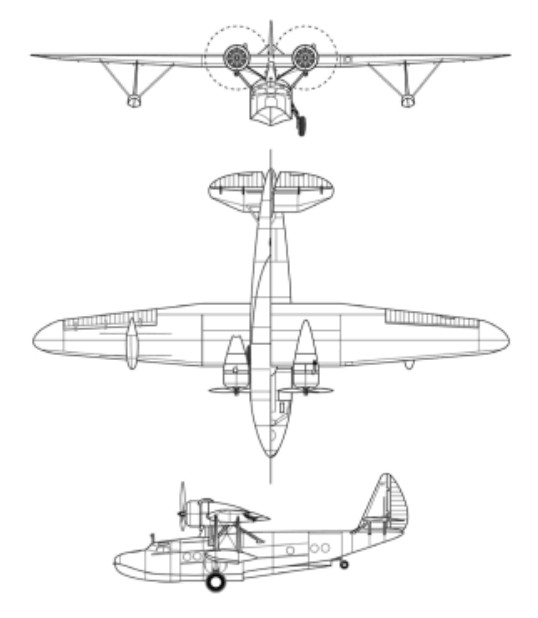
Essentially a scaled-down version of the S-42, the S-43 employed a single-step hull and a single tail group. The wing rested on a central pylon, supported on either side by N-struts. Wing flaps covering 48% of the span reduced the stall speed to 65 mph.
The S-42 had twin vertical tails. Many of the S-43s had the same arrangement, but some had a single tail. Biggest difference other than size and the S-43’s amphibious capabilities (although some S-43s were built as flying boats) were the powerplants, only two 750hp Pratt & Whitney Hornets on the S-43. The smaller airplane had a gross weight of 19,5001b (8,845kg) and could seat 16 to 24, depending on the legroom. Both transports were certificated in 1935.
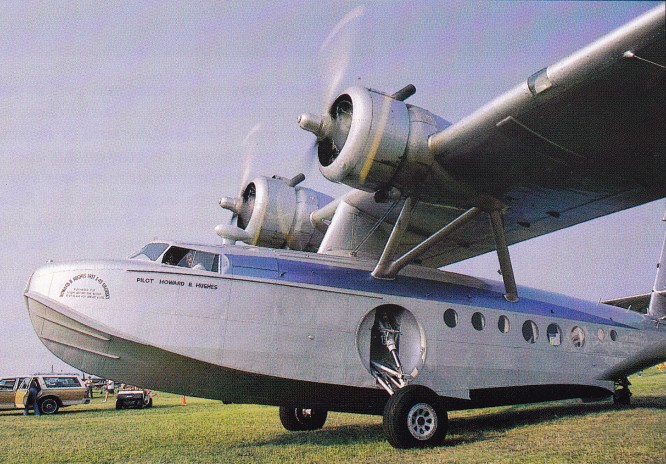
After the first flight on 5 June 1935 (piloted by Boris Sergievsky), the first of fourteen S-43s delivered to Pan American (ATC 593) entered Latin American service in April 1936, though most were subsequently turned over to Panair do Brasil and other subsidiary operations.
Sikorsky Aircraft built 53 S-43 twin engined amphibians in the mid 1930s.
In 1938 Pan American used one of its S-43s on survey flights for planned route extensions to Alaska.
Additionally, four were sold Inter-Islan Airways Airways (later renamed Hawaiian, Airlines) in the Hawaiian Islands, four to Aeromaritime – an Air France affiliate, in West Africa, KLM’s Netherlands East Indies associate, and one to DNL-Norwegian Airlines.
Twenty-two amphibians were delivered as S-43s (NC15061-15068, NC16925, NC16928, NC16934, and NC20698), plus one S-43-A and three S-43-Bs (NC16926-16927, and NC16931-16933) with minor detail changes.
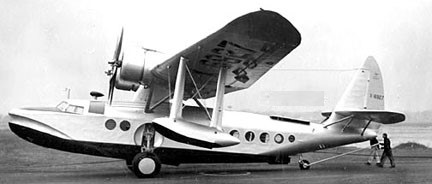
Three delivered in 1937-8 for inter-island operations in the Phillipines were registered as S-43-W’s (ATC 623) with a one-foot fuselage extension and Cyclone engines, plus one as the S-43-WB witthout amphibious landing gear (NC16929-16930, and PK-AFT, PK-AFU). Two S-43s were custom built in 1937 as personal transports, one to Howard Hughes and another to Harold Vanderbuilt.
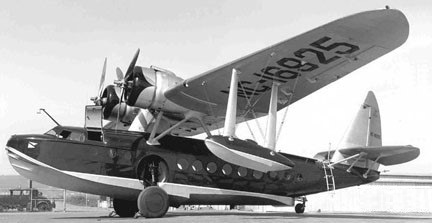
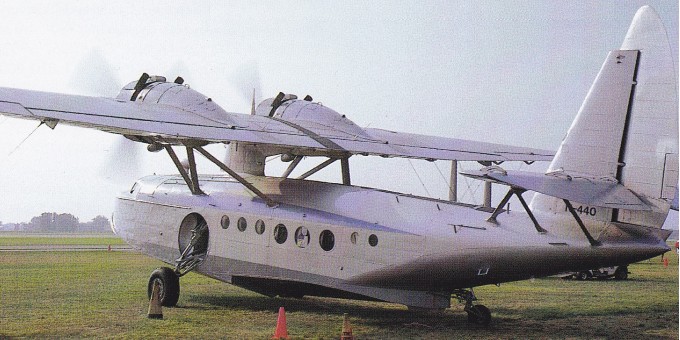
One ‘Baby Clipper’ was ordered in 1937 by Howard Hughes especially equipped for a proposed 1938 around the world flight. Registered NR440, it was fitted with larger 900hp Wright GR-1820 Cyclone radials and additional fuel tanks in the cabin. However, it proved too slow and Hughes made his flight in a Lockheed 14.
Hughes had a mishap with his S-43H, modified with twin tails in 1941, flying NC440 into Lake Mead, Nevada, in May 1943 while practicing alightings in preparation for flying the HK4 Hercules flying boat. Raised by a US Navy diving team, the airplane was rebuilt as a S-43W with a single tail, fitted out as a ten-seat executive transport. Manufacturer’s serial number 4327 served only briefly in this capacity and spent most of its time in storage at Hughes Tool Co in Houston TX until 1977.
Ronald Van Kregten, an acquaintance of both Hughes and lgor Sikorsky, purchased the S-43 from the Hughes estate in 1977 and restored it essentially to its executive configuration, obtaining certification. The airplane was based at Houston. Van Kregten planned to flying it occasionally to air shows.
Between 1937 and 1939 the Navy acquired seventeen S-43s that entered service under the designation JSR-1 (0504-0506, 1054-1063, and 1191-1194), two being assigned to the Marine Corp.
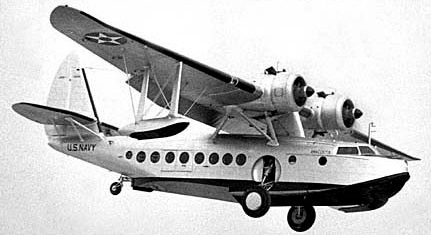
During the same time, five were delivered to the US Army Air Corp as the Y10A-8, 37-370 to -374, and in 1942, a commercial S-43, after being re-equipped with 875 hp R-1690-S2C engines, was impressed into the USAAF as OA-11 serial 42-01 VIP transport.
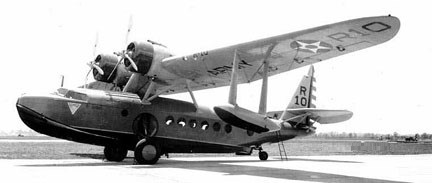
Military craft remained in service throught World War II. One S-43 was sold to the Soviet Union and several ex-Pan American examples were used in Brazil along the rubber river routes. Reeve Aleution Airways acquired an S-43 which it operated in Alaska and Catalina Island until the early 1960s.
One (a JRS) was in storage at the National Air & Space Museum’s facility at Silver Hill, Maryland.
S-43
Engine: 2 x 750hp Pratt-Whitney R-1680-52 Hornet
Props: 3 blade variable pitch, metal
Wingspan: 26.21 m / 86 ft 0 in
Length: 15.60 m / 51 ft 2 in
Height: 5.38 m / 18 ft 8 in
Wing area: 781 sq.ft
Empty weight: 12,750 lb
Max take-off weight: 8662 kg / 19097 lb
Max. speed: 306 km/h / 190 mph
Cruise speed: 167 mph
Ceiling: 6310 m / 20700 ft
Range: 1247 km / 775 miles
Crew: 3-4
Passengers: 15
S-43
Engine: two 750hp P&W Hornet
Wingspan: 86’0″
Length: 51’2″
Useful load: 6750 lb
Max speed: 194 mph
Cruise: 167 mph
Stall: 65 mph
Range: 775 mi
Ceiling: 17,500′
Passengers: 16-25
S-43-A
Engine: two 750hp P&W Hornet
Wingspan: 86’0″
Length: 51’2″
Useful load: 6750 lb
Max speed: 194 mph
Cruise: 167 mph
Stall: 65 mph
Range: 775 mi
Ceiling: 17,500′
Passengers: 16-25
S-43-B
Engine: two 750hp P&W Hornet
Wingspan: 86’0″
Length: 51’2″
Useful load: 6750 lb
Max speed: 194 mph
Cruise: 167 mph
Stall: 65 mph
Range: 775 mi
Ceiling: 17,500′
Passengers: 16-25
S-43-H
Engine: two 750hp P&W Hornet
Wingspan: 86’0″
Length: 51’2″
Useful load: 6750 lb
Max speed: 194 mph
Cruise: 167 mph
Stall: 65 mph
Range: 775 mi
Ceiling: 17,500′
Passengers: 16-25
S-43-W
Engines: two 760hp Wright Cyclone
Wingspan: 86’0″
Length: 52’3″
Useful load: 6040 lb
Max speed: 186 mph
Cruise: 177 mph
Stall: 65 mph
Range: 775 mi
Passengers: 19-25
S-4-WB
Engines: two 760hp Wright Cyclone
Wingspan: 86’0″
Length: 52’3″
Useful load: 6040 lb
Max speed: 186 mph
Cruise: 177 mph
Stall: 65 mph
Range: 775 mi
Passengers: 19-25
JRS-1
Engines: 2 x P&W R-1690-23, 750 hp
Wingspan: 86’0″
Length: 52’1″
Max speed: 185 mph
Ceiling: 20,700′
Seats: 2-12
 All Aero