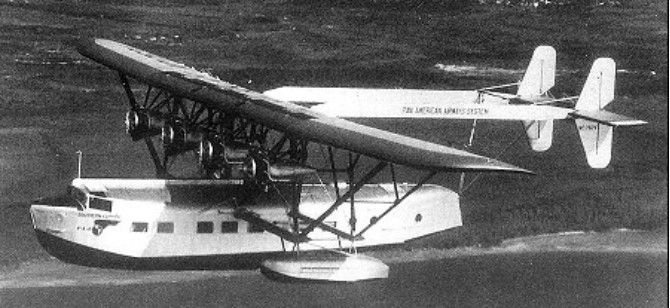
On December 20, 1929, Pan American awarded a contract to build three aircraft as the S-40, with deliveries starting mid-1931. The S-40 featured four engines and a two-step all metal hull, divided into seven watertight compartments, twin-boom, twin-tail and parasol wing. Almost sixty feet in length, accommodation was provided for up to thirty-two passengers and the added luxury of a smoking room with three chairs. Sikorsky selected a monoplane wing with stabalising floats mounted on outrigger booms. When built the Sikorsky S-40 was the largest amphibian in the world.

First flying on 31 August 1931, piloted by Boris Sergievsky and S Gluhareff, flight testing of the S-40 began in early 1931, and it was delivered to Pan American the following October, as soon as the ATC certificate was granted (ATC 454).
The seaplane version had an 11,000 lb load and slightly higher speed.
Selling for $139,000, named “American Clipper” and piloted by Charles A. Lindbergh, the first S-40 inaugurated the Miami-Canal Zone route on 19 November 1931. “American Clipper” pioneered Pan American World Airways mail and passenger routes around the Caribbean and to South America. It was joined by the second, ‘Caribbean Clipper’, later the same year, then by the the third, ‘Southern Clipper’, in early 1932.
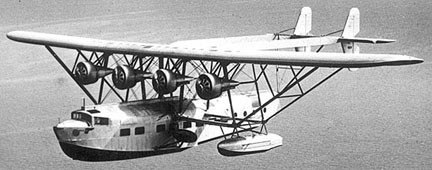
The three S-40s (NC80V, NC81V, and NC752V c/ns 2000 to 2002) established regular airline service between the US east coast and South American destinations such as Rio de Janerio and Buenos Aires, operated without their amphibious gear to improve range as needed. The S-40 carried 40 passengers over distances of 500 mi. at speeds up to 115 mph.
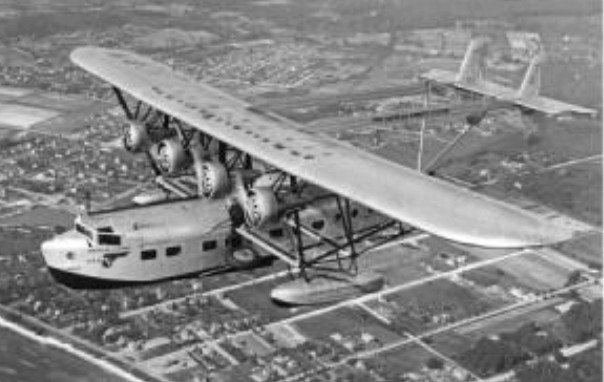
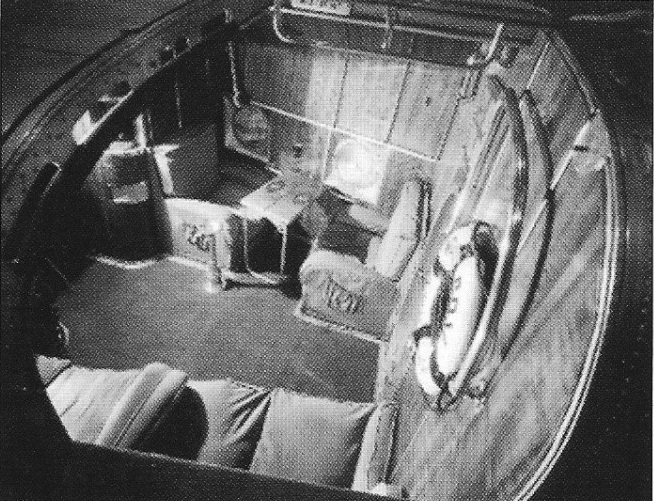
During 1935, after all three had their engines upgraded to super-charged 660hp P&W Hornets, their designation was changed to S-40-A (ATC 562). By the end of 1939 the S-40As had been withdrawn from Pan American service. Caribbean Clipper later served with the Navy as a navigational trainer and is said to have amassed a total of 13,000 flying hours before being scrapped in 1944.
S-40
Engines: 4 x Pratt & Whitney R-1690 Hornet B, 575hp / 425kW
Wingspan: 34.8 m / 114 ft 2 in
Wing area: 174.0 sq.m / 1872.92 sq ft
Length: 23.4 m / 77 ft 9 in
Height: 7.3 m / 24 ft 11 in
Hull length: 48’0″
Max take-off weight: 15400 kg / 33951 lb
Useful load: 9252 lb
Max. speed: 210 km/h / 130 mph
Cruise speed: 185 km/h / 115 mph
Stall: 65 mph
Ceiling: 5550 m / 18200 ft
Range w/max.fuel: 925 km / 575 miles
Crew: 4
Passengers: 40
S-40-A
Engines: 4 x Pratt & Whitney R-1690-44 Hornet, 600 hp
Prop: 2 blade, ground adjustable, metal
Wingspan: 154 ft 0 in
Wing area: 1740 sq.ft
Length: 76 ft 8 in
Max speed: 140 mph
Cruise: 120 mph
Stall: 65 mph
Ceiling: 13,000 ft
Range: 900 miles
Empty weight: 21,000 lb
MTOW: 34,000 lb
Useful load: 10,813 lb

 All Aero