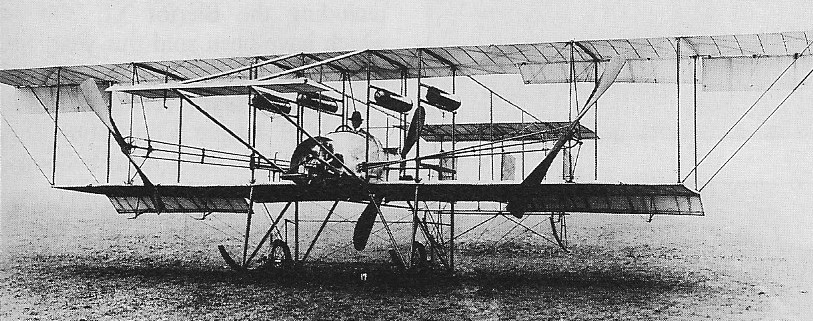
The Short Brothers designed and built a variant of the S.27-type with two engines which could be shut down independently; this biplane, S.39, could maintain flight on either one of its two engines and was thus the first example in the world of twin engines being used to enhance safety.
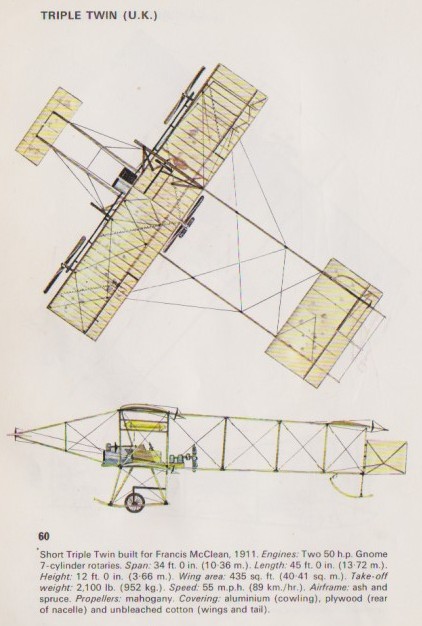
The S.39 was structurally the same as the improved Farman-Sommer-type Short biplane of 1911 apart from the nacelle and power plant arrangement; it had a stronger chassis laterally braced by struts, three rudders below the tailplane and a front elevator carried on inset pivots by booms pitched closer together than normal. The nacelle contained a cockpit with two seats side-by-side and carried a 50 hp Gnome engine and propeller on a standard overhung pusher mounting at the back; another 50 hp Gnome was mounted at the front, rotating in the opposite direction so that gyroscopic moments cancelled out when both engines were running. The forward engine drove two wing-mounted tractor airscrews through Wright-type Renold chain gears, the port chain being crossed to obtain counter-rotation, and the ‘bent-end’ airscrews were exactly like those made for the Short-Wright biplanes.
S.39, known as the Triple-Twin, was first flown on 18 September, 1911, by Frank McClean; he made a brief solo flight, then, with Samson as passenger, flew eight wide circuits of Eastchurch aerodrome, throttling back each engine in turn and experiencing for the first time the luxury of an ample speed range while flying a level course. The effect of the outboard slipstream on lateral control was not up to Horace Short’s expectations, but he was pleased with the Triple-Twin’s overall performance and next decided to try the effect of co-axial counter-rotation on stability. The first step was to convert Cecil Grace’s old S.27 to a similar twin-engined layout, but with the front engine direct-coupled to an airscrew, as shown in patent No. 22,675 of 1911.
This version was called the Tandem-Twin, or, less formally, the Gnome Sandwich, and retained the original S.27 wings and cambered tail unit unchanged except for the addition of two extra top rudders. The chassis was strengthened in the same way as for S.39, and the existing front elevator and booms were retained, since they allowed adequate clearance for the central airscrew. The Tandem-Twin was flown by McClean on 29 October, 1911, without any preliminary taxying; after a short flight at 100 ft he landed and expressed even more satisfaction than with the Triple-Twin; he spent the rest of the day taking up various passengers to test their reactions to the slipstream and to the location of the rear propeller only 10 in behind their heads. The draught in the cockpit was quite powerful and the Tandem-Twin soon acquired yet another soubriquet – The Vacuum Cleaner – and was credited with the ability ‘to pull the hairs out of a fur coat’; this was mainly due to the open hole in the floor, which was the only means of access. The Tandem-Twin could maintain height with either engine throttled back, but was unstable in every direction, due to insufficient aileron power and to unpredictable variations in torque reaction with the rear propeller working in the wake of the front one. Horace Short investigated this effect very thoroughly and deduced design rules for the relative diameters and pitches of tandem airscrews which were still valid 20 years later.
He also designed a larger biplane with two central engines of 120 hp each, driving four propellers arranged in tandem pairs in the wings, with independent chain gears for the front and rear engines. He obtained a number of patents (Nos. 8,108, 8,394 and 22,750 of 1911) for co-axial and interconnected airscrews, but the four-screw aeroplane was never built; however, Maurice Egerton apparently had his S.35 biplane converted into a Triple-Twin and flew it regularly from April 1912 onwards. Both S.39 and S.27 were flown at first without wing extensions, and on 21 November, 1911, they were raced by Longmore and Gerrard respectively; both did better than 55 mph, but S.39 seemed to have the edge over S.27. In December, S.39 was fitted with extensions and double fuel capacity; in February 1912, S.39’s extensions were removed and fitted to S.27, and in October 1912, S.39 was temporarily given equally extended upper and lower wings of 50 ft span, which further top extensions later increased to 64 ft. S.39 was purchased by the Admiralty in June 1912 and given serial T3, later simplified to 3; in the spring of 1913 it was returned to the works for overhaul and completely remodelled as a two-seat tandem pusher with new wings and no front elevator, as already described. The Admiralty declined to buy the Tandem-Twin, which remained McClean’s property (it was No. 11 in his private fleet list), but he lent it to the Naval Flying School without charge, and it was eventually crashed by Samson; Egerton’s S.35 appears to have been dismantled and probably formed the basis of one of the Sociables of early 1914. The final development of the triple-twin theme was the Triple-Tractor S.47.
Two other types of pusher biplane deserve notice. One was a startling metamorphosis of the original Triple-Twin, S.39, which reappeared on test by Sydney Pickles on 24 July, 1913, as a neat two-seat tandem pusher without a front elevator. It had constant-chord wings of improved profile with struts of oval steel tube and the landing gear and tail unit of a late production S.38-type, with balanced rounded rudders; it still retained its original serial 3, which was almost its only link with the past. Lighter in weight than a standard S.38-type, it had a very lively performance, with a top speed of 65 mph and the then exceptional rate of climb of over 600 ft/min; its ceiling was better than 9,000 ft. It was a favourite mount of Samson’s, and he used to fly it at night; he took Winston Churchill up in it during his visit to Eastchurch on 24-25 October, 1913. Finally, it joined the scratch squadron which Samson took to Flanders early in the war and was based at Poperinghe in October 1914, but was never armed and only used as a communications hack.
Triple-Twin
Span 34 ft (103 m), later 50 ft (15-3 m)
Length 45 ft (13-7 m)
Wing area 435 sq ft (40-4 sq,m), later 500 sq ft (46-5 sq.m)
Empty weight 1,800 lb (816 kg)
Loaded weight 2,100 lb (953 kg)
Speed 55 mph (88-6 km/h).
Tandem-Twin
Span 34 ft 2 in (10-4 m), later 50 ft (15-3 m)
Wing area 480 sq ft (44-6 sq.m), later 517 sq ft (48 sq.m)
S.39 (rebuilt)
Span 52 ft (15-84 m)
Length 29 ft (8-85 m)
Wing area 500 sq ft (46-5 sq.m)
Empty weight 1,000 lb (454 kg)
Loaded weight 1,500 lb (680 kg)
Speed 65 mph (104-6 km/h).
 All Aero