
The closure of Italian and Italian colonial seaports to Imperial Airways in the Mediterranean in 1929 brought a need for a longer range flying boat, with mail carriage a priority. The Kent biplane flying boat was Short’s response, and three were built.
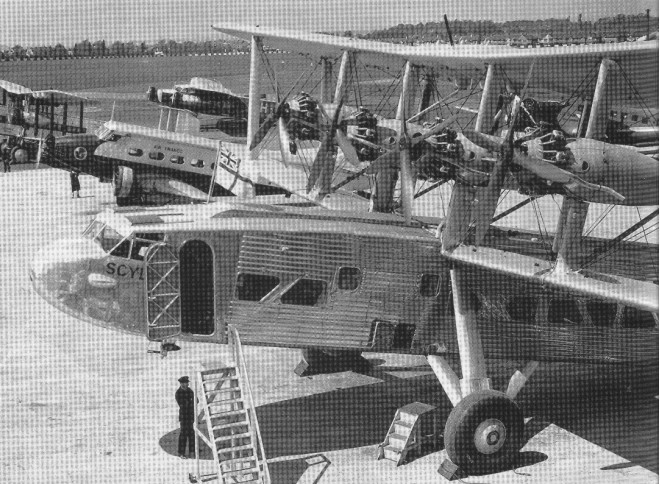
During the spring of 1933, Imperial Airways asked Short Brothers to develop a landplane version of its Kent flying boat. Differing little from the Kent, apart from the wheeled undercarriage and principally different in having a rectangular fuselage and a fixed undercarriage., Scylla and Syrinx were constructed outdoors since Shorts had no means of building and flying a landplane at its own facilities and was forced to use Rochester airport due to the urgency of the requirement.
Both of the new aircraft entered scheduled service on 7 June 1934, on the Paris route. The cabins featured three passenger compartments, two toilets and a buffet. The average cabin width was almost 11 ft / 3.35 m.
Scylla did suffer a minor accident at Paris Le Bourget on 3 August 1934.
The two Scylla examples stayed in service longer, and had very short RAF careers in 1939-40. They were the last of Short’s biplane designs and the last in service.
 All Aero