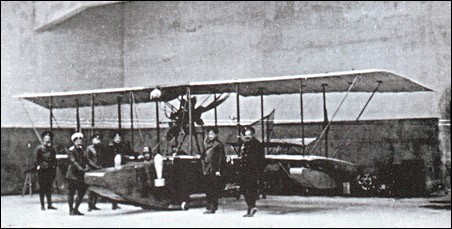
In the summer of 1913 at the Schetinin factory the first work with seaplanes began. Between 1912 and 1913 the Baltic Sea Aviation acquired a number of French Donnet-Lévêque flying boats. On July 25, 1913, the naval pilot von Litgard, belonging to the experimental station directed by the second-rank captain DN Alexandrov, had an accident in one of them.
Taking into account that the flight had been carried out without completing some formalities, the pilot decided to repair the plane at his own expense. The specialists of the RBVZ (Rusko-Baltiski Vagonni Zavod or Russo-Baltic Wagon Factory) valued the repairs at 6,500 rubles, and at the newly opened Lievediev factory the price reached 6,000 rubles, which at the time was a considerable amount of money, which was not within the reach of a fleet officer.
In view of this von Litgard decided to try the Schetinin factory. Grigorovich, advised by the head of the factory drawings bureau Andrei Nikolayevich Sidielnikov, convinced Schetinin, who decided to take over the repair at his factory for the symbolic sum of 400 rubles. In the repair process, Grigorovich was able to carry out an in-depth study of the construction of the aircaft and practically all the pieces were copied. The hull coating was replaced in just 10 days. The plane was able to operate satisfactorily, the pilot managed to repair the plane cheaply, his boss Alexandrov avoided a reprimand, and Grigorovich obtained the necessary information to create the foundations for his future career as a naval aircraft construction specialist.
The plans obtained from the copy of the parts and pieces of the Donnet-Lévêque boat allowed Schetinin to present to the Navy in September 1913 his willingness to build a new model and on the 24th of that month the State Naval Major General asked the commander of the port of St. Petersburg to sign the official request for a seaplane with a Gnôme engine of 80 hp. According to the contract signed on October 23, the entire project was initially valued at 9,000 rubles (later increased by another 300 rubles). 50% of the requested amount would be paid after the tests of the Gnôme engine in Moscow or in Paris, 25% after the inspection of the production process by representatives of the fleet and the rest upon delivery of the airplane. The work was to be completed by December 23 with the possibility of testing the model in May 1914 due to winter. Finally, a point in the contract established that the engine and the flying boat would remain at the disposal of the manufacturer and the Navy, respectively, in the event that the tests were considered unsuccessful. The new design was called M-1 Sea-first (Russian: Григорович М-1).
As requirements, the ability to climb to 300 meters in less than 10 minutes during a 30-minute flight and glide to 100 meters during another 15-minute interval was established.
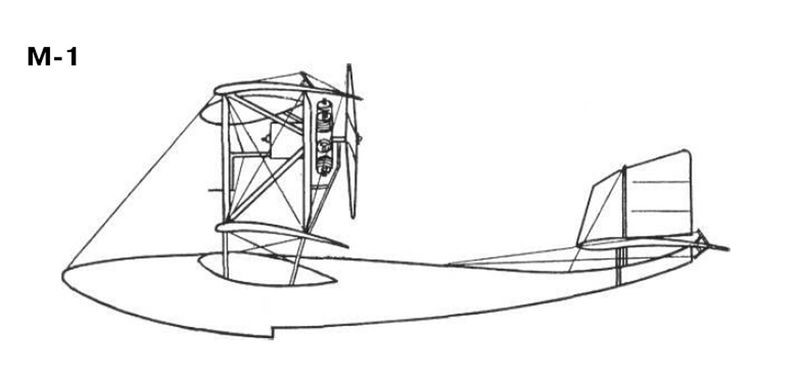
Despite having been based on the French Donnet-Lévêque , the M-1 introduced some appreciable differences. It was shortened by about a meter and its nose became sharper. The bottom was flat, becoming rounded near the recess, and behind it sharpened slightly. The height of the huts in the area of the rediente reached 200 mm.
The M-1 had a hull with stringers made of ash and frames of ash and basswood covered in 3 mm thick birch plywood on the upper part of the bow and the rails of the tail section and 5 mm on the rest of the body. helmet. The bottom of the hull had a double layer of 5 mm and three layers at the back. The coating was fixed using yellow copper lag screws.
The entire boat was divided into 6 watertight compartments, of which the second and third were the cabins for the pilot and his passenger. The entire interior of the hull was tarred and the crew seat was painted grey.
The airfoil was modified to bring it closer to that used by the Farman XVI, which was produced at the Schetinin factory, but the biplane box shape and wing area were retained. Plans featured unequal spans and four pairs of parallel uprights on each side constructed of American pine braced by tension cables. The wing spars were made of basswood and pine. The trunk-like nerves of the alar root of ash and the intermediate nerves of linden. The entire wing covering was cloth with three layers of “Novavia” paint.
The wing box was located on the hull, fixed to its structure by means of triple 160 mm long supports made of welded steel tubes. In the intrados of the lower plane, the stabilization floats were located, made of wood with quite flat shapes. The control surfaces consisted of two fabric-covered wooden fins.
The tail unit, monoplane type, was also located separated from the hull structure by means of tubular supports and featured strong cable bracing. The stabilizers and the empennage were made of ash wood and covered with fabric.
The power plant selected was the French Gnôme engine fixed to the structure of the upper plane and with a manual starting system from the Bosh firm. BV Shavrov in his work “Aeronautical construction in the USSR until 1938” defines the power of the engine at 50 hp, but more recent research has established that it was a Gnôme of 80 hp. This engine had a two-bladed wooden Shower propeller which had a diameter close to 2.60 meters. The fuel system consisted of two 50-litre tanks within the hull structure and a small 20-litre tank fixed to the upper midplane. The oil tank had a capacity of 35 liters and was made of 0.7 mm brass.
The pilot was located in an open cabin at the bow and a little further back the capacity to transport a passenger was installed.
Some photos taken at the “Kilkond Station” naval base in September 1914 show two bombs located on the rails, on the sides of the cabin, which presupposes a premature attempt to interest the naval forces in the military development of the model for observation and bombing.
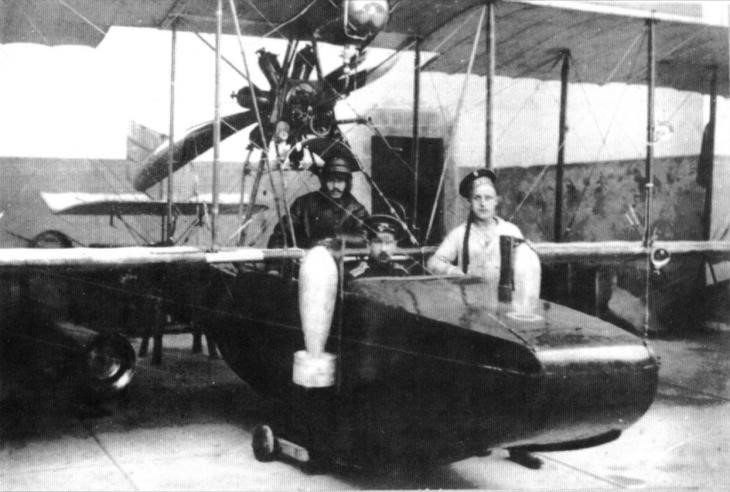
The construction of the flying boat was assigned to DP Grigorovich, who served as technical director of the factory. By December 18, 1913, the first copy was completed, designated M-1, an acronym for Morskoi (Naval) -1. Factory tests started on June 1, 1914.
On June 6, 1914, after carrying out several flights at the First Naval Aviation Station in Libava (Liepāja), Latvia, with the pilot II Kulniev at the controls, the plane was officially registered in the list of military assets under the Sch-1 designation (relating its origin to the Schetinin factory). For this purpose, a reception commission was sent there. During the test flights in a flight of 32 minutes, 600 meters of height were reached. The 300 meters were reached in 10 minutes. Before being officially named Sch-1, the model was known simply as Donnet-Lévêque No.1 and the military designated it with the code “B”.
The flying boat M-1 showed acceptable flight qualities, but it was clear that the model needed revisions and improvements in order to improve its performance. Among the outstanding deficiencies, which were already stated at a meeting of the Aviation Committee of the Baltic Fleet, held on May 6, the following were highlighted:
Problems with the stabilizer;
Powerplant location too far back;
Engine reliability problems that required constant repairs;
Dangerous gliding at heights greater than 100 meters;
Lack of hull rigidity.
For these reasons the Sch-1 was used as a training flying boat.
When Germany declared war on Russia on July 19, 1914 , the Naval Fleet Aviation (AVMF) had only four aircraft: two Sikorski S-10 , the Schetinin Sch-1 and a Donnet-Lévêque (under repairs for the month of August according to the report No.425 of the Naval General Staff of August 13, 1914).
To increase the number of units, the Navy decided to increase requests to Russian factories. Schetinin received a request to build 4 copies of the M-1. However, in the naval ministry they already knew about the work of DP Grigorovich with a view to improving this model, so the request was finally withdrawn and the M-1 ended up being a unique example.
The M-1 (Sch-1) remained on the military register until December 2, 1914, when it was destroyed in a flight by Lieutenant A.A. Tuchkov, chief of the Aeronautical Department of the General Staff at the Second Kilkond Naval Station ( Ezel Island). During the landing with a headwind and after making a turn, the aircraft lost speed, began to fall touching the ground with the tip of the upper right wing. The plane hit the ground and ended up hull up, destroying the wing box. The pilot managed to get out alive despite suffering several injuries. It was decided not to restore the airplane.
М-1
Engine: 1 × Gnome, 37 kW (50 hp)
Upper wing span: 10.28 m
Lower wingspan: 7.04 m
Length: 7.96m
Hull length: 7.41m
Height: approx. 3m
Wing area: 26.90 m²
Stabilizer surface: approx. 2.96 m²
Empty weight: 420 kg (926 lb)
Gross weight: 620 kg (1,367 lb)
Power Load: 12.4kg/hp
Payload capacity: 230-260 kg (175 kg + fuel + oil)
Top speed: 90km/h
Cruising speed: 68km/h
Practical range: 100 km
Time to 300 m: 10 minutes
Accommodation: 2

 All Aero