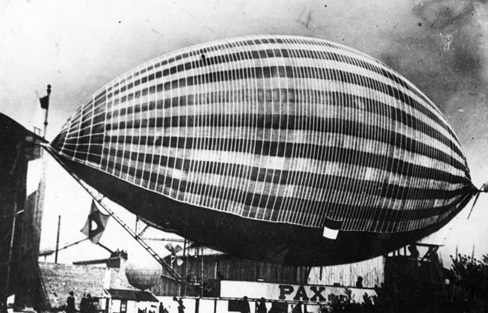
At the end of 1901 Brazilian inventor Augusto Severo de Albuquerque Maranhão travelled to France to build an airship, the semi-rigid “Pax”. It had no directional rudder but seven propellers, one at the stern, one at the bow, another at the nacelle and four at the sides. He had intended to use electric motors, but the lack of resources and time made him opt for two Buchet-type engines, one of 24 hp and the other of 16 hp. The envelope had a capacity of 2,500 cu.m, 30 m long and 12 m at the largest diameter.
Two pusher propellers set at 50 rpm drove the aircraft. The forward and aft propeller diameters were 5 and 6m, respectively. in addition, two other propellers were placed parallel to the machine’s longitudinal axis for lateral control, only. a further propeller was placed below the deck and was employed to control the pitch movement of the 30-m-long aircraft. Maranhão had some insights in designing the Pax, which were not taken into account by his predecessors. one of them was the placement of the traction line coincident with the drag one to better control and handling of the aircraft.
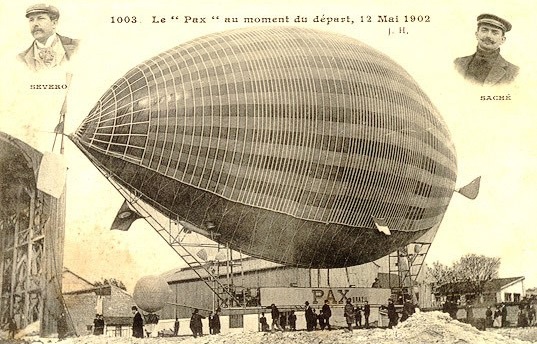
The trials were successfully performed on May 4 and 7, 1902. At 5 am on May 12, 1902, Severo and his mechanic, Georges Saché, set off, intending to fly from Vaugirard in Paris to Issy-les-Moulineaux. It rose quickly, but at about 400 meters’ altitude it exploded, crashing on Avenue du Maine. Both Severo and Saché were killed.
 All Aero