
The original Santos-Dumont Demoiselle is said to have supported 260 pounds on 100 square feet of area, making a speed of sixty miles per hour. Its proprietor was the first aviator in Europe of the heavier-than-air class.
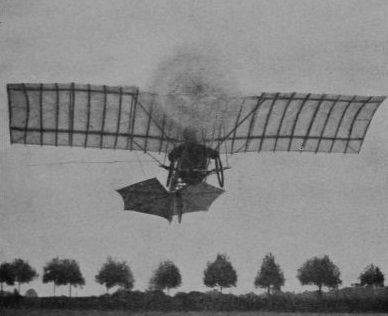
The La Libélula (later changed to Demoiselle) was the most popular aircraft model created by Dumont, with appreciable improvements in flight control and in the ailerons of its aircraft. They were the smallest and cheapest airplanes of their time, (5000 francs) expressly manufactured at very popular prices, by at least forty workshops throughout France. The design was constructed in various versions, powered by 24 to 30 hp Duteil-Chalmers or 30 hp Darracq engines. The Darracq engine radiators were under the wings.
After having done pioneer work with dirigible balloons, he won the Deutsch prize for a hundred meter aeroplane flight (the first outside of the United States) in 1906; the speed being twenty-three miles per hour. His first flight, of 400 feet, in a monoplane was made in 1907. Alberto Santos-Dumont displayed his original Demoiselle at the Aero-Auto Salon in France in 1908.
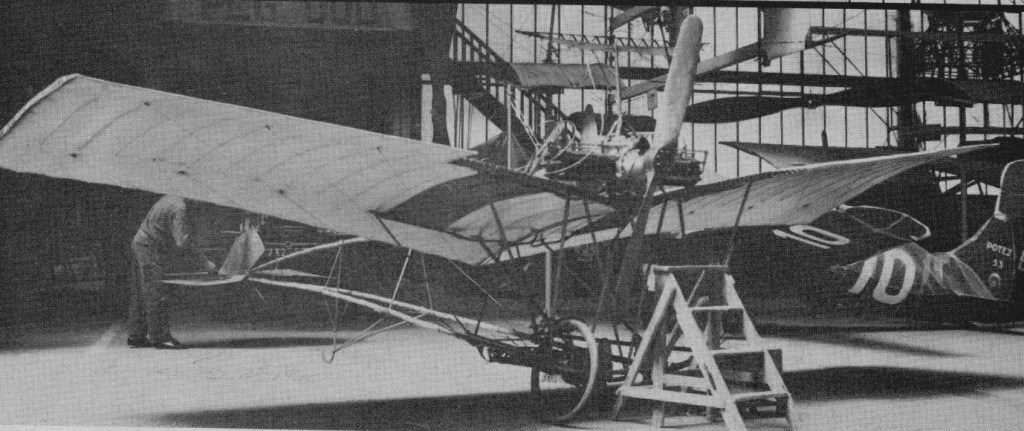
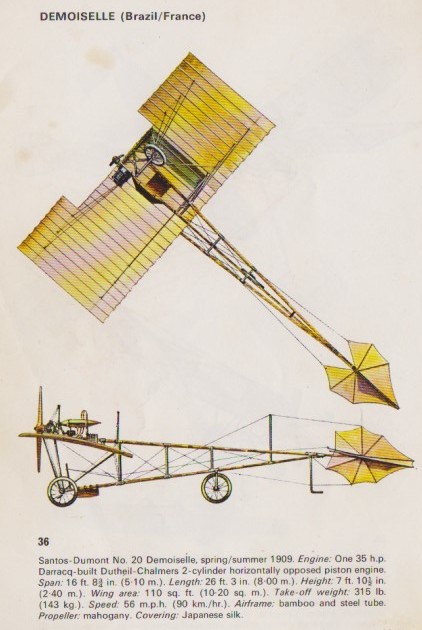
It was a small high-wing monoplane, with only 5.10 m wingspan, 8 m long and weighing 260 lb empty little more than 110 kg with Santos Dumont at the controls. With optimum performance, easily covering 200 m of ground during the initial flights and flying at speeds of more than 100 km/h. Santos-Dumont first flight of 1.24 miles was made on 5 April 1909 and on 13 September he made a flight of 4.96 miles at a speed of 56 mph in a 5 minute run at St. Cyr.

In total, Santos Dumont built nine types of Demoisellles, always refusing to patent his inventions, expressing that his interest was not to hinder other researchers, who could use his discoveries freely and also because his dream was that costs would be so cheap that planes were familiar and cost the same as a car. He never opposed those who wanted to copy his projects or those who wanted to sell prototypes made from his designs. Clément Bayard, an automotive maker, constructed several units of Demoiselle.

In 1909, Santos Dumont produced an airplane capable of flying kilometers in one go, the Demoiselle IV, with an 18-horsepower Dutheil-Chalmers engine and arched wings, which produced quite a bit of lift. In the first test, carried out on March 9, the aircraft fell immediately after takeoff and was left with one of the wheels shattered, but the aeronaut was not injured. On April 8, Dumont, with the aircraft already repaired, made a flight of 2,500 meters at an altitude of 20 meters.
In September Santos Dumont fitted a 30-horsepower Darracq steam engine to the plane and wrapped the radiator tubes around the wings, creating the Demoiselle VI. It was in that device that he made his most durable and extraordinary flights by plane. On the 13th of that month, it flew the 8 kilometers that separate Saint-Cyr from Buc in 5 minutes, at an average of 96 km / h, unprecedented speed for an air vehicle. The next day he made the flight in reverse, this time using 12 minutes due to the opposite wind.
On the 15th, in Saint-Cyr, he broke the world start record, with a takeoff of 70 meters, timed in 6.25 seconds. On the 16th she broke her own record, taking off at 60 meters, and took the opportunity to fly in 10 minutes and 27 seconds. Shortly thereafter she rose again, now carrying a dead weight of 20 kilos. This additional load, contrary to what was expected, did not hinder the maneuvers and when released in mid-flight, before an enthusiastic audience of about three thousand people, caused tension among the spectators, who feared that the delicate plane would destabilize and hood. The aircraft, however, continued its trajectory with perfect harmony and grace, landing 2 minutes later near the Saint-Cyr hangar.
Constructed with a fine structure, lightness characterize the monoplane of Santos Dumont justifying its name. It is made up of a 8 meter long bamboo spine. At the front it carries the Dutheil and Chalmers horizontal two-cylinder engine, with characteristics such as: diameter: 125 mm, length: 100 mm giving it a power of 18-20 horsepower. The supporting plane or wing, presents a dihedral for stability. The propeller is directly coupled to the engine, being two blades and 1 metre in diameter, at the rear end of the bamboo it is cruciform acting as an elevator and steering wheel. The set is mounted on a rectangular frame consisting of three wheels. The entire unit weighs 106 kg.
On November 21, Santos Dumont, during one of the flights, an accident occurred when the wooden propeller of his Mademoiselle broke, making an arrangement to the propeller in his Modemoiselle II model to avoid such a dangerous mishap.

Built of bamboo and canvas in an attempt to produce a low-priced aeroplane that could be assembled and flown safely by anyone. Santos dumont’s Demoiselle was the first aeroplane to be sold in ‘kit’ form. The advertised price in England was £300.
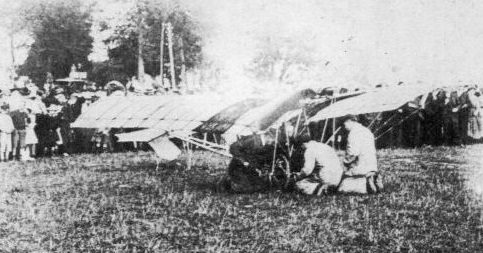
In 1908 Hélène Dutrieu was asked by the Clément Bayard factory, in France, to be the first pilot of its new ultralight aeroplane, the Santos-Dumont-designed no.19 Demoiselle (Young Lady) monoplane. She crashed on take off during her first flight and the aeroplane was wrecked.
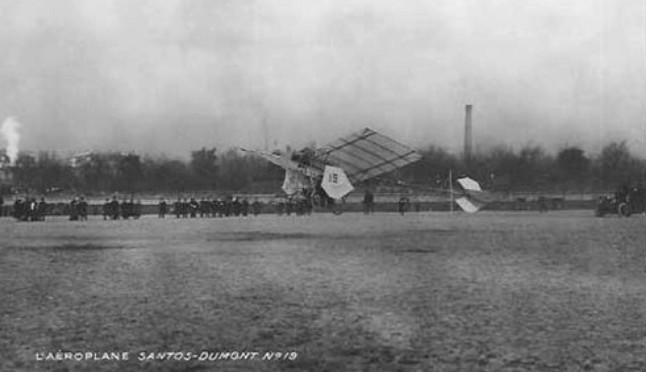
Replica:
Bianchi Santos-Dumont Demoiselle
Engine: Dutheil and Chalmers two-cylinder, 18 – 20 HP
Empty weight: 106 kg
Seats: 1
Engine: Darracq, 25 hp
Span: 16’5″ – 18 ft
Length: 26’3″
Weight: 242 lb
Engine: Darracq, 30 hp
Prop: 5 ft dia, 1600 rpm
Span: 18 ft
Wing chord: 6 ft
Length: 26 ft
Weight: 250 lb
 All Aero