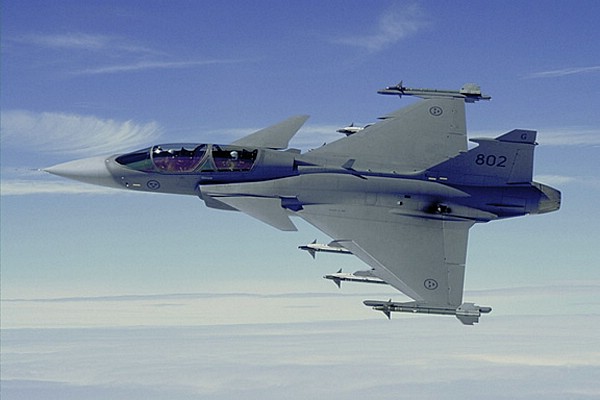
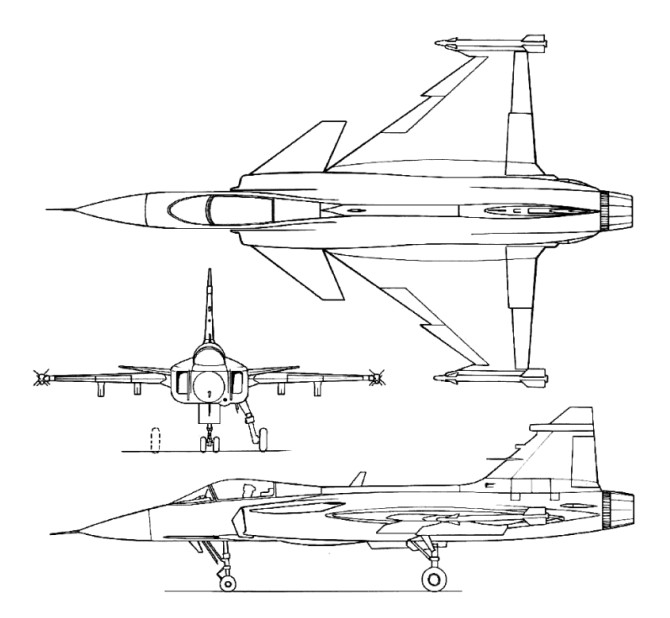
The JAS 39 Gripen is a small, agile and lightweight fighter design for multiple roles in the Royal Swedish Air Force. JAS stands for Jagt-Attack-Spaning which means Fighter-Attack-Reconnaissance. The Gripen (Griffon) design features canards positioned close in front of the delta wing. It is powered by a single 80kN reheated Volvo RM12 licensed built General Electric F404-GE-400 engine.
The JAS 39 Gripen is a Swedish fourth-generation multi-role fighter developed by Saab. Its name comes from the mythical griffin, symbolizing divine power.
The design work began in 1979, the first flight took place in 1988, and in 1997 the Gripen entered service with the Swedish Air Force. Costs range from $30 million to $60 million depending on the modification.
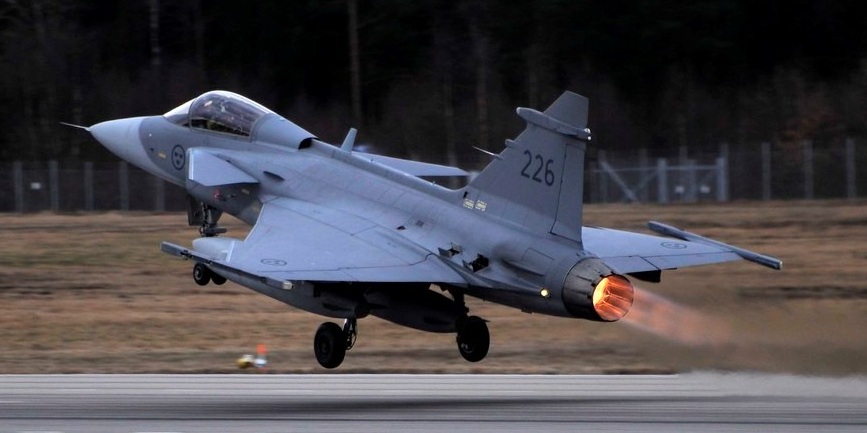
The fighter features a canard aerodynamic layout: control surfaces generate lift at any speed, while the delta wing compensates for negative lift at supersonic speeds. This design provides high maneuverability, stability during supersonic flight, and excellent takeoff and landing performance.
To reduce landing distance, the aircraft is equipped with powerful air brakes. Key systems, including the RM12 engine and PS-05/A radar, are modular, simplifying maintenance and upgrades.
A powerful turbofan engine with high bypass allows a top speed of 2,130 km/h and takeoff acceleration in 18 seconds. Initially, the aircraft had a limited weapons set, but it later gained the ability to use most European and American air-launched weapons: bombs, unguided rockets, and precision missiles for ground and naval targets.
It is a canard delta design with a triplex digital fly-by-wire flight control system, a multimode Ericsson PS-05A pulse-Doppler radar, a Honeywell INS, a Hughes wide-angle headup display, an external Flir pod, and an advanced cockpit with three CRT displays. British Aerospace designed and developed the carbonfibre wing, and produced them for the first three prototypes.
It has a modern glass cockpit with three multi function displays and a wide-angle HUD. Its easily programmable software and associated systems make the aircraft suitable to configure it for all kinds of mission profiles.
Armament includes a 27mm Mauser BK27 cannon internally, and six hardpoints.
The first prototype of the JAS 39 was rolled out on April 26, 1987, and first flown in 1988.
Five Gripen prototypes were to be followed by an initial batch of 30 production aircraft. Options were held on another 110, although the total Swedish Air Force requirement exceeded 300 aircraft to replace Drakens and Viggens.
The JAS 39A single-seater and the JAS 39B two-seater were the first production aircraft to enter service in the Swedish Air Force in 1997. The improved JAS 39C and two-seat version JAS 39D were a later production batch. Improvements include air-to-air refuelling capability, NATO weapon pylons, and NATO compatible systems. The export versions are also based on the C/D variants.
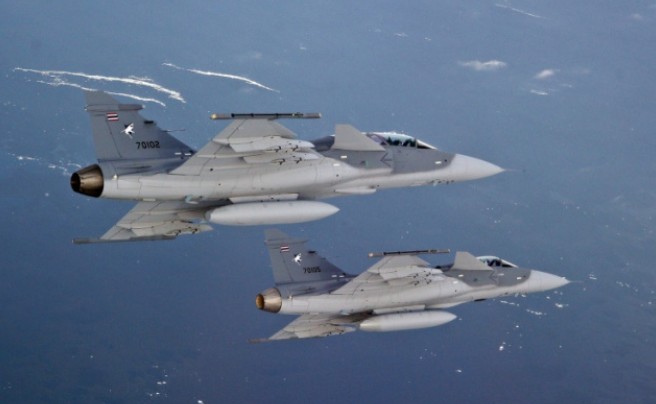
After 2004 Swedish A/B variants were to be updated to Batch 3 (C/D) standard.
Export customers include South Africa, Czech Republic and Hungary. South Africa was the first foreign customer for the Gripen, ordering 19 single-seat and 9 twin-seat aircraft in 1999. The aircraft were to be delivered between 2007 and 2011 and replace the Cheetah C/D aircraft in service.
In 2003 Hungary signed a lease-and-purchase contract for 12 single-seat and 2 twin-seat aircraft to be delivered in 2006 and 2007. The contract consisted of a 10 year lease after which the aircraft will be property of the Hungarian government. The Gripen will be fully NATO compliant and represent the main fighting force of the Hungarian air force.
In 2004 the Czech Republic signed a lease contract for twelve single-seat and two twin-seat Gripen aircraft for a period of 10 years. The aircraft are diverted from the production line destined for the Swedish Air Force for reduced delivery times. The first Czech Gripen made its first flight in November 2004 and were to be delivered to the Czech Air Force in April 2005, making the Czech Republic the first NATO operator of the type. The last aircraft is to be delivered in August 2005. The JAS 39 C/D is fully NATO compliant and will fill the gap in the Czech air defense left by the MiG-23/29 disposal and MiG-21 retirement.
The Gripen was also offered to Poland to fill its requirement for 48 fourth generation fighter aircraft, but Lockheed Martin’s F-16C/D Block 52 fighter was the winner. Austria preferred the Eurofighter Typhoon over the Gripen. The Saab-BAE SYSTEMS consortium also lost potential export sales to customers the Joint Strike Fighter, such as the Netherlands and Australia.
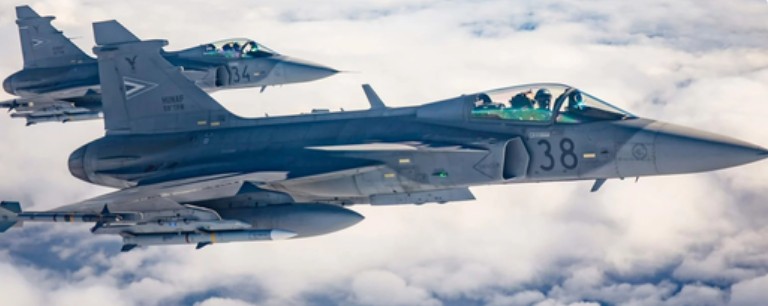
The Gripen boasts a top speed of Mach 2 and a combat radius of about 500 miles.
Its delta-wing design and fly-by-wire controls make it highly agile, while its PS-05/A pulse-Doppler radar, upgraded in the MS20 configuration, allows it to track multiple targets and deploy a wide array of weapons, from AIM-120 AMRAAM missiles to precision-guided bombs like the GBU-39.
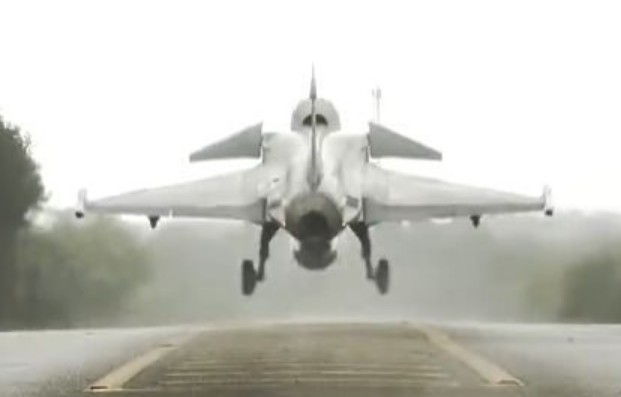
The jet’s versatility shines in its ability to operate from short, unprepared airstrips—a feature rooted in Sweden’s Cold War strategy of dispersed basing—which gives it an edge in flexibility over heavier platforms like the F-35.
At roughly 18,000 pounds empty, it’s a fraction of the F-35’s 29,000-pound weight, and its operating costs, estimated at $4,700 per flight hour, are significantly lower than the F-35’s $44,000, according to a 2021 Pentagon report (2025).
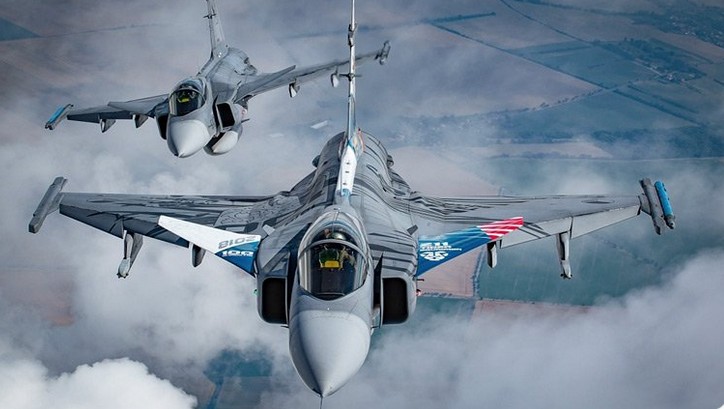
The first prototype Gripen E made its maiden flight from Saab’s Linköping facility on June 15, 2017. The aircraft is slightly larger than the C-model at just under 50 feet and includes a beefed-up fuselage that accommodates approximately 30 percent more fuel. The aircraft also features larger air intakes, the more powerful General Electric F414-GE-39E engine, and a total of 10 hardpoints. A two-seat F-model is now in development for Brazil, which currently has 36 E/F variants on order as the first export customer for the latest versions.
December 2020 saw the first of a planned 60 Gripen Es being handed over to the Swedish Air Force to commence the joint test program for verification and validation between Saab, the Swedish Armed Forces, and FMV, the Swedish procurement agency.
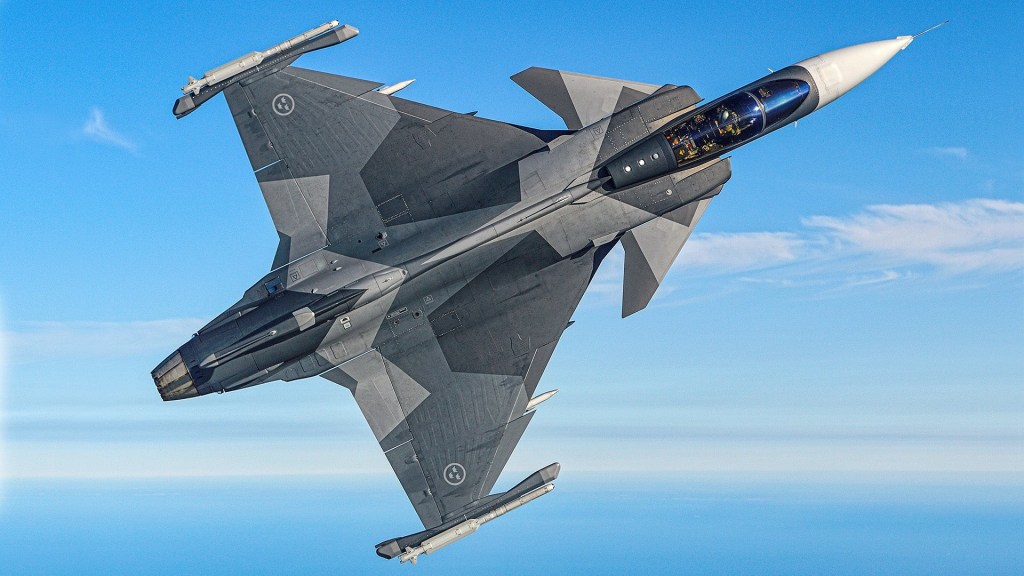

Key specifications of the Gripen E:
Engine
Turbofan engine General Electric F414-GE-39E, providing up to 22,000 pounds of thrust with afterburner. This engine delivers 25% more thrust compared to previous models, enhancing the aircraft’s maneuverability and efficiency.
Radar
Active electronically scanned array (AESA) Raven ES-05, offering high accuracy and long-range target detection.
Weapons systems
The Gripen E has 10 hardpoints, allowing it to carry a wide range of weapons, including Meteor and IRIS-T missiles, as well as various air-to-ground and air-to-air bombs and missiles.
Avionics
Modern flight control and sensor systems provide a high degree of integration and automation. The cockpit features multifunction displays and voice-command control capabilities.
Mobility and support
The Gripen E is designed for efficient combat operations in various climates and can operate from airfields with limited infrastructure, making it highly versatile for diverse operational environments.
The Gripen E is already in service with the Swedish Air Force and is used by other countries, including Brazil and Czechia.
JAS 39A
Engine: 1xGeneral Electric/Volvo Flygmotor RM12 (F404-GE-400) afterburning turbofan, 80.5 kN (18,100 lb st)
Length 14.10m (46 ft 3 in)
Height 4.50m (14 ft 9 in)
Wing span 8.40m (27ft 6.25 in)
Wing area: 322.92 sq.ft / 30.0 sq.m
Empty weight: 6622 kg (14,600 lb)
Max Take-Off Weight: 12.500 kg (27,560 lb)
Wing loadimg: 88.77 lb/sq.ft / 433.0 kg/sq.m
Max level speed at 10975m (36,000 ft): Mach 2.0 / 2126 km/h / 1321 mph
Maximum range: 1620 nm / 3000 km
Armament: one Mauser MK27 27mm cannon, up to 6500 kg external
Hardpoints: 6
Crew: 1
 All Aero