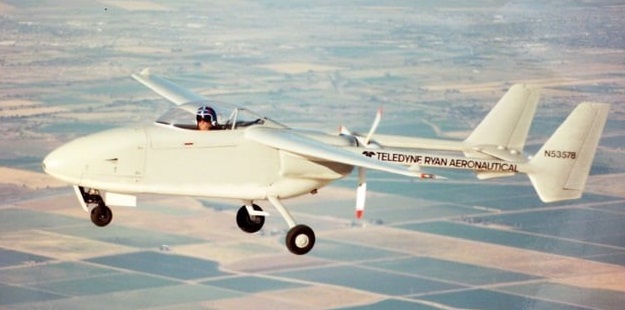
The Teledyne Ryan Model 410 was a surveillance UAV designed in the United States in the late 1980s. In configuration, it was a high-wing cantilever monoplane with twin tails carried on booms and linked by a common horizontal stabilizer. The engine was mounted pusher-fashion at the rear of the fuselage, between the booms. The nosewheel of the tricycle undercarriage was retractable. Construction throughout was of composite materials.
The Model 410 was Ladislao Pazmany’s last design before he quit Ryan. First flying on 27 May 1988, the sole prototype entered its flight test phase at Holtville, Calif, in October 1987. It was converted to manned operation for safety reasons, and completed its manned flight tests early in June 1988. It retained this configuration for the whole of the testing and development phase.
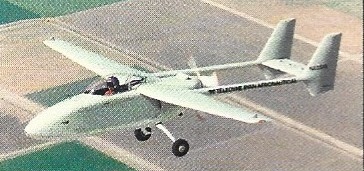
In 1993, the Model 410 was submitted to the UAV Joint Projects Office in response to an RFP for a Tier II system. In January 1994, the contract was awarded to General Atomics for what would eventually become the RQ-1 Predator.
Nothing is known about its fate or current whereabouts of the sole prototype, N53578, but it was deregistered. According to a Northrop Grumman employee, the Model 410 eventually proved overweight.
Powerplant: 1 × Lycoming TIO-320-C1B , 160 hp (120 kW)
Wingspan: 31 ft 0 in (9.45 m)
Empty weight: 1,450 lb (657.7 kg)
Capacity: 300 lb (140 kg) sensor payload carried in internal bay
Range: 1,200 mi (1,931.2 km, 1,000 nmi)
Endurance: 16 hours
 All Aero