
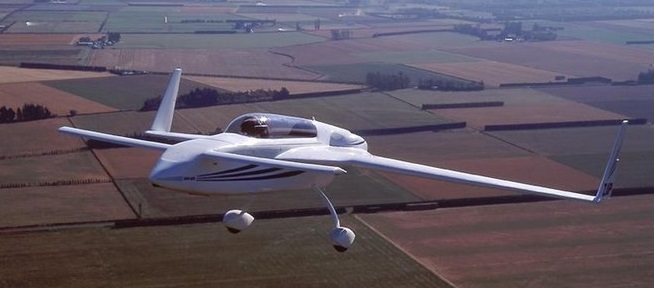
The same basic concept of the model 27 was retained in the Model 31 VariEze. The type was designed in 1974, and the construction of a prototype GRP two-place tandem design took Rutan just 10 weeks to complete. Rutan built two prototypes in succession; the second incorporated several major changes. When the larger O 200 engine was installed on the second prototype (the first had a VW), the additional torque produced an unpleasant wing heaviness under power. So Rutan added an electric trim tab on the right wing, rudder trim, a fuselage mounted drag brake, and a pair of small inboard spoilers on the rear wing roots that both quicken the roll response and eliminate the unwanted pitch. With a manually retractable nosewheel, its handling and approach qualities are now more or less conventional, with a bit more reliance on rudder for roll, and a bit less concern with keeping the ball centered, than we’re used to.
A lot of experimental work was necessary, but the VariEze is a radical departure from conventional methods in aerodynamic and structural design. An alteration was the replacement of the VariViggen’s electrically retracted tricycle landing gear arrangement by a tricycle arrangement with a mechanically retracted nose unit and fixed main units with glassfibre legs. The nose unit can be retracted on the ground, a feature that eases access to the cockpit, provides greater propeller clearance for manual starting, and removes the need for chocks. The complete airframe is made of unidirectional glassfibre over a foam core.

This sleek, fast, lightweight homebuilt is capable of achieving a top speed of 210 mph with Continental’s 100-hp engine. The unusual aircraft combines the use of a NASA GA (W)-1 airfoil with Whitcomb winglets and was actually the first aircraft to fly with the latter. The wing is a nonlaminar flow airfoil optimized for good lift and stall qualities. The ship’s low induced drag lets the pilot negotiate steep, 90-degree banks with strong spiral stability. First flew, in prototype form, in May 1975. In its refined form, with its retractable nose leg which had to be retracted to gain cabin entry, could cruise comfortably at 140 mph when propelled by 100 horsepower.
Rutan claimed that a VariEze could be built in 600 hours. By contrast, 2,000 to 3,000 hours had always been the average for completing a conventional homebuilt. Structural strength was provided by epoxy fiberglass skins and spars that were laid up over cores of light plastic foam. The wings consisted of several foam cores cut from blocks with an electrically heated wire and joined end to end. A chunk the shape of the box spar was cut out of the assembled wing core, and the spar webs laid up around it. Then the still wet spar core was reinserted in the wing core, the multilayer spar caps laid down, and the wing skins laid down over the whole works. One side of a wing was skinned and allowed to cure. Then the wing was flipped over and the other side laid up. Rather than conventional plans, Rutan put out an instruction book in which verbal instructions replaced blueprints, and the builder was led, step by step, from the beginning of the project to the end.
First offered to homebuilders in the summer of 1976, VariEze plans were bought by more than 2,000 prospective homebuilders within six months; and in that same period, the first buyer built airplanes were already flying.
In the meantime, several companies put portions of VariEze kits on the market.
By 1979, of the 3,000 buyers of plans, 1,800 have bought some sort of kit; about 100 VariEzes were flying, and hundreds more are near completion.
The hot wire cut polystyrene foam cores used for flying surfaces were easy to work with, though a few errors in the plans did lead to irritating minor discrepancies in final assembly. These were corrected piecemeal in Rutan’s frequent newsletter.
The VariEze’s performance is not a free lunch. You pay for it in somewhat peculiar handling qualities. The seating is comfortable but quite supine; that plus a narrow bubble canopy makes it difficult to turn your head. The pi¬lot, who sits in front and commands the only controls, can barely communicate with the passenger, even using simple ideas and loud shouts.
The pilot’s controls in the first of the two prototypes were uniquely simple: a small side stick on the right armrest was connected directly to movable surfaces on the canard to provide both pitch and roll control. There were no movable surfaces on the main wings. Rudder pedals controlled outward going rudders on each wingtip; pressed farther, they activated wheel brakes as well. A simpler, lighter control system could not be devised. But the plane was hard to fly; its glide was so flat and it floated so far in experienced hands that it required a 3,500 foot runway; roll response was liable to be nullified completely by a touch of the wrong rudder and apt to include a bit of unwanted pitch in the bargain.
By 1990 the Rutan design stable of VariEze, LongEze, Defiant and Solitaire were no longer offered for sale.
Prototype N7EZ
Propeller type: fixed pitch wood
Wingspan: 21 ft
Useful load: 481 lb
Fuel capacity: 14 USG
Cruise (75 %): 173 mph
Stall: 76 mph
Max tinge (75 %): 580 sm
Best climb rate: 1100 fpm
Service ceiling: 14,000 ft
Wing loading: 14.9 lb/sq.ft
Landing gear type: fixed main, ret. nose
Seats: 2
Engine: Rolls Royce 0200A
Prop: Hendry 56×70
Cruise: 130-150 kt
Engine: 1 x 100-hp (74.5kW) Continental 0-200-B
Seats: two seated in tandem.
Maximum cruising speed 195 mph (313 km/h) at optimum altitude
Initial climb rate 1600 ft (487 m) per minute
Range 850 miles (1368 km)
Empty weight: 580 lb (263 kg)
Maximum take-off 1050 lb (476 kg)
Wingspan 22 ft 2.5 in (6.77 m)
Length 14 ft 2 in (4.32 m)
Wing area 53.6 sq.ft (4.98 sq.m)
Canard foreplane area 13 sq.ft (1.21 sq.m)
Fuel capaci¬ty 26 USG
Takeoff run 900ft
Landing roll 900ft
Range 700miles
Engine: Lycoming O 235
Max speed: 180 kt at sea level
ROC: 800 fpm
Gross wt: 1,050 lb
Engine: Lycoming O 320
Empty weight: 772 lb
Gross wt: 1,350 lb
 All Aero