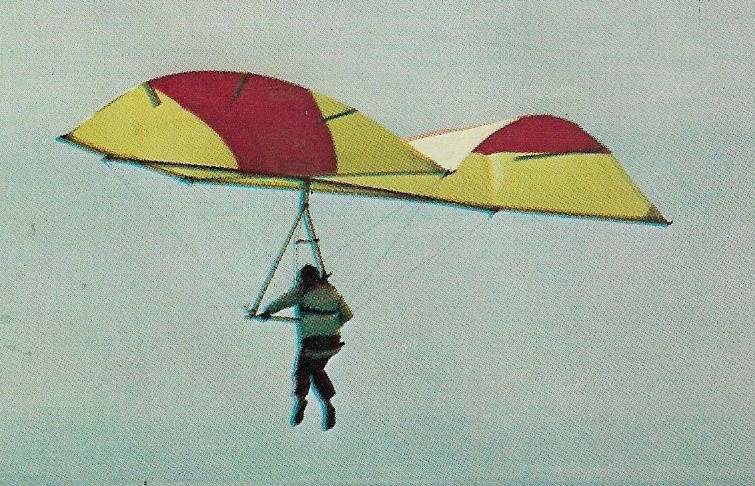
In 1948, Francis Rogallo, a NASA engineer, and his wife Gertrude Rogallo, invented a self-inflating flexible wing they called the Parawing, also known after them as the “Rogallo Wing” and flexible wing.
The term “Rogallo wing” is synonymous with one composed of two partial conic surfaces with both cones pointing forward. Slow Rogallo wings have wide, shallow cones. Fast subsonic and supersonic Rogallo wings have long, narrow cones. The Rogallo wing is a simple and inexpensive flying wing with remarkable properties.
The wing itself is not a kite, nor can it be characterized as glider or powered aircraft, until the wing is tethered or arranged in a configuration that glides or is powered. In other words, how it is attached and manipulated determines what type of aircraft it becomes. The Rogallo wing is most often seen in toy kites, but has been used to construct spacecraft parachutes, sport parachutes, ultralight powered aircraft like the trike and hang gliders. Rogallo had more than one patent concerning his finding; the due-diligence expansion of his invention involved cylindrical formats, multiple lobes, various stiffenings, various nose angles, etc. The Charles Richards design and use of the Rogallo wing in the NASA Paresev project resulted in an assemblage that became the stark template for the standard Rogallo hang-glider wing that would blanket the world of the sport in the early 1970s.
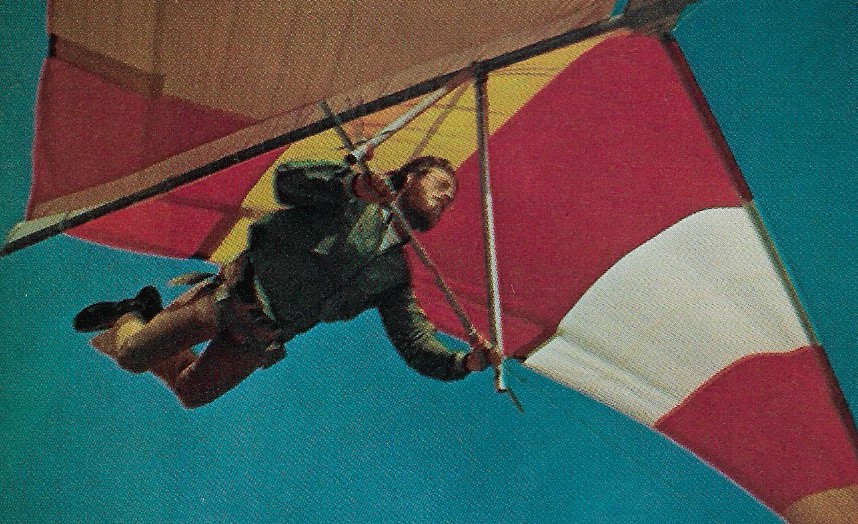
Beyond that, the wing is designed to bend and flex in the wind, and so provides favorable dynamics analogous to a spring suspension. Flexibility allows the wing to be less susceptible to turbulence and provides a gentler flying experience than a similarly sized rigid-winged aircraft. The trailing edge of the wing – which is not stiffened – allows the wing to twist, and provides aerodynamic stability without the need for a tail (empennage).
In 1961–1962, aeronautical engineer Barry Palmer foot-launched several versions of a framed Rogallo wing hang glider to continue the recreational and sporting spirit of hang gliding. Another player in the continuing evolution of the Rogallo wing hang glider was James Hobson whose “Rogallo Hang Glider” was published in 1962 in the Experimental Aircraft Association’s magazine Sport Aviation, as well as shown on national USA television in the Lawrence Welk Show.
 All Aero