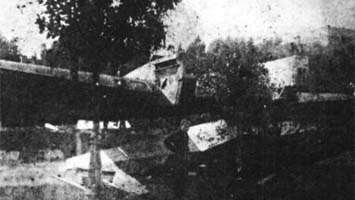
During his years in the USSR, French aircraft builder Paul Aimé Richard designed and built the Richard TOM-1 (Russian: Ришар ТОМ-1) Naval float bomber and torpedo boat. Only one prototype was built that was not produced due to the introduction of a navalized version of the Tupolev TB-1 with similar features and capabilities, but cheaper and easier to build.
The projecting task of the Open Sea Torpedo Boat or TOM was assigned to the KB led by Richard in late 1928. Several Soviet engineers participated in its development, who would soon achieve international renown for their creations. Notable among them were: II Artamonov, DM Jomnski, D. Samsonov, SA Lavochkin, IV Ostoslavski, MP Mogilievski, AL Gimmelfarb, GS Yelenievski, ZI Zhurbin, NI Kamov, MI Gurevich, SP Koroliov, IV Chetverikov, NK Skrzhinski, GM Beriev, IA Berlin, DA Mikhailov, VB Shavrov, GM Mozharovski, among others.
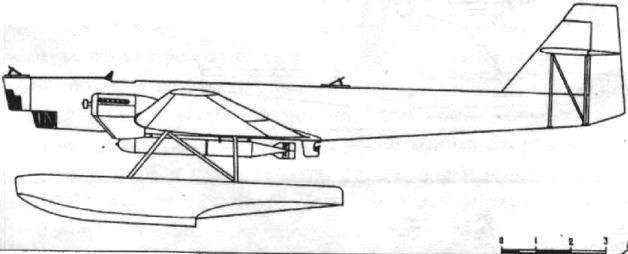
The TOM-1 was envisioned as a large monoplane of all-metal construction with floats. All the coating was made with smooth duralumin sheets of 0.5 – 0.6 mm, which gave it good aerodynamics. The structure was also designed entirely in duralumin, which was uncharacteristic of Soviet aircraft construction for those years.
The very thick wing with a 33 meter span had a rectangular midplane that was joined to consoles with a trapezoidal shape in the plane and marked narrowing towards the ends. The wing had a Sen-Sir-60 profile, with two skeletal spars and laminated ribs with large circular and oval holes to reduce weight. These ribs were located at a distance of 0.4 meters (quite compact for Soviet standards of the time). The segments of the stringer structure were achieved by joining two grooved pieces to form a kind of rectangular tube. Louvred flaps, capable of tilting downward at 40º angles, were located along the entire span of the trailing edge on the consoles.
The fuselage was a monocoque structure with the frames every 0.4 meters. The stringers were located every 150 mm, both in the fuselage and in the floats.
The tail unit was located high with triple empennage and was braced by means of N-pillars. The tail rudders incorporated trimmers to reduce the effort on the controls.
The large floats were fixed to the fuselage by means of 4 struts with tensioners between them.
The whole construction of the TOM-1 was quite light and very strong, but it was very technically demanding and expensive, almost twice that of the similar TB-1, and required a great deal of expensive sheets of duralumin, of which a considerable part was lost when drilling to reduce weight.
The two 680 hp BMW VI engines located on the wings.
The armament consisted of three firing points with PV-1 machine guns. These points were located fore and aft and a third in a retractable turret located in the lower section of the fuselage.
In the ventral zone, between the floats, one or two torpedoes could be fixed, developed by the OsTex Byuró.
The model was developed by the workshops located in the same KB building. On July 3, 1929 the project was completed and signed by PA Richard, his deputy DM Jomski and specialist SA Lavochkin.
In the fall of 1930, the plane was built and on January 1, 1931 it was transferred to Sevastopol for testing.
Assembly and preparation for testing were extremely lengthy. The plane was only ready in August. During the tests, carried out by pilot NI Kamkin with NI Kamov as engineer in charge, the aircraft presented acceptable performance. However, the new torpedo bomber was similar in capacity and performance to the TB-1 bomber and Tupolev was already successfully projecting a navalized version of this giant known as the ANT-4P. Building a similar plane, expensive and developed with unusual materials, was considered little objective. Only the prototype was built.
In 1931 Richard left the USSR due to the lack of new orders.
TOM-1
Engines: 2 x 680 hp BMW VI
Wingspan: 38.00 m
Length: 19.95m
Wing area: 120.00 sq.m
Empty weight: 5255 kg
Normal takeoff weight: 8030 kg
Top speed: 210km/h
Cruising speed: 182 km/h
Practical ceiling: 5500 m
Armament: 3 x 7.62mm PV-1 machine guns
Bombload: 1000 kg of bombs or two torpedoes
Accommodation: 4-5
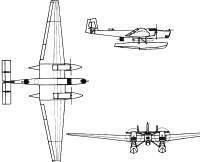
 All Aero