
The project was initially a cooperative one with Grumman American, GA supplying wings and empennage, for the most part off the shelf Cheetah parts, and retaining an option to market the airplane in the U.S. RFB has been responsible for design, development and certification. The second prototype embodied improvements in duct and fan technology and a somewhat larger airframe; it was the prototype that will be used for certification in Germany, from which, under reciprocal agreements between the two countries, FAA certification will more or less routinely follow. Grumman declined the marketing option in January 1977, but there is a continuing agreement between the two firms to explore the possibilities of ducted fans.
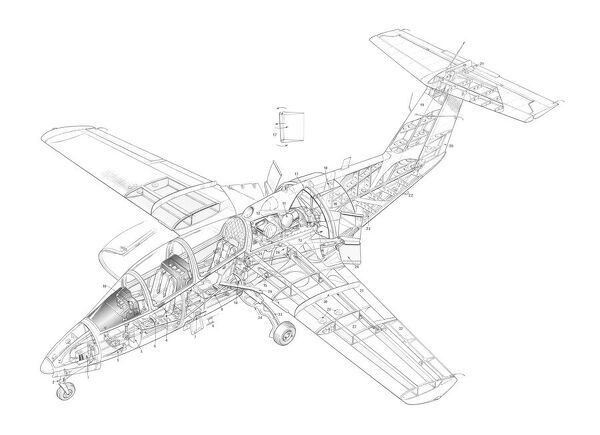
RFB / Rhein-Flugzeugbau Fantrainer Article
Luigi Colani ended up designing the entire forward fuselage and cabin a fiberglass and plexiglass shell grafted onto a simple keel upon which the entire airplane is built. The pilot and single passenger recline in an elegantly streamlined shell at the front of the airplane. Behind them is a smallish luggage space precisely like that in a small sports car, right down to the transmission tunnel hump provided by the keel structure. A well padded firewall separates the cabin from the engine compartment, the tubular spar of the GA wing. Wings and gear are from a Grumman Cheetah. Reconfigured from a low wing to a mid body location.

The engine is a two rotor NSU Wankel of 150 horsepower. It is water cooled and uses a double automotive ignition system of the battery/generator/coil/distributor type. The Wankel comfortably delivers its peak power at about 6,000 rpm, and the ducted fan allows it to turn at that speed regardless of the forward speed of the airplane.
Rather than take advantage of the ability of the fan to operate efficiently at high speed to eliminate the need for reduction gearing; RFB found that the noise produced by the small, multi-blade, fast-turning fan was so unbearable that they had to turn to a larger three blade version geared down to turn at about half the speed of the engine.
The fan itself is simply a fixed pitch propeller with broad, stubby blades of rather complicated shape. The optimum design has not yet been found, but it is thought that replacing the blades with a scimitar shaped type will further reduce noise at no cost in thrust. The circular duct enclosing the propeller counteracts the natural inefficiency of a stubby blade, which, like a stubby wing, tends to produce a lot of drag along with its lift.
The engine is cooled by radiators behind and below the cabin, with almost invisible flush air inlets be-neath the aft fuselage, exhaling into the fan duct. Cabin heat (not satisfactory on the prototype) is provided, as in most cars, by pumping some of the engine cooling water through a heat exchanger in the cabin air inlet.
The composite-construction Fantrainer first flew in October 1973 powered by two Wankel rotary engines.
Subsequent aircraft have used a single Allison 250 turboshaft to drive a Dowty Rotol five-blade constant-speed ducted fan. Its 150hp, water cooled Wankel engine drives a 43 inch, three blade, shrouded fan, which is located directly behind the two seat cabin. The tail cone is not a cone; instead, it consists of intersecting vertical and horizontal beams whose caps pass around the fan, and at whose intersection is a slender, tapering tube the “cone”. The empennage is a “T” arrangement with a swept vertical.
The RFB AWI 2 Fantrainer first prototype (98+30) was flown for the first time on 27 October 1977. Two prototypes of this tandem two seat trainer had been ordered by the Federal German defence ministry for evaluation as a potential replacement for the Piaggio P.149D primary trainers in Luftwaffe service.
The RFB Fantrainer, flown in AWI 2 and ATI 2 prototype forms, was in production in 1984 as the Fantrainer 400 and Fantrainer 600 with 420 shp (313 kW) and 650 shp (485 kW) Allison turboshafts for the Royal Thai air force. All but six of the 31 Fantrainer 400s and 16 6Ws were assembled in Thailand.
The Royal Thai Air Force is to receive 31 Fantrainer 400s and 16 more-powerful Fantrainer 600s. All but four are to be assembled in Thailand from kits supplied by RFB but using Thai designed and built metal wings in place of the original GRP units. The Thai aircraft will have four underwing weapons pylons. The first two German-built aircraft were delivered in October 1984, but the license-assembly programme has suffered a number of delays, particularly associated with production of the metal wings. To expedite deliveries, a number of Thai-assembled aircraft have been completed using German-supplied GRP wings. Thai aircraft also have a revised cockpit, Alkan stores management, and Stencel Ranger rocket assisted escape systems.
Two production models were offered, the Fantrainer 400 with the Allison 250-C20B 420 shp engine, and the Fantrainer 600 with a 650 shp Allison 250-C30 power plant.
Lufthansa also selected the type for its pilot training school.
Projected Fantrainer 800 did not enter production; neither did the proposed Tiro-Trainer with a turbofan engine.
Fantrainer 400
Engine: 1 x Allison 250 turboshaft, 420 shp
Fantrainer 600
Engine: 1 x Allison 250-C30 turboshaft, 600 shp
Span: 9.7 m
Length: 9.5 m
Height: 3.2 m
Wing area: 150.696 sq.ft / 14 sq.m
Empty wt: 2557.8 lb / 1160 kg
MTOW: 2300 kg
Warload: 800 kg
Max speed: 430 kph
Landing speed: 61 kts / 113 km/h
Cruising speed: 200 kts / 370 km/h
Initial ROC: 960 m / min / 2952.76 ft/min / 15.0 m/s
Service Ceiling: 25000 ft / 7620 m
T/O run: 200 m
Ldg run: 270 m
Fuel internal: 475 lt
Range: 1390 km
Endurance: 4.8 hr
Crew: 2

 All Aero