Baldwin’s Aerial Rowboat proved a remunerative attraction, though a short-lived one: One night its hydrogen inexplicably ignited, destroying the craft.
That didn’t deter Alva L. Reynolds from launching his own version at nearby Fiesta Park the same year. Thirty-four feet long and 14 feet in diameter, Man Angel had a four- by 10-foot wooden gondola, a 3,000-cubic-foot gas envelope, and a weight of only 18 pounds. Like Baldwin’s craft, it was propelled by oars.

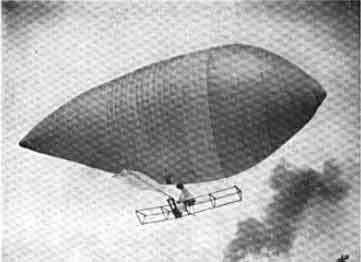
The earliest of six neutral-buoyancy man-powered dirigibles designed and built by Alva L. Reynolds of Los Angeles, California, trials performed above Fiesta Park, Los Angeles, where the aerial rowboat was first flown by Herbert Burke on July 27, 1905.
Reynolds claimed that just about anyone could operate Man Angel. To prove it, he allowed 17-year-old Hazel Odell to take the helm. According to a reporter at the Los Angeles Herald Examiner:
“Miss Odell entered the car and…raised herself to 100 feet. After slight effort she was able to propel the airship in any direction and control its ascent and descent at will. When asked for her motive for performing the feat Miss Odell said: ‘Why should I not? Other people have done it and I was not afraid.’ ”

Reynolds built six Man Angels and leased them to fairs in Kansas, Arizona, and Texas. He also opened a flying school, where he gave twice-daily demonstrations.

The 1905 “Man Angel” hydrogen-filled balloon was 34 feet long and carried an 18 pound frame in which a man sat using ten foot long oars to row across the sky.

The U.S. government investigated purchasing one.
That October, Reynolds challenged Baldwin to an airship race. When Baldwin’s pilot, the balloonist Roy Knabenshue, asked for $20,000 in expense money, Reynolds said Knabenshue was “afraid to race.” In 1906, to keep up interest (and revenue), Reynolds challenged an automobile to a 30-mile race from Chutes Park to Pomona. So confident was Reynolds that Man Angel No. 6 would win, he gave the Herald Examiner $1,000 to hold as prize money. On the day of the race, Man Angel faced such strong head winds it was handily beaten. In a subsequent race, the airship got caught on a telephone wire and crashed into a treetop.
Reynolds never raced Man Angel again. He returned to inventing, and found a method for generating electricity from ocean waves.
 All Aero