
The first prototype Republic XP-84 made its maiden flight on 28 February 1946, powered by a General Electric J35 engine.
Fifteen YP-84A were built in 1946 for service trials; 45-59482 to 45-59496.
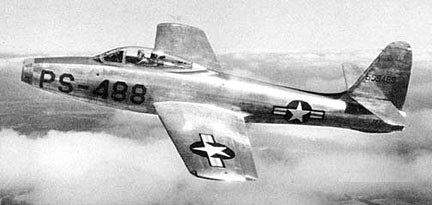
Dubbed ‘Thunderjet’, the straight-winged F-84 saw operational service in Korea from December 1950, first as an escort fighter to B-29 bombers and then in the ground attack role. The F-84G was developed to carry nuclear weapons for tactical warfare and was used by TAC and SAC; F-84Gs without nuclear weapon delivery systems were supplied to various NATO air forces and no less than 4,457 straight-wing Thunderjets were built.
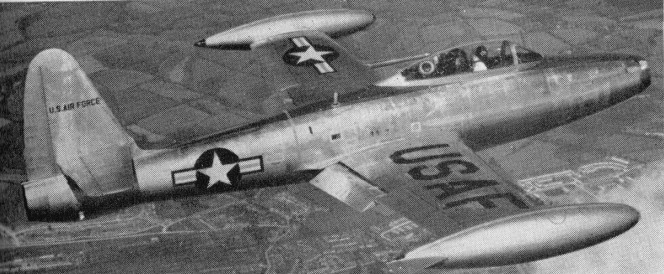
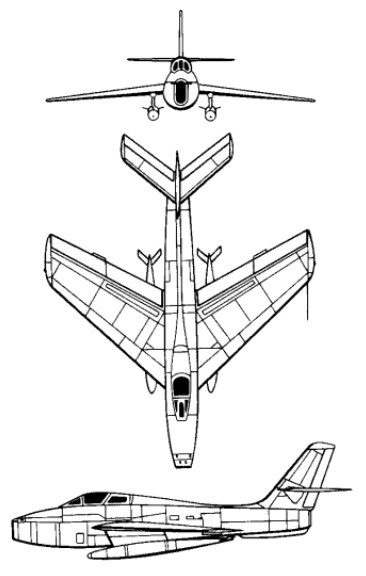
Although it shared the same generic designation number as the straight-winged F-84 Thunderjet, the Republic F-84F Thunderstreak was essentially a new aircraft. The prototype XF-84F was an F-84E Thunderjet fitted with 40 degree sweptback wing and tail, and longer, faired-in cockpit hood. It was powered by a 5200 lb Allison J-35-A-25 turbojet. When Curtiss-Wright acquired a license to build the Armstrong Siddeley Sapphire turbojet in America, Republic fitted an imported Sapphire in the YF-84F prototype which flew on 14 February 1951. The USAF ordered this aircraft into production, with a Wright-built J65 Sapphire, as the F-84F Thunderstreak.
Republic F-84 Thunderstreak Article

The RF-84F served as the backbone of NATO tactical strike forces, operating with Belgium, France, Italy, Greece, the Netherlands, Turkey and West Germany.

On 10 March 1953, five days after a Polish pilot had defected with his MiG-15 to the Danish island of Bornholm, two Czechoslovakian MiG attacked two American F-84G Thunderjets over Regensburg in Bavaria. One of the Thunderjets was shot down by the 23mm and 37mm cannon of one of the MiGs. The pilot ejected safely over Czechoslovakian territory.
By 1955 the F-84F Thunderstreak was the standard U.S.A.F. fighter-bomber, replacing F-86 Sabres and F-84E and -G Thunderjets. Can carry the tactical atomic bomb, and can be carried itself by GRB-36 “mother-plane”. Versions carried by GRB-36 have anhedral (downswept) tailplane.
Initially conceived by Republic dating 1949, the Thunderstreak was first flown in prototype form as the YF-84F on 3 June 1950, this aircraft using a standard F-84E fuselage with a swept wing and being powered by a single Allison YJ35-A-25 engine rated at 2359-kg (5,200-lb) thrust. Early flight testing of this aircraft very quickly revealed that the performance left a great deal to be desired and it was therefore decided to incorporate the British Sapphire (Wright J65) engine, impetus for the change being largely provided by US involvement in the Korean War, although in the event the F-84F did not see action in that conflict. Adoption of the more powerful engine in turn necessitated some redesign and it was not until late 1952 that the first production specimen made its maiden flight. Altogether 2,711 F-84Fs were built for service with allied nations from the late 1950s onwards.
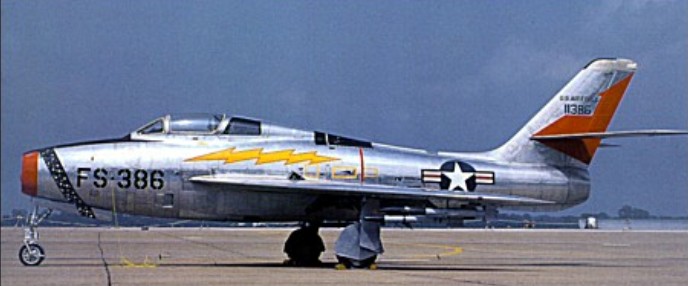
A specialized photo-reconnaissance derivative of the F-84 known as the RF84F Thunderflash was evolved more or less concurrently, this being most easily recognized by its revised air inlet layout which permitted the battery of cameras to be mounted in the extreme nose section. The RF-84F Thunderflash photo-reconnaissance aircraft had cameras in lengthened nose, only 4 guns, and wing-root air intakes. It too can be carried by GRB-36. The first prototype flew in February 1952. Including the prototype YRF-84F, 716 Thunderflashes were built, almost half of this figure being destined for overseas service under the terms of the Mutual Defense Aid Program, examples being supplied to Italy, Greece, West Germany, Turkey, the Netherlands, Belgium, Denmark, Taiwan, France and Norway.
It has another distinction so far as the USAF is concerned, being the aircraft with which flight refuelling techniques for fighters were developed.

A total of 4457 F-84 “Thunderjet” were built.
The second attempt to use the B 36 as an aircraft carrier took place in 1955 and 1956. Seeking a reconnaissance aircraft with sufficient range to reach the Soviet Union, the USAF came up with FICON, which stood for Fighter In CONvair. By hitching a Republic RF 84 Thunderflash to a B 36, the photo-reconnaissance jet’s range could be extended from 3220 km (2000 miles) to 19,310 km (12,000 miles). Some thought was also given to a nuclear bomb equipped Thunderstreak substituting for the Thunderflash. Twenty five RF 84Fs were modified for parasite duty. On a typical mission the mother ship B 36 would depart from Fairchild Air Force Base, Spokane, Washington to be joined in the air by an RF 84K (as the parasite Thunderflashes were designated) from Moses Lake Air Force Base. The fighter would be hoisted into the B 36’s bomb bay.

The F-84G Thunderjet featured conventional ailerons, elevators, rudder and trailing edge flaps. An air-brake is under the centre fuselage. The tricycle undercarriage has a single wheel on each unit, the mains retracting inward into the wings, and nose-wheel retracts rearward.
Even in the mid-1950s the superiority of the jet powerplant for combat aircraft was questioned by some. A modern technology propeller driven by a turbine (a turboprop) offered high speeds, long endurance and low landing speeds. To test this concept the USAF commissioned two XF-84Hs from Republic.
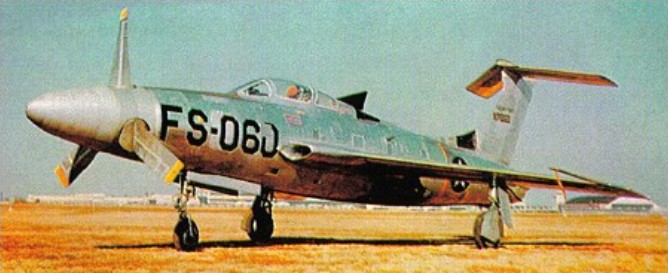
Powered by the Allison XT-40 coupled turboprops driving a singe supersonic blade propellor, the noise the F-84H made has been described as an ‘unholy shriek’, leading to the nickname ‘Thunderscreech’. Resonance off the ground made groundcrew physically sick. The two aircraft only made a dozen test flights, all but two of which resulted in emergency landings and the USAF refused to accept it for their own tests, cancelling the programme in 1956.
The first XF-84H spent 40 years on a pole at Bakersfield Airport, California, its propeller slowly (and quietly) rotated by an electric motor.
F-84E Thunderjet
Fighter-bomber
Engine: 5,000 lb. thrust Allison J35-A-17 turbojet.
Wingspan: 37 ft. 5 in
Length: 38 ft. 5 in
Loaded weight: 18,000 lb.
Max. speed: 630 m.p.h.
Ceiling: over 45,000 ft
Normal range: 1,700 miles
In flight refueling: yes
Armament: 6x.50 in. machine-guns
Bombload: 4 x 1,000 lb. bombs or up to 32 x 5 in. rockets.
Crew: 1
Republic F-84F Thunderstreak
Type: single-seat strike fighter
Powerplant: one 3275-kg (7,220-lb) thrust Wright J65-W-3 turbojet
Maximum speed 1118 km/h (695 mph) at sea level
Initial climb rate 2499 m (8,200 ft) per minute
Service ceiling 14020 m (46,000 ft)
Combat radius, clean 724 km (450 miles)
Ferry range 3444 km (2,140 miles)
Maximum take-off 12701 kg (28,000 lb)
Wingspan 10.26 m (33 ft 7¼ in)
Length 13.23 m (43 ft 4¾ in)
Height 4.39 m(14 ft4¾ in)
Wing area 30.19 sq.m (325 sq ft)
Armament: six 12.7-mm (0.5-in) M3 machine-guns
Bomb load, 2722 kg (6,000 lb)
Crew: 1
RF-84F Thunderflash
Engine: Wright J65-W-7, 7800 lb
Wingspan: 33 ft 7 in
Length: 47 ft 7.75 in
Height: 15 ft
Max speed: 679 mph at SL
Max ROC: 8000 fpm
Service ceiling: 46,000 ft
Max range: 2200 mi
Armament: 4 x .50 in mg
F-84G Thunderjet
Engine: 1 x Allison J35-A-29, 24.9kN / 5600 lb
Wingspan: 11.4 m / 37 ft 5 in
Length: 11.7 m / 38 ft 5 in
Height: 3.8 m / 12 ft 6 in
Wing area: 24.2 sq.m / 260.49 sq ft
Wheel track: 16 ft 6 in
Max take-off weight: 8455-10670 kg / 18640 – 23523 lb
Empty weight: 5033 kg / 11096 lb
Max. speed: 970 km/h / 603 mph
Cruise speed: 775 km/h / 482 mph
Ceiling: 12350 m / 40500 ft
Range w/max.fuel: 1680 km / 1044 miles
Armament: 6 x 12.7mm machine-guns
Bombload: 4500 lb
Crew: 1
XF-84H
Engine: 1 x 5850 hp Allison XT40-A-1 turboprop
Wingspan: 10.18 m / 33 ft 5 in
Length: 15.67 m / 51 ft 5 in
Height: 4.67 m / 15 ft 4 in
Max take-off weight: 8123 kg / 17908 lb
Max. speed: 837 km/h / 520 mph
Crew: 1


 All Aero