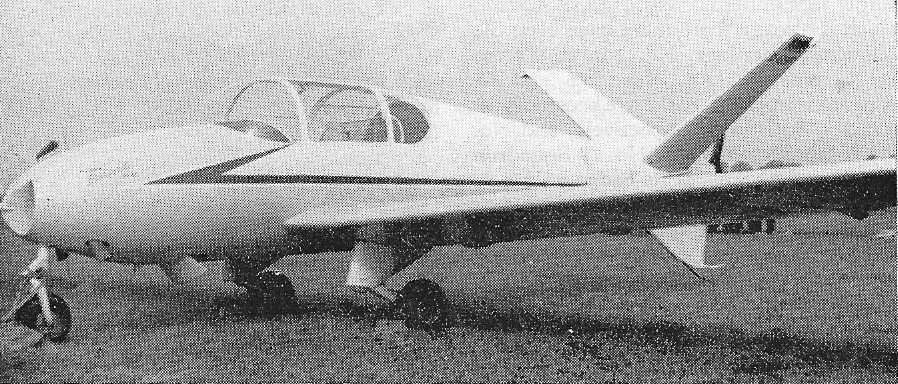
In the mid-1950s, the German Air Force showed interest in an inexpensive training aircraft for their budding jet pilots. Based on his experiences with the Pützer Dohle, Alfons Pützer suggested a propeller-driven piston aircraft for this purpose, the pusher propeller of which was arranged at the rear of the aircraft between a double tail unit.
Alfons Pützer and Karl Lürenbaum had already tested a long-distance shaft between the engine located in the fuselage and the propeller located at the stern as part of the Pützer Dohle, which, however, had only delivered unsatisfactory results. Karl Lürenbaum therefore applied to the Ministry of Economics and Transport for the Institute for Engine Dynamics at the RWTH Aachen for funds to further develop existing long-distance wave concepts under the project name SR-57. The research project also included the construction of a test vehicle for the drive, which Alfons Pützer KG operated under the name Pützer Bussard. Originally, Alfons Pützer saw a design similar to that of the Fouga Magister jet trainer for this test vehicle with two seats arranged next to each other and a low-wing construction, which had the double tail unit known from the Pützer Dohle in the rear area and a fuselage wedge to protect the propeller arranged at the rear. However, due to the power loss observed in the Pützer Dohle due to turbulence in the rear propeller, Walter Horten suggested using a V-tail instead of the twin tail of the Dohle. For the first time, Pützer also envisaged a retractable undercarriage for the Buzzard. The Continental C90-12F drive known from the Pützer Elster was used as the engine.
Problems were caused by the 6-metre-long remote shaft running through the entire hull, which showed frequent failure of dynamic components on the remote shaft test bench in Aachen and whose vibration behavior only showed satisfactory results after a complete redesign in the form of a three-part shaft.
In January 1959, the drive was installed in the test vehicle in Bonn. The German Research Institute for Aviation (DVL) in Cologne-Wahn was commissioned to test the test vehicle. There the Pützer Bussard took off for its maiden flight in February 1959 with provisional traffic approval D-EHIV. During the subsequent testing, the Pützer Bussard showed satisfactory results at the DVL up to the end of 1959, especially in the take-off and landing phase.
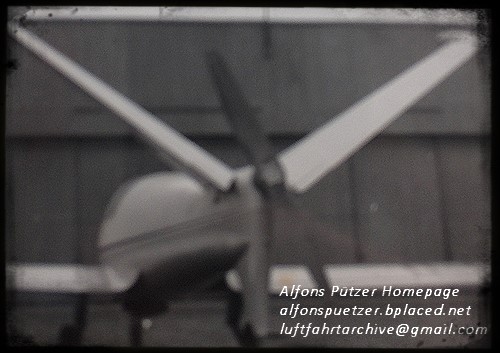
After the introduction of the Fouga Magister jet trainer, the German Air Force changed its training concept for its jet pilots. In the new training concept, the use of inexpensive upward trainers was no longer provided. Despite the positive testing, the Luftwaffe was no longer interested in purchasing the Pützer Buzzard in 1959. With the end of the SR-57 project, the test vehicle was shut down in the fall of 1959.
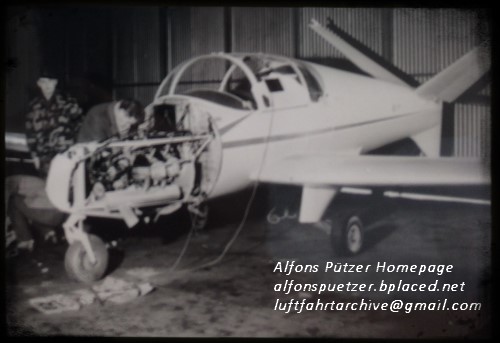
Erich Ufer has been working at Bölkow GmbH in Nabern since 1956 on the development of ring tail units. As part of this development, Bölkow GmbH planned to build the Bölkow P.103 test vehicle. After Ludwig Bölkowand Erich Ufer had not received any funding from state programs for the test vehicle by 1959, Alfons Pützer suggested converting the Bussard long-distance test vehicle that was no longer required to accommodate a ring tail unit. Apart from the redesign of the entire tail unit area with the ring manufactured by Bölkow in GRP construction, the Pützer Bussard received a new landing gear, also designed by Bölkow as part of the P.103, which ensured the necessary ground clearance for the ring tail unit. Due to the high weight of the ring tail, Alfons Pützer exchanged the Continental C90 engine for a 145 hp Continental O300, for which Karl Lürenbaum made the necessary changes to the remote shaft in Aachen.
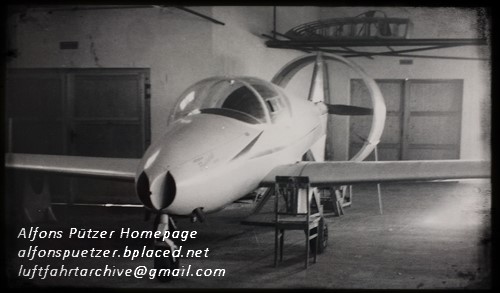
After completion of the model tests in the wind tunnel in Stuttgart, the conversion of the Pützer Buzzard took place until the end of 1960, which was then given the designation SR-57-2K. In order to gain further experience with the ring tail, before the first flight in early 1961 another wind tunnel program was carried out, in which the finished prototype was examined aerodynamically. On July 12, 1961, the first flight of the Pützer Bussard with a ring tail took place in Bonn-Hangelar. Satisfactory results were demonstrated in a three-month flight test. On March 22, 1963, the Federal Aviation Authority issued a provisional license for the ring tail carrier SR-57-2K. With the submission of the final report in June 1964, the test vehicle was shut down again.
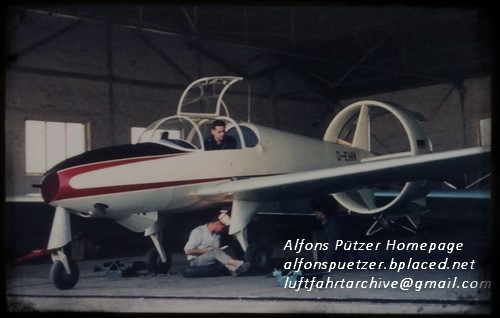
After completing the ring tail testing, the Pützer Bussard came to Karl Lürenbaum’s Institute for Engine Dynamics in Aachen. Together with the Rhein-Flugzeugbau RF-1 developed by Hanno Fischer at Rhein-Flugzeugbau, the Buzzard was used in ground and test bench tests in Aachen to develop turbofan engines, such as those used for the first time in 1968 on the motor glider Rhein-Flugzeugbau Sirius. The Pützer Bussard was largely dismantled during these tests and was later stored in Merzbrück near Aachen.
Walter Horten took over the dismantled Pützer Bussard in 1971. With the support of the Oskar Ursinus Vereinigung (OAV), Horten replaced the annular tail unit with a conventional tail unit and removed the long-distance shaft. Instead, the engine located in the bow was connected to a bow propeller of conventional design. Wings, landing gear and center fuselage with cockpit remained unchanged.
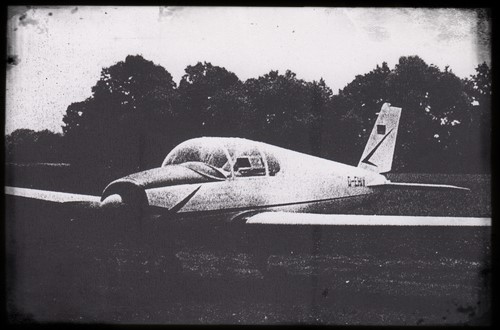
The Pützer Bussard was probably used in this configuration by the OAV for a number of years as a touring aircraft. It is said to have been destroyed later in a fire.
SR-57 (V-tail)
Engine: 1 × 70kW Continental C90-12F
Wingspan: 12.00 m
Wing area: 18.00 m²
Length: 6.30 m
Height: 2.20 m
Empty weight: 600kg
Maximum take-off weight: 760kg
Cruising speed: 180km/h
Crew: 1
Passengers: 1
SR-57-2k (Ring Tail)
Engine: 1 × 145hp Continental O300
Wingspan: 12.00 m
Wing area: 18.00 m²
Maximum take-off weight: 840kg
Crew: 1
Passengers: 1
 All Aero