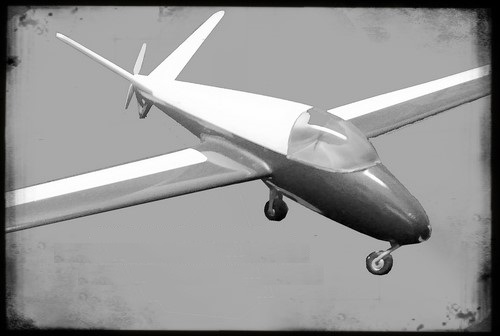
Around 1955, Walter Horten was interested in developing a long-distance drive for his flying wing aircraft. He commissioned Prof. Karl Lürenbaum ‘s Institute for Engine Dynamics at RWTH Aachen University to develop a suitable engine. Walter Horten commissioned his childhood friend Alfons Pützer to build a suitable test vehicle for long-distance wave testing. Pützer suggested using a Fritz Raab Doppelraab design, which had already been used in the Pützer Motorraab.
Pützer then commissioned Fritz Raab to modify a Doppelraab 6, in which a small engine was placed in the center of gravity behind the pilot’s seat. The tailplane of the Doppelraab was replaced by an endplate tailplane with two fins, in the middle of which a pusher propeller was placed at the rear of the aircraft. The two-cylinder, two-stroke engine Hansa-Lloyd with 400 cm³ displacement and 12 hp drove the propeller at the rear via the long-distance shaft developed by Karl Lürenbaum. The test vehicle was created by Alfons Pützer KG in Bonn.
In December 1956, the Pützer Dohle took off on its maiden flight in Bonn-Hangelar. The air sports club in Bonn received the jackdaw in early 1957 for its training operations to test in continuous operation. There were several disturbances in the area of the long-distance wave. The propeller, which had little ground clearance at the rear, was also damaged several times.
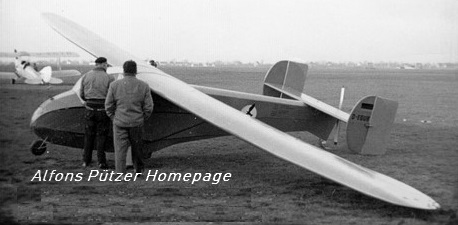
By arranging the engine in the center of gravity of the aircraft and the pusher propeller at the rear, the fundamentally good gliding characteristics of the Doppelraab were retained with the Dohle. Alfons Pützer then developed the jackdaw as a motor glider. He replaced the weak and too heavy Hansa engine with an Ilo F2x376 with 30 hp, with which the Dohle II should be able to self-launch. The small 14 kg fuel tank was replaced by a 40 kg fuel tank for longer cruising flights. This allowed the Dohle II to remain in the air for up to five hours. To protect the rear propeller from touching the ground, the Dohle II was fitted with a spur wedge at the rear.
The Dohle II was created in 1957 by converting the Dohle I at Alfons Pützer KG. It took off on September 2, 1957 in Bonn-Hangelar with the provisional approval D-EGUB for its first flight under its own power. In 1957, the Dohle II was one of the first usable motor glider constructions in Germany. However, Alfons Pützer had to stop further testing a short time later, since the start of series production of the Pützer Elster in the winter of 1957/58 occupied all capacities at Alfons Pützer KG.
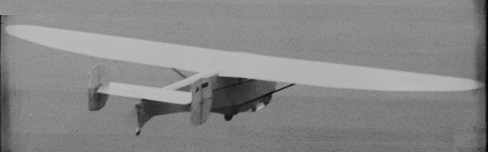
The basic structure of the Dohle II was later the starting point for the development of the Pützer Bussard trainer aircraft , which was also to be equipped with a pusher propeller at the rear in order to achieve jet-like behavior. The first drafts of the buzzard show a completely redesigned fuselage and low-lying wings. As with the Dohle II, however, the terminal plate tail unit with wedge spur was used. This tail was later replaced by a V-tail on the Bussard.
Only after the successful start of Elster production did Alfons Pützer take up the development of a motor glider again at the end of 1958. Drafts from this period show a further developed jackdaw with the V-tail already used in the Bussard and a low-lying wing. From 1959, however, Alfons Pützer gave up further development of the Dohle in favor of the completely new Pützer MS-60 motor glider design. The Dohle II was shut down in 1960.
Jackdaw I
Engine: 1 × Hansa-Lloyd, 12 hp
Wingspan: 13.20 m
Wing area: 18.00 m²
Aspect ratio: 9.7
Length: 7.20 m
Height: 2.00 m
Empty weight: 300kg
Maximum take-off weight: 420kg
Payload: 120kg
Crew: 1
Jackdaw II
Engine: 1 × Ilo F2x376, 30 hp
Wingspan: 13.20 m
Wing area: 18.00 m²
Aspect ratio: 9.7
Length: 7.20 m
Height: 2.00 m
Crew: 1
Empty weight: 325kg
Maximum take-off weight: 450kg
Payload: 125kg
 All Aero