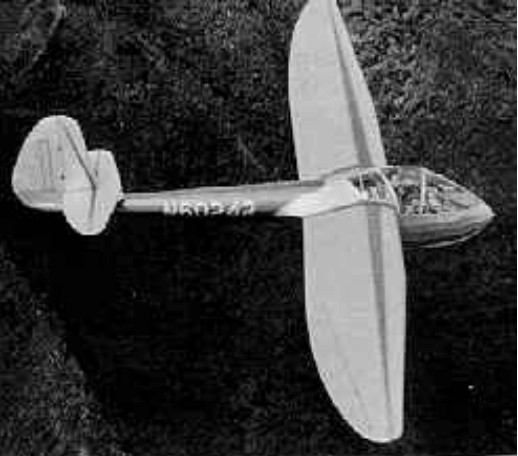
The Pratt-Read had two distinctions for a World War II training glider; the side-by-side seating and that it was the only training glider designed for the U.S. Navy. After release by the Navy, the LNE-1’s were acquired by the Army Air Corps which used some for a thunderstorm research project. Pratt-Read was a piano manufacturer and the G1 its only glider project. It has Schempp-Hirth type airbrakes. It won the multi-place world record for Absolute Altitude 13,489 m. / 44,255 ft. flown by Larry Edgar and H. Klieforth in 1952. One belongs to the National Soaring Museum.
Designed by M. Gluhareff, P. Leonard, J. Buxton, R. Stanley, H. Struck and R.W. Griswold, the PR-G1 has wood/ fabric wings and tail wood aft fuselage, steel-tube/ fabric forward fuselage.
This particualar airplane, N60242, crahsed about 1962 in Waimanalo, Oahu, from a low-altitude spin. Spin came from a low-altitude turn chasing a thermal in the landing approach! The pilot suffered back injuries but the ship was destroyed. Elevator and instrunments were recovered intact but everything is still in the gulch where it crashed. Pilot was a very light person and nose ballast may have been removed during a prior overhaul, as the aircraft was used to set a 71-hr aloft soaring record and all possible weight was removed to allow for supplies to be carried.
Ted Ralston
Wing span: 16.6m / 54.5 ft
Wing area: 21.37sq.m / 230sq.ft
Empty Weight: 349kg / 770 lb
Payload: 172kg / 380 lb
Gross Weight: 521kg / 1150 lb
Wing Load: 24.38kg/sq.m / 5lb/sq.ft
Aspect ratio: 12.9
Airfoil: GS-4, GSM, GS-1
L/DMax: 26 84 kph / 45 kt / 52 mph
MinSink: 0.91 m/s / 3.0 fps / 1.78 kt
Seats: 2
No. Built: 75
 All Aero