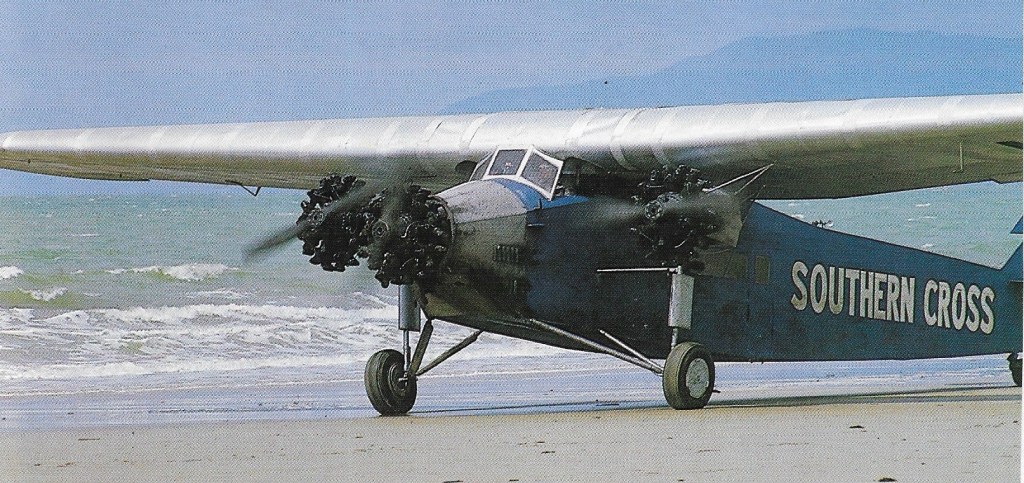
The plane’s replica was the project of South Australian flying instructor John Pope, who created the plane as a travelling history lesson that would fly around the country. Southern Cross is a flying close replica of the famous record breaking Southern Cross Fokker FV11B of Sir Charles Kingsford Smith from the 1920s and 1930s.
Built in South Australia in the period 1980 to 1987 as a tribute to Smithy, the aircraft toured Australia during the 1988 Bicentenary raising money for the Royal Flying Doctor Service registered VH-USU.
She is a faithful replica built to modern standards using the traditional aircraft construction of steel tubing and timber with doped Irish Linen for the fuselage and an all wooden (spruce and plywood) wing. She is the largest “exact replica” aircraft in the world and has the largest one piece wing ever made in Australia.
Aircraft Research and Development Unit was tasked to carry out the test flying of a replica of the 1926 Fokker Tri-Motor as flown by Australian aviation pioneer, Sir Charles Kingsford-Smith. The purpose of the test programme was, firstly, to ensure safe operation of the aircraft throughout its proposed flight envelope and, secondly, to provide data to allow the issue of a Certificate of Airworthiness or Permit to Fly. The trial included a cockpit and systems assessment as well as an evaluation of the aircrafts flight and ground handling characteristics. Airborne assessments covered stability and control characteristics, stall characteristics, general aircraft performance, asymmetric power characteristics and an evaluation of the aircrafts take-off and landing performance and handling. The flight characteristics of the test aircraft were found to be similar to those expected from an original Fokker VIIb-3M. Consequently, the aircraft could not meet some modern certification requirements. Notwithstanding this the aircraft was found to be generally safe and airworthy provided it was operated by experienced pilots in daylight Visual Meteorological Conditions and that the main recommendations of this report are adopted.

The aircraft first flew in 1987 and during the 1988 Bicentenary she toured around Australia as a fund raising exhibit for the Royal Flying Doctor Service. The aircraft was a major drawcard to the 1988 Bicentennial Air Show and many thousands of people saw her. In 1990 the aircraft even ventured to New Zealand for air show appearances.
After 555 hrs flying tine, on the 25th of May 2002 it had an accident at Parafield South Australia when she lost a main wheel on takeoff. Landing on the one good wheel and the tail, the pilot kept the damaged wheel off the ground by keeping its wing high in the air. When the aircraft stopped the high wing came down and snapped off around 3 metres from the wing tip. HARS bought the damaged plane in 2000.
After considerable negotiation HARS acquired the aircraft from the SA Government in 2010. It is being restored to full airworthy status.
Engines: 3 x Jacobs R-775 A2, 300 bhp
Wing span: 22.1 m
Length: 14.3 m
Height: 4.3 m
Maximum takeoff weight: 5,700 kg
Cruising speed: ~155 km/h (max ~185 km/h)
Ceiling: 8,500 ft
Endurance: 7.5 hr
Crew: 2 x pilots
 All Aero