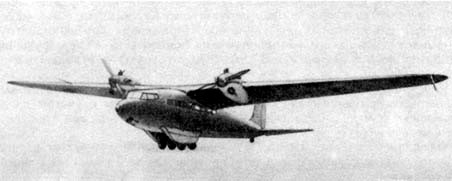
The excellent results obtained during Aeroflot’s experimental use of the BDP-2 prototype as cargo transport made Polikarpov think about the possibility of developing a motorized model, especially that there was talk of the possibility of producing a small series.
To achieve this goal, two cowled 145 hp M-11F engines were installed on the wing leading edge. The new model was called MP (Russian: Поликарпов М П), short for Motoplanior (motor glider).
In the MP operation, the autonomous take-off variant was envisaged, but with the full load capacity the low power of the engines was unable to guarantee take-off. Generally, the MP had to take off and even arrive at the site of operations dragged by a tow plane, but after dropping its load, unlike conventional gliders, it could return to its airfield using the installed motive power.
As a small capacity transport aircraft, the MP could carry 12 equipped soldiers or a similar weight capacity.
The MP motor glider generally maintained the constructive characteristics of the BDP glider. It was designed as a monoplane with a high wing of 20 meters of wingspan and a fuselage with an aerodynamic design. The entire construction was made of wood.
The fuselage was entirely made of wood and featured monocoque construction.
The exit of personnel and cargo was carried out through two doors of 860 x 900 and 850 x 950 mm, one located in the front region on the right and the other in the rear on the left. In the lower part of the fuselage, behind the cargo area, a hatch was prepared to leave the parachute glider.
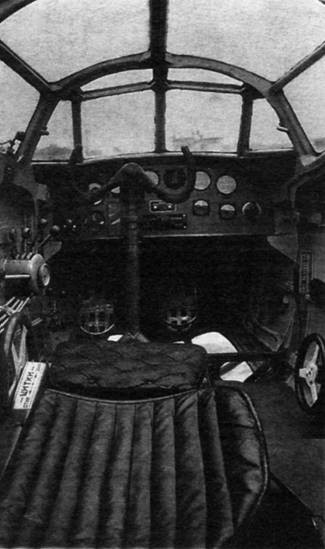
The pilot had an emergency cover with a structure also in wood. To improve visibility during landing, the lower area of the cabin was glazed. People sat on benches located on the sides of the glider, attached to the fuselage frame. Between the two benches there was a 600 mm wide corridor.
The wing of the BDP was made of wood and featured a double-spar centre and single-spar consoles. The coating of the leading edge and the force points was done with plywood. The rest of the wing was covered with fabric. The wing profile used was the NACA 230. In order to reduce the landing speed in the section between the ailerons and the fuselage, Shrenk-type flaps were installed.
The tail was monoplane and cantilever, constructed of wood covered with plywood and fabric.
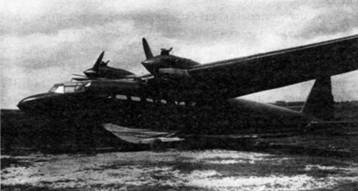
The landing gear on this model was modified with the addition of wheels to the basic glider ski gear. These wheels were installed in two rows under the fuselage and featured rubber cushioning.
The powerplant consisted of two 145-hp M-111M-11F engines located on the wing leading edge and cowled, moving 2.35-meter propellers from Polikarpov U-2 training aircraft. The fuel capacity allowed for 7 hours.
The glider did not have its own weapons, but did have attachment points for seven DP-type infantry machine guns. Two machine guns could be installed in special hatches located in the area of the leading and exit edges of the wing to defend the upper hemisphere. To defend the tail a section of the upper rear fuselage could be raised and become a firing point for the gunner. Two other positions were located to the sides.
Inside the fuselage were 12 5.5 mm armored plates of 480 x 550 mm. The pilot had armor on the back of the seat. All this armor added 127 kg to the weight of the glider.
The motor glider was built ay the Novosibirsk Factory No.51 in the summer of 1943. The acceptance tests were carried out at the Moscow Central Airfield with flights to the Air Landing Forces (VDV) airfield at Medvied Lake and to the LII airfield in Ramenskoye. These flights were developed by the chief of flights and test pilot of the OIAE VDV Captain SA Anojin.
Between July 12 and September 10 of 1943 70 flights with a total duration of 40 hours and 10 min were performed. In flights towed by an SB bomber, heights of 4500 meters and speeds of 270 km / h were reached.
As a conclusion of the tests the pilots VN Yuganov, VL Rastorguyev, GM Shiyanov, AN Grinchik, PF Fedrova, PM Stefanovski, VV Shevchenko, AK Dolgov, PG Savtsov, Gavrilov, Romanov and Borodin wrote that the MP had good stability, it was simple in the piloting, accessible to pilots of low qualification. With a single engine and a flight weight of 3000 kg the aircraft was easily controllable, keeping its flight horizontal and responding to turns.
Between September 10 and 13, 1943 the MP was tested by the VDVs. Load tests were carried out with 4000 kg in different variants:
11 armed infantry soldiers with light weapons;
A group of anti-tank artillery made up of 6 soldiers with a 45 mm piece and two shell boxes (40 units). Assembly of the barrel to its operational state took 8-10 minutes;
A DShK antiaircraft battery with its 5 servers and ammunition;
A light anti-tank group with 10 soldiers and three anti-tank weapons;
Two or three motorcycles (3 of the Velosiet type or 2 Indiana).
The excellent layout of the motor glider for these configurations was highlighted and its use was recommended for VDV units and transport aviation. Series production of the model was also proposed.
Despite these results, the MP was never produced. By that time the Red Army had liberated a large part of the territory occupied by the Germans and the supply needs of the guerrilla groups had diminished.
Only the prototype was produced.
Polikarpov MP
Engines: Two 145 hp M-11F
Wingspan: 20.00 m
Wing area: 44.72 m²
Length: 13.60 m
Height: 3.20 m
Empty weight: 2420 kg
Normal loaded weight: 3500 kg
Payload capacity: 1280 kg
Wing loading: 78.5 kg / m²
Maximum speed at sea level: 185 km / h
Maximum speed at 1000 m: 179 km / h
Range: 390 – 700 km
Endurance: 7 h
Time to 1000 m: 12.5 min
Service ceiling: 2,700 m
Take-off run with 3500 kg: 480 m
Crew: 1
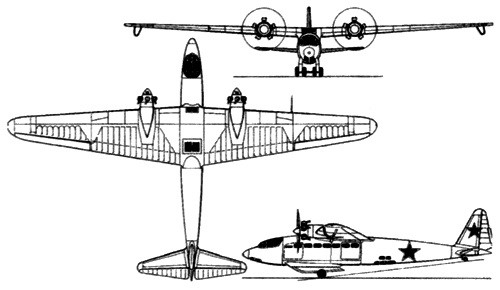
 All Aero