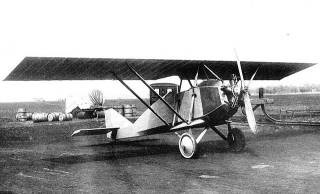
The PWS 3 was the first sports aircraft manufactured by the Polish aerospace industry not counting earlier amateur designs. It was designed by Stanislaw Cywinski in the PWS factory in 1927. The fuselage is built upon a bottom boom, what made possible changing of upper fuselage part with cockpits, and developing single-seater, two-seater or other specialized variants.
The PWS 3 was a two-seater parasol wing braced monoplane of wooden construction. The fuselage was built around a box-section wooden boom, with a superstructure of wooden laths, covered with plywood and fabric the front fairing of the aircraft in the rear. The engine compartment was covered with duralumin plating. The empennage was wooden, with a fixed surface, made of plywood and fabric on the control surfaces. The rectangular wooden wings had two spars and was covered with plywood in front and cloth in rear. Originally slotted ailerons on the whole wingspan, later to be shortened. The fuselage had a cockpit for two in tandem, with windscreens and dual controls. The chassis consisted of a fixed split axle conventional chassis, with a rear skid. Both main landing gear and wing struts were installed a small horizontal winglets at the bottom of the fuselage. Fuel in two tanks, 100 litres in total, in the Central section of the wing.
The 5-cylinder Walter NZ 60 radial air-cooled engine provides a nominal power of 60 HP and take-off power of 65 HP, driving a two-bladed wooden fixed pitch propeller. The cruise fuel consumption was 22 l / h.
Prototype 3 PVA designated 3B and issued registration number R-PWSS, was flown on May 20, 1927 in Biała Podlaska. After testing, the handling improved. In 1928, the aircraft underwent modifications, having a rounded tip rather than square, and less aileron.
It took part in the 1st competition of the Polish light aircraft from 6 to 9 October 1927, finishing in 2nd place.
Re-registered SP-ACJ in 1930.
Later it was bought by the Lopp paramilitary organization in Lublin and used for propaganda flights.
 All Aero