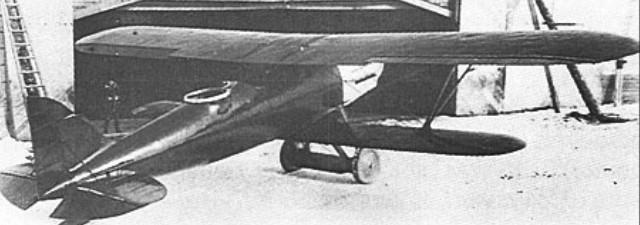
The Polikarpov 2I-N1 or DI-1 (Russian: Поликарпов 2И-Н1 (ДИ-1)) aircraft was designed under the direction of NN Polikarpov as part of the experimental aeronautical construction program approved in October 1924 and conceived for three-year development.’’
Its name 2I-N1 means Dvuxmiestni Istrebitel c odnim Napirom or Two-seat fighter with a Napier engine, although it was also known as DI-1 or Dvuxmiestni Istrebitel – 1 (Two-seat fighter – 1).
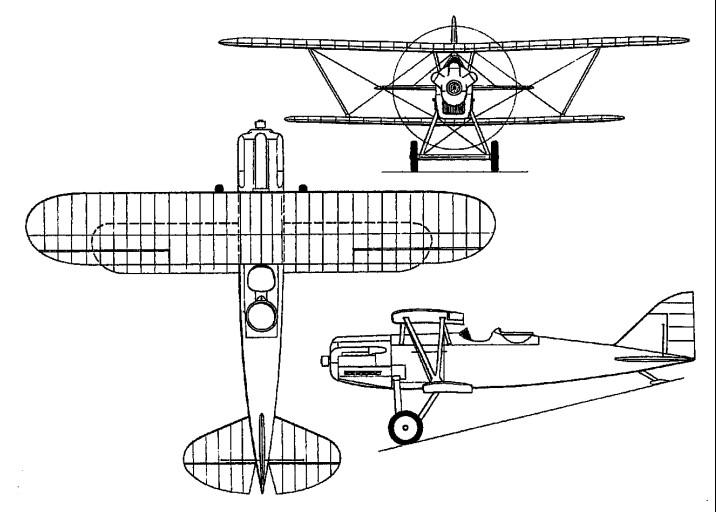
The 2I-N1 was designed as a single-section sesquiplane of wooden construction. The monocoque fuselage, developed by VM Oljovski, was constructed of glued wooden sheets and plywood was used in some sections. The cross section was circular. The coating varied between 4 mm in the front section and 2 mm towards the tail.
The wings, with an area of 27.15 sq.m, had a double wooden spar structure. The upper and lower planes were covered with 1.5 mm plywood, which made it possible to obtain a very clean exterior surface and lighten the interior structure. The V-shaped interlayer supports were made of duralumin tubes with an aerodynamic section and the braces were laminated steel strips.
The tail unit and ailerons were made of fabric-covered duralumin.
The landing gear, of a conventional tailskid type, featured solid wheels joined by a central piece. Each semi-axle was made up of two support pieces with rubber cushioning.
The power plant, a 450 hp Napier Lion 12-cylinder W engine was installed, allowing a maximum speed of almost 270 km/h. Its fuel capacity an endurance of 2.5 – 3 hours.
According to the project, the 2I-N1 was to be armed with a PUL-9 synchronized machine gun firing through the propeller and a mobile machine gun located in a TUR-3 mount in the gunner’s position. This second machine gun was never installed.
The model was characterized by its clean lines and careful finishing. Unlike the reconnaissance models, the 2I-N1 had much smaller dimensions, reduced equipment and lower fuel capacity, which made it light and efficient. During its development, vibration calculations were carried out for the first time in the USSR.
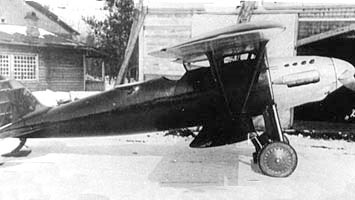
The design project of the 2I-N1 was completed at the beginning of 1924, but execution was delayed for a few months due to the impossibility of having a Napier engine. Finally, on October 8, 1924, Factory No.1 “Duks” received the order to begin construction. Shortly afterwards, after several discussions on design issues, the final design of the aircraft was defined. On February 9, 1925, the Scientific Committee of the main leadership of the VVS approved the task of developing the two-seat fighter that received the designation 2I-N1. In parallel, the development of a single-seat model called 1I-N1 was approved, but this project would never be completed.
By the beginning of the summer of 1925, the construction of 2I-N1 was proceeding at a good pace. Despite this, on June 15 it was decided to accelerate the work to finish construction by November 15. In practice this proved impossible. On January 1, 1926, the plane was still 90% complete. By this time a brand new Napier Lion engine, purchased from England in December 1925, was received.
The preparation of the 2I-N1 in the factory workshops ended on February 8, 1926, and by the 9th of that month the prototype was transferred to the Moscow Central Aerodrome on the Khodynka field, where preparation for flight was completed. It was winter, so the plane was equipped with skis.
On February 25, 1926, pilot VN Filippov made two first familiarization flights. The next day this same pilot carried out the entire set of high-school piloting figures in the 2I-N1 without any difficulties being detected. The evaluation of the device was excellent. The 2I-N1 surpassed in speed all the single-seat fighters in service with the VVS, even operating with skies.
According to Shavrov, NN Polikarpov himself participated in two of the test flights as an observer, including the eighth flight, which was intended to define the ceiling of the plane.
On March 31, 1926, on the ninth flight, intended to define the maximum speed in horizontal flight, a tragic accident occurred, resulting in the death of test pilot VN Filippov and timekeeper VV Mikhailov.
The plane had already made several passes over the marked kilometer. In the next pass the plane made a descent to gain speed and level the horizontal flight at a height of about 100 meters. At that time the speed reached (according to ground timekeepers) about 300 km/h, which was exceptional for a two-seater device also equipped with skies. Suddenly on the upper right wing there was a loud crack and the upper surface covering came off, followed by the lower one. The upper right wing collapsed, causing the destruction of the lower wing and the plane, still flying about 500 meters, fell to the ground. The two crew members died as a result of the impact.
The cause of the accident was poor fixation of the plywood skin to the wing structure. In many places the coating did not stick and the fixing screws to the wing ribs, due to assembly errors, were left out. On the other hand, the ventilation windows intended to balance the pressures inside and outside the wing during flight at high altitudes were ignored in the coating. During the high-altitude flight tests on the eighth flight, the attachment of the coating to the wing had to come off due to the difference in pressures, and when the test was carried out at high speed on the ninth flight, the detachment materialized, causing the wing to break.
Another possible cause of the accident appears recorded in the official documents of the VVS management. According to this version, the catastrophe occurred when a dive was made with a sudden attempt to exit it and it is established that initially the explosion occurred in the coating of the lower wing and this resulted in the rupture of the upper wing. These documents also explain that the plane was built using outdated structural resistance standards, despite the fact that during the plane’s design process the VVS had already approved new ones. Despite these facts, the report ends with the phrase: “The causes of the catastrophe have not been clarified so far.”
On June 18, 1926, the head of the VVS RKKA PI Baranov sent a report on the causes of the accident to the president of the RVS of the USSR. In this document it was specified:
“The 2I-N1 plane, calculated according to outdated standards, should never have been approved for factory tests… I propose to hand over all the materials to justice so that the culprits can answer”
The issue of the 2I-N1 accident was actually raised to the Supreme Court of the USSR, which in February 1927 requested all documentation of the development of the static tests of the aircraft. The development of the judicial process lasted all year and had a very negative influence on the work of the collective led by NN Polikarpov. Finally, the 2I-N1 accident was one of the main causes of Polikarpov ‘s arrest and his closest collaborators.
Work on the two-seat fighter was never resumed and as a direct result of its failure, resistance standards and technical control of the production process were increased, which caused an unnecessary increase in weight in future models. Also, as a consequence, a rigorous flight test program of the experimental prototypes began to be implemented.
The 2I-N1 would serve as the basis for the development of the I-3 single-seat fighter, which was produced in series, and the DI-2 two-seat fighter, both with a similar layout and construction.
2I-N1
Powerplant: 1 x 450 hp Napier Lion
Wingspan: 12.00 m / 39 ft 4 in
Wing area: 27.15 sq.m / 292.24 sq ft
Length: 9.75 m / 32 ft 0 in
Height: 3.32m
Empty weight: 1153 kg / 2542 lb
Max take-off weight: 1700 kg / 3748 lb
Wing loading: 62.5 kg/ sq,m
Power load: 3.8 kg/hp
Fuel and oil capacity: 300 kg
Total load capacity: 547 kg
Maximum speed at sea level: 268 km/h / 167 mph
Cruising speed: 243 km/h
Landing speed: 92 km/h
ROC: 385 m/min
Practical range: 800 km
Endurance: 3 hours
Practical ceiling: 7100 m
Time to 1000 m: 1.8 min
Time to 2000 m: 3.8 min
Time to 3000 m: 6.1 min
Time to 5000 m: 13.0 min
Landing run: 200 m
Takeoff run: 100 m
Armament: two 7.62 mm machine guns
Accommodation: 2
 All Aero