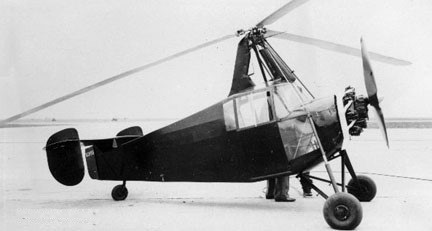
Cierva developed progressively more sophisticated designs with a means to tilt the rotor head and altering the pitch (angle) of each individual rotor blade, called collective and cyclic control, and, making use of Pitcairn’s prerotator, achieved a “jump takeoff” capacity with the C19MkIV in 1931-32 The rotor would be spun up at zero pitch and then “snapped” into a positive angle, causing the aircraft to “jump” into air, an ability developed by Pitcairn the next year in the developmental PA-22 Autogiro.
The PA-22 was an experimental wingless with a three-blade, foldable rotor system. Side-by-side cabin.
Only one was built; NX13199. The first roadable autogyro built by Pitcairn.
Year: 1933
Engine: Pobjoy Cataract, 84 hp
No of blades: 3
Rotor dia: 32 ft
Length: 18 ft 0 in
Width: 7’10”
Gross wt: 1140 lb
Empty wt: 600 lb
Max speed: 105 mph
Cruise: 90 mph
Range: 350 mi
Seats: 2
 All Aero