
1928 found Cierva giving demonstrations of the O-19 and selling the manufacturing rights to representatives from around the world. The American rights were purchased by Harold Pitcairn who made a few design changes but retained the basic design principles and features found on Cierva’s machine.
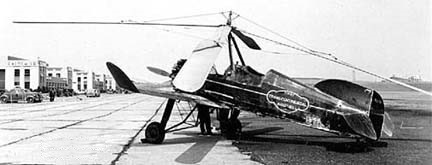
Pitcairn used a more modern fuselage with better aerodynamic qualities for his PCA-2 gyroplane, and offered two engines for use in the aircraft. Both were radial aircraft engines mounted in the usual tractor configuration: the first produced 300 horsepower, the second, 420hp. Pitcarin also utilized a four-bladed rotor system with Civerva’s flapping hinge. It innovated with a clutched gearbox that briefly transmitted power to prerotate the rotor to greatly shorten the takeoff run.
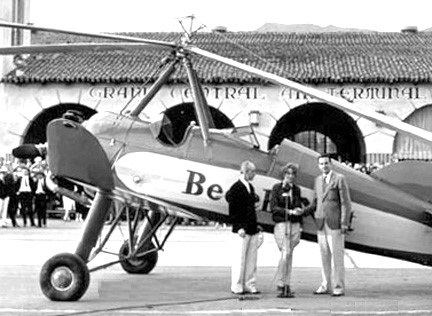
Pitcairn produced and sold 24 of his PCA-2 gyroplanes over the next few years at $15,000, including NC26/NC2624, NR784W, NC799W, NC10761, NC10768, NC10780/19781, NC10785/10791, NC11608/11611, and NC11613. They showed the versatility and practicality they had been designed for by carrying the mail over a federally contracted route, being used to reach the scene of the news and for aerial photography by the “Detroit News” daily newspaper, and by setting new world records. Amelia Earhart flew a PCA-2 to the record altitude of 18,415 feet over Willow Grove, Pennsylvania on April 8, 1931. On 25 September 1932 Lewis Yancey reached 21,500 ft.
The first “non-conventional” aircraft to earn government approval; ATC 410.
Three were used by Earhart for a transcontinental cross-country flight in 1931, including NR10761 and NC10780.
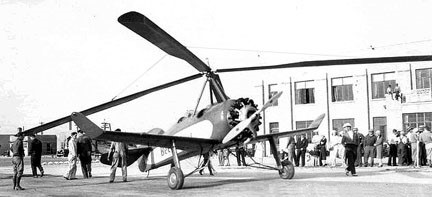
Amelia had two different accidents; the first was at Abilene TX on 12 June 1931. A second PCA-2 was flown to her to continue her transcontinental journey. On 12 September 1931, she dropped it in from 20 feet at Detroit. She was quoted in the New York Times as saying, “Nothing to it, it was all my fault, and I’m not injured at all. I just didn’t level off soon enough.” Then, “Within a few hours after the crash, Mrs Putnam set out for Saginaw in another Autogiro to fulfill an exhibition flying engagement.”
Prototype
Year: 1931
Seats: 3
Engine: Wright R-760-4, 240 hp
Gross wt: 3000 lb
Rotor dia: 48 ft
No of blades: 4
Year: 1931
Engine: Wright R-975/E, 300 hp
Rotor dia: 45 ft
No of blades: 4
Wingspan: 30’0″
Length: 23’1″
Gross wt: 3000 lb
Empty wt: 2025 lb
Max speed: 118 mph
Cruise: 98 mph
Range: 290 mi
Seats: 3
 All Aero