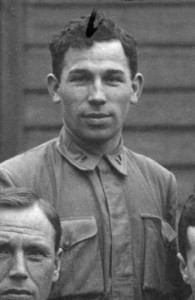
Victor Osipovich Pisarenko (Russian: Виктор Осипович Писаренко) was born in 1897 in Belarus. In 1915, during World War I, he finished technical courses and joined a telegraph battalion. After the October Revolution he voluntarily enrolled in an aviation squadron, beginning as a motorcyclist and later as a mechanic.
In 1920 he received the rank of pilot-observer (corresponding to navigator). He participated in the Civil War, fighting on different fronts. In 1921, after passing new navigator courses, he was assigned to the 13th Aviation Brigade in Kazan. In this unit and under the direction of PJ Mezheraup, he took part in combats on the Northern front against the White Finnish troops that occupied the Karelian Isthmus.
In 1922 he entered the Kacha Aviation School, finishing it a year later with excellent results, so it was decided to keep him there as a flight instructor. In he built the VOP-1 light aircraft in the school workshops, which would become the first Soviet monoplane with a low cantilever wing. On November 27, 1923, this plane rose for the first time and in the following days he would perform another set of flights. In January 1924 the VOP-1 would be transferred to Moscow, where he would end up making several hundred flights.
A short time later Pisarenko would go on to work as an instructor at the Serpujov Higher School of Air Combat, Shooting and Bombing (Strelbom), leading the flight brigade. In this center in 1925 he would build his second self-designed model known as the Pisarenko-T, which was characterized by its original wing profile. After receiving the approval only to run the plane down the runway, Pisarenko disobeyed, remounted the flight and headed for Moscow, landing at the Central Aerodrome. Once there he made a second flight, executing several high school piloting tricks. He planned to build a two-seater training version with financing from the UVVS, but the appearance of the Polikarpov U-2 put a stop to these plans.
Since 1925 by decision of the head of the VVS P.I. Baranov, Pisarenko went to work as a test pilot at the NOA (acronym for Nauchno Opytni Aerodrom or Experimental Scientific Aerodrome), predecessor of the NII VVS. In this period he would participate in tests of the I-4 (ANT-5) fighter in 1927, Heinkel HD-37 (I-7) in 1928, R-5 in 1929 and R-7 (ANT-10) in 1930.
From July 27 to August 9, 1926 with second crew member BV Stierligov, he would make a record Moscow – Kharkov – Rostov-on-Don – Sevastopol – Kiev – Moscow flight, with a total range of 3,000 km.
On July 20, 1928, during the NII VVS spin performance tests of the Heinkel HD-37 fighter, the plane went into a flat spin and Pisarenko found no way out of it. For some time he was unable to leave the aircraft and when he did he was only 300 meters from the ground. The parachute was slow to open and the pilot hit the ground hard, fracturing his leg. As it became known later, in the translated document delivered by the manufacturers, the exit methods were ignored.
On July 21, 1929 Ya. I. Alksnis and VO Pisarenko made a non-stop flight on the Moscow – Sevastopol route in an R-5, covering 1,276 km in 5 hours and 30 minutes.
From September 1930 he began working at the VVS flight inspection as a senior assistant to PJ Mezheraup.
In 1931 Yakov I. Alksnis was appointed Head of the VVS. Coming from the Alksnis ground troops, he decided that he had to learn to fly. The piloting classes were taught by Pisarenko.
He died on September 9, 1931 in a plane crash in an R-5 over the Bryansk region. He and PJ Mezheraup were carrying out an inspection flight in adverse weather conditions. With the fog, visibility decreased and they ended up hitting the tops of some trees. The remains of both crew members were found several days later. The burial took place in the building of the Zhukovski Aeronautical-Military Academy.
His remains rest in Moscow’s Donskoi Cemetery.
 All Aero