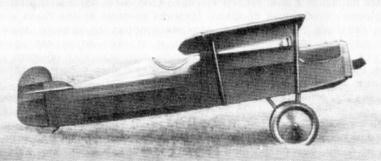
After moving to the Serpukhov Higher School of Air Combat, Shooting and Bombing (Strelbom), Pisarenko, with the help of cadets, began construction of his second aircraft. This model was called VOP-T (Víctor Osípovich Pisarenko – Trenirovochni (coach)) (Russian: Писаренко-Т or ВОП-Т).
The Pisarenko-T was conceived as a parasol-braced wing single-seat monoplane. As a distinctive feature of this model we can point out its unconventional wing profile, with flat upper and lower surfaces, a curved leading edge and a flattened tail. In general, a strange wing with a sharp leading edge was obtained.
The wing, with a double spar structure, had parallel wooden supports that fixed it to the sides of the fuselage. The covering was plywood.
The Pisarenko-T was powered by a 150-hp Hispano-Suiza engine driving a two-blade wooden propeller.
The plane was built at the Serpukhov school and was ready in 1925.
Pisarenko prepared the plane for its first flight and when it was ready, he went to the head of the school for permission. The plane had been built with hardly any calculations and its pilot was only authorized to race down the runway. Pisarenko disobeying, took the flight back and headed for Moscow, landing at the Central Aerodrome in Jodinka. Once there, before the authorities could react and ban him, he made a second flight, executing several high school piloting tricks that included inverted flight and several rolls.
Once the second flight was completed, Pisarenko never flew his plane again, nor did he request permission to do so.
The success of his model led to Pisarenko soon receiving an application to build a training aircraft with funds from the VVS leadership. He began to work in this direction, but the appearance of the excellent trainer Polikarpov U-2 soon made him leave the company.
Powerplant: One 150 hp Hispano-Suiza engine
Accommodation. 1
 All Aero