
ln 1938 Piper introduced the improved J-3 Cub. Powered by 40-hp Continental, Lycoming or Franklin engines, the J-3 sold for $1,300. Engine horsepower was soon raised to fifty and reached sixty-five by 1940. Piper also standardized a color scheme; just as Henry Fords Model T’s were all black so Wiliiam Piper’s Cubs were all bright yellow with black trim.
The lightly loaded USA 35 B airfoil, a new aileron shape, modification of the wing interior for durability and ease of manufacture wheel brakes, tail wheel and larger seats, slightly reshaped tail surfaces and an aerodynamically balanced rudder were the only air frame differences between it and the J 2. Though it was initially powered by the same A 40, optional engines for the J 2 were soon offered as other manufacturers began to see a future in general aviation. Fifty hp Continental, Lycoming and Franklin models as well as the three cylinder Aeromarine Lenape radial were available, although only a few of the last were ever installed as the engine/ airframe combination resulted in excessive vibration. In 1938, the 65 hp Continental, Lycoming and Franklin were added to the list even though some felt the plane overpowered with that staggering amount of thrust.

The J 3 had a balanced rudder and a modified vertical stabilizer, upholstered chair type seats (instead of plywood chair frames), and such other refinements as a tailwheel and brakes items that remained essentially unchanged as the J 3 evolved into the Super Cub 12 years later.
In the J 3, yellow was established as the standard Cub colour; earlier models could be purchased with solid blue, red or green paint schemes.
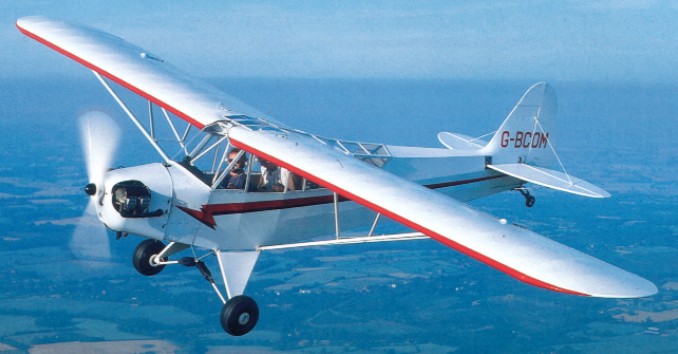
When first produced by Piper in 1937 under ATC 660, the Piper J-3 Cub was powered by a 30kW Continental A40-4 flat-four engine, but it was not long before the 37kW A50-4 or alternative A50-5 with dual ignition system was introduced on the J-3C-50 Cub. The resulting improvement in performance made this already attractive lightplane an extremely marketable commodity and during 1938, which was the new company’s first full year of production, 737 Cubs were built. The Cubs initially sold for $1,249, then $1,098 in 1939, and $995 in 1940. The Continental A50 was a new engine, early experience proving that it was reliable and had development potential, and it was later re-rated at 48kW at a higher engine speed. Its introduction by competitors meant that Piper had to follow suit, and in 1940 the J-3C-65 Cub appeared with the Continental A65 engine. With alternative Franklin flat-four engines, the 37kW 4AC-150 or 48kW 4AC-176, the Cub was designated J-3F-50 and J-3F-65 respectively and, similarly, with the Avco Lycoming 37kW O-145-A1 or 48kW O-145-B the Cub had the respective designations J-3L-50 and J-3L-65. Also built in comparatively small numbers was a version designated J-3P-50, powered by a 37kW Lenape Papoose 3-cylinder radial engine. The higher-powered Continentals and Franklins Cubs were Group 2 (ATC 691, 692, 695, 698).

All models of the Cub carried large loads for their horsepower and were excellent short field airplanes. With the standard 8:00 x 4 doughnut tires and rugged shock cord damped gear, the plane really didn’t care whether it was on an airport or a pasture. With a stall¬ing speed of 35 mph, any little field would do. It was not unusual in the 1930s and ’40s to see a Cub land in a meadow or on a road near a gas station to refuel on a long cross country. And any cross country was long; speed was not among the airplane’s virtues. The 65 hp J¬3 cruised in the high 70s on a good day.
Sales began to soar, and then in 1941 the US Army selected this aircraft for evaluation in artillery spotting/direction roles. Four were obtained, 42-460 to 42-463, as YO-59, powered by the 65hp Continental C-65/O-170.
Shortly afterwards ordered 40 similar aircraft, including 42-7813 to 42-7852, under the designation O-59, all redesignated, briefly as L-59, finally L-4. These aircraft were used by the US Army under virtually operational conditions during annual manoeuvres at the end of 1941, and it was very soon discovered that the little Cub had far wider applications than at first anticipated.
One had the distinction of the final WW2 aerial victory in Europe, as the war there was ending, when a rather slow and ungainly dogfight—more of an aerial ballet—between an L-4 and a German Fieseler Fi.156 observation plane took place. USAF Lts Duane Francis and Bill Martin fired their .45 pistols at the German, convincing him to land and surrender.
Six Mutual Defense exports were obtained in 1951; 51-16086 to 51-16091.
This practical experience enabled the US Army to obtain an improved O-59A which, powered by a 48kW Continental O-170-3 flat-four engine, had better accommodation for the pilot and observer with an enhanced all-round view. Orders for O-59As totalled 950 (41-15159 to 41-15329, 42-36325 to 42-36824, 42-38380 to 42-38457, and 43-29048 to 43-29246), but as a result of designation changes they entered service as L-4A aircraft, the earlier YO-59 and O-59 aircraft then being redesignated L-4, and the type later received the name Grasshopper.
Subsequent procurements covered 980 of the L-4B version (43-0491 to 43-1470) with reduced radio equipment.
Civil-Cubs impressed for Army service at the beginning of World War II included eight J-3C-65s and five J-3F-65s which were designated L-4C and L-4D respectively. Two impressed J-3C in 1942 (42-79557 and 42-79558) were designated UC-83A, and later became L-4C.
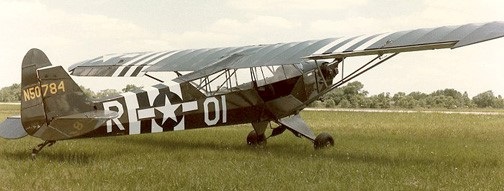
Total L-4C impressment was 111, plus 5 more lost in the records somewhere.
The 1943 L-4D were five impressed J-3F.
The 1943 L-4E were one impressed J-4E, plus 1 redesignated from UC-83B, 42-79555.
L-4F were 45 impressed J-5A. plus 42-57505 and five redesignated from UC-83 (42-79551/79554, -107424).
The 41 L-4G were impressed J-5B in 1943.
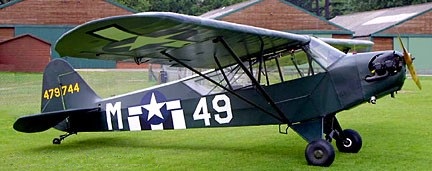
There were 1,801 of the L-4H variant (43-29247 to 43-30547, and 44-79545 to 44-80044), with only detail changes, and 1,680 of the L-4J (J-3C) model with 65hp Continental which introduced a variable-pitch propeller.
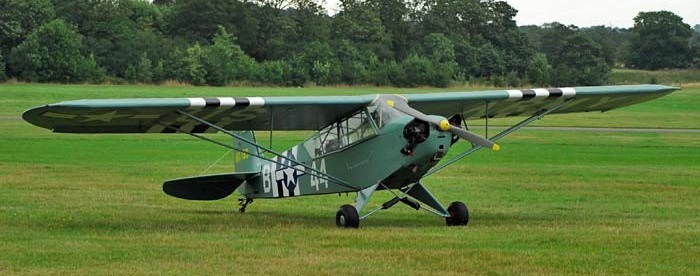
Piper was then requested to develop a training glider from the L-4 design and this, with powerplant removed and the forward fuselage redesigned to accommodate an instructor and two pupils, was built to a total of 250 for the US Army under the designation TG-8. Three of these gliders were acquired for evaluation by the US Navy under the designation XLNP-1.
The US Navy also procured 230 NE-1 aircraft, 26196 to 26425, which, basically similar to the US Army’s L-4s, were used as primary trainers; 20 similar aircraft procured at a later date were designated NE-2, 29669 to 29688. One ship was used for experiments as a potential carry-on by blimps (like a mini-version of the Curtiss Sparrowhawk and USS Akron merger) for long-range sub spotting, but with PBY and PB4Y fitting that role better, the plan was never fully implemented.
When, in 1949, production was switched to the improved Cub J-4 Coupe, Piper had built a total of 14,125 civil and 5,703 military.
Very important to the airplane’s popularity was Pip¬er’s aggressive marketing and pricing. A 1940 brochure lists the 40 hp version of the J 3 for $995, $333 down. And they even threw in a free 12¬month subscription to Air Facts. With a 65 hp Continen¬tal, the price of the J 3 was $1,598.
There were 105 recorded exports to the Turkish AF.
Production increased by leaps and bounds – nearly 600 in 1938, 1100 in 1939, 1800 in 1940. A total of 19,888 were built at Lock Haven and another 150 in Canada. Some were built as L-4 Grasshoppers for the United States military before production ended in 1947.
Certification of the J3C-50 and -65 is under FAA A-691.
The 1944 J-3X was built with a cantilever wing.
Modified lift struts increase the MAUW from 1100 lbs to 1220 lbs.
In 1978 PATTS College of Aeronautics in the Philippines assembled a modified L-4J Piper Cub and flew using 100% alcogas as fuel. In May 1988 a modified version of an L-4J, RPX-25, built by PATTS College of Aeronautics flew.
Variations:
Wagner Cub Twin
Ultralight replicas:
Light Miniature Aircraft LM-1
Microwings Cubby
Wag-Aero CUBy / Sport Trainer / Acro Trainer
J-3 Cub
1937
Engine: Continental A-40, 40hp
Wing span: 35’3″
Length: 22’6″
Useful load: 422 lb
Max speed: 87/ mph
Cruise speed: 72 mph
Stall: 32 mph
Range: 210 mi
Seats: 2
J-3C
1938
Engine: Continental, 40, 50, or 65hp
Piper J-3C-65 Cub
Engine: 1 x Continental A65-8, 48kW / 64 hp at 2350 rpm
Max take-off weight: 499 kg / 1100 lb
Empty weight: 290 kg / 639 lb
Fuel cap: 11 USgal
Wingspan: 10.73 m / 35 ft 2 in
Length: 6.78 m / 22 ft 3 in
Height: 2.03 m / 7 ft 8 in
Max. speed: 148 km/h / 92 mph
Ceiling: 3660 m / 12000 ft
Range: 402 km / 250 miles
Take-off distance (50ft obstacle): 730 ft / 223 m
Landing distance (50ft obstacle): 470 ft / 143 m
Climb Rate: 450 ft/min / 2 m/s
Crew: 2
J-3F
1938
Engine: 1 x 40, 50, 60, or 65hp Franklin 4AC
J-3L
1938
Engine: 1 x 50, 55, or 65hp Lycoming O-145
J-3P
1938
Engine: 1 x 50hp Lenape Papoose
No built: 27
J-3R
1939
Engine: 1 x 65hp Lenape Papoose
No built: 1 (NX21806)
J-3X
1944
Engine: 1 x 65hp Continental
Speed: 111 mph
No built: 1 (NX42111)
NE
Engine: 65hp Continental O-170
Wingspan: 35’3″
Length: 22’3″
 All Aero