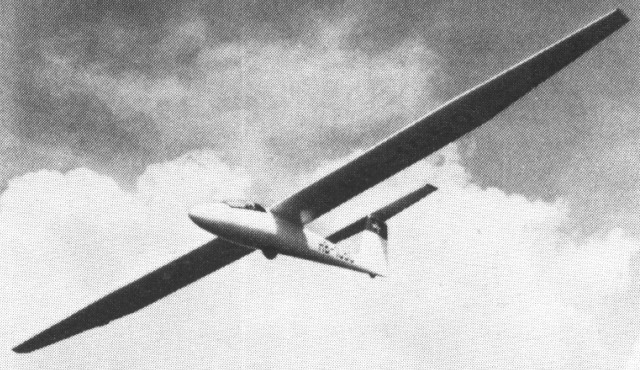
The only glider manufactured by Swiss aircraft manufacturer. First flying in 1972 the Pilatus B4 is an all-metal design to Standard Class specifications. It has full aerobatic capability including inverted maneuvers.
The B4 is a cantilever shoulder-wing monoplane with a T tail; the wings are of light alloy with a U-shaped light alloy main spar and hard PVC foam ribs between the metal ribs; the large skin panels are attached to the main spar by a single row of countersunk rivets, and the ailerons are of similar construction. There are light alloy spoilers in the wing upper surfaces at the 60% chord line. The semi-monocoque fuselage is also of light alloy, with a flush-riveted skin, and the rear fuselage consists of two half-shells riveted together. The light alloy T-tail has PVC ribs and a fixed-incidence tailplane, and the elevator has a bias spring for trimming. The landing gear consists of a non-retractable unsprung Tost monowheel with drum brakes, although a retractable one can be fitted if the customer desires, and there is a fixed tailwheel; small doors enclose the monowheel when retracted. The pilot sits in a semi-reclining position under a sideways-hinging canopy that is jettisonable in flight, and a battery radio and oxygen system are optional.
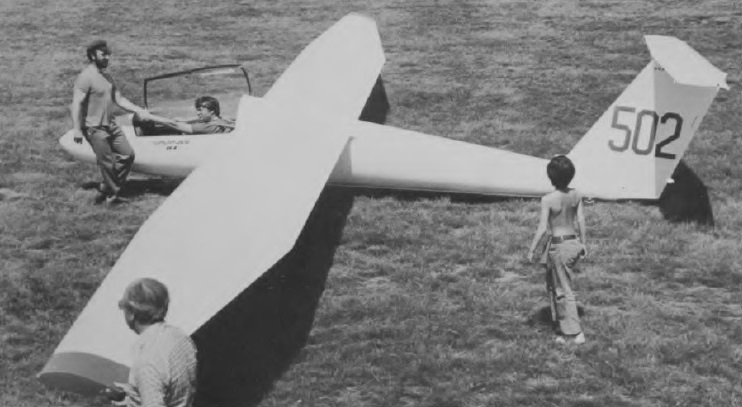
Certification for full aerobatic manoeuvres was granted in January 1975. Of all-metal construction, the type was designed by Ingo Herbot as a private venture and first flew in prototype form, as the B-4, in 1966; the design was taken over and developed by Pilatus as the B4-PC11, which first flew in 1972. Swiss certification was granted on 12 June that year, and the first delivery was made shortly afterwards. Seventy eight B 4s were sold in 1977, and 320 were in operation.
More than 330 examples of the Standard Class Swiss single-seater had been delivered to customers in no less than 30 countries by March 1978, and the production rate was as high as 7-8 aircraft per month.
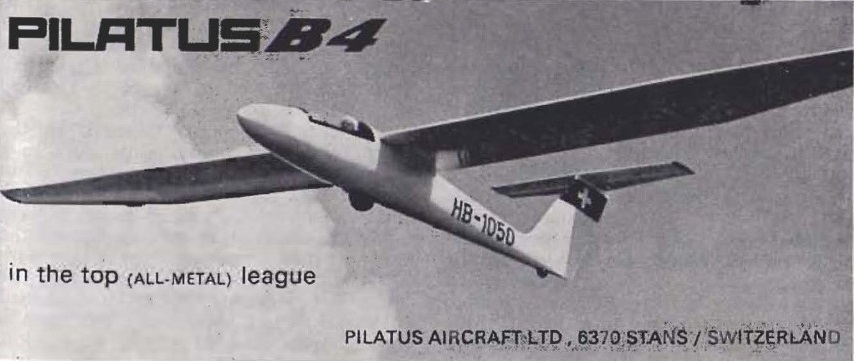
On 19 June 1978 Pilatus announced the sale of all manufacturing and sales rights in the B4 to the Japanese firm of Nippi – Nihon Kikoki Kabushiki Kaisha (or Japan Aircraft Manufacturing Co Ltd) so as to be able to concentrate on production and development of the PC-6 Turbo-Porter and PC-7 Turbo-Trainer.
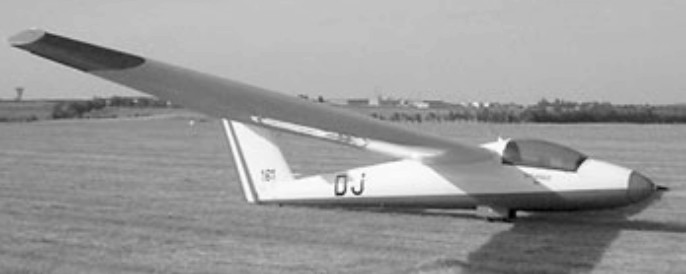
The first Nippi-built B4-PC11 AF was rolled out on 1 June 1979 and initial production was to be at three per month after Japanese certification. The first Nippi-built B4-PC11 AF made its maiden flight on 25 November 1979. Pilatus was to continue the product support of Swiss-built examples.
Number of aircraft built to 6/30/81 400.
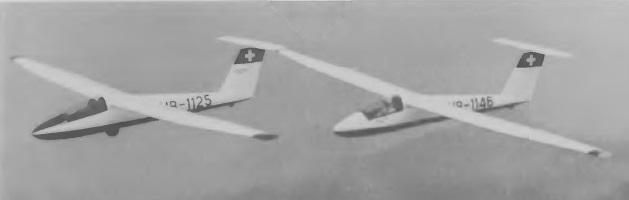
Pilatus B4
Wing span: 49 ft 2.5 in
Length: 21 ft 6.5 in.
Seats: 1
Wing loading: 5.13 lb/sq.ft.
Aspect ratio: 16.1
Max TO wt: 770 lb.
Empty wt: 506 lb
Useful load: 264 lb.
Max speed: 130 kt
Rough air speed: 130 kt.
Stall: 30 kt
Lift to drag: 35 @ 46 kt.
Sink: 2.1 fps @ 39 kt.
B4-PC11
Wing span: 15.0 m / 49 ft 2.5 in
Length: 6.57 m / 21 ft 6.5 in
Height: 1.57 m / 5 ft 1 in
Wing area: 14.04 sq.m / 151.1 sq ft
Wing section: NACA 643 618
Aspect ratio: 16.0
Empty weight: 230 kg / 507 lb
Max weight: 350 kg / 772 lb
Water ballast: None
Max wing loading: 24.93 kg/sq.m / 5.1 lb/sq ft
Max speed: 129.5 kt / 240 km/h
Stalling speed: 33.5 kt / 62 km/h
Min sinking speed: 0.64 m/sec / 2.1 ft/sec at 39 kt / 72 km/h
Max rough air speed: 129.5 kt / 240 km/h
Best glide ratio: 35 at 46 kt / 85 km/h
B4-PC11AF
Wing Span: 15m / 49.2ft
Wing Area: 14.04sq.m / 151.1sq.ft
Length: 21 ft 7in
Height: 5 ft 2 in.
Empty Weight: 230kg / 506lb
Payload: 120kg / 264lb
Gross Weight: 350kg / 770lb
Wing Load: 24.93kg/sq.m / 5.13lb/sq.ft
Min Sink @ 39 kts / 45 mph: 0.64 m/s / 2.1 fps / 1.24 kt
L/D Max: 35 @ 85 kph / 46 kt / 53 mph
Max speed: 129 kts / 149 mph (in smooth air)
Stall speed: 33 kts.
Rough air airspeed: 86 kts
Max aero-tow speed: 112 mph
Airfoil: NACA 64(3)-618
Aspect ratio: 16.1
Seats: 1
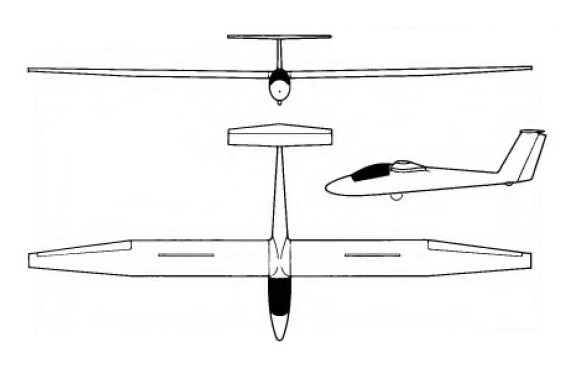
 All Aero