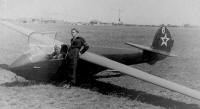
Between 1947 and 1948, the test pilot and aeronautical constructor Alexei Ivanovich Pietsuj developed two new projects at the MAI that were called PAI-5 and PAI-6 (Russian: Пьецух ПАИ-6).
The PAI-6 was designed as a single-seater training glider to take advantage of thermal flight and had full aerobatic capabilities. It was generally similar to the previous PAI-5, but was notable for its increased wingspan.
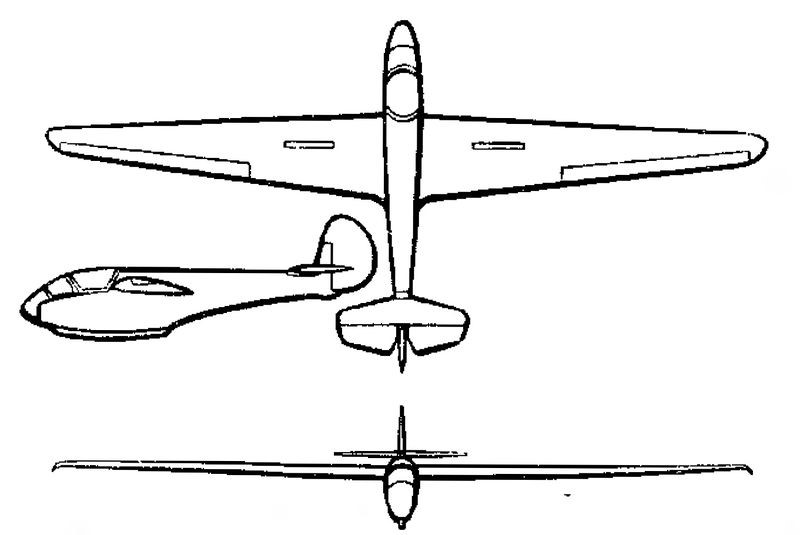
The PAI-6 was a high-cantilever glider with a large trapezoidal high-wing.
The glider was built entirely of wood. The fuselage had a simple construction made up of 24 frames joined by three stringers and a set of stringers. The exterior coating was made with plywood between 1.5 and 2 mm thick. The cross section was oval, with downward elongation. In the upper part of the fuselage, a slit was made, crossed by the force elements of the wing. An aluminium cover was placed over this slit.
The wing composition comprised two trapezoidal-shaped consoles in plane joined at their bases on the longitudinal axis of the apparatus. The consoles had a TsAGI R-Sh profile of constant relative thickness (15.5%) and were fixed to the fuselage by means of four points of two reinforced frames located in the upper part. The two consoles were joined together by screws and conical fixings. The fixing points to the frames were located on the spar and on the last wing spar.
The wing featured a single spar structure with ends working by twisting. The stringer was made up of two faces with plywood partitions. The wingtips and the frontal region of the wing were covered with plywood and the rest with fabric covered with paint.
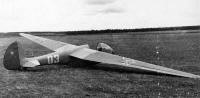
The ailerons were attached to an auxiliary spar at three points and featured a single spar structure with diagonal ribs. The front part was covered with plywood and the rest with fabric. The wing-end interceptors were conceived as smooth pine frames with fabric covering on both sides. Each interceptor was attached to the wing spar by three points.
The horizontal tail plane was raised to the top line of the fuselage and positioned in front of the vertical tail. The stabilizer featured a single spar construction with plywood overlay. The elevators also used a single spar and coating similar to that of the ailerons.
The keel was an integral part of the fuselage construction and ended in a rudder with aerodynamic compensation. This rudder featured a two-stringer structure. From the leading edge to the second spar the covering was plywood and from there on fabric. All rudders featured three-point fixation. The landing was made on a wooden ski, with a trunk structure, located in the lower part of the fuselage.

The cockpit, located in front of the wing, was closed by a cover that protruded from the upper line of the aircraft. The flight control was mixed with control of the ailerons by means of ropes and bars for the control of the tail planes.
The control of the interceptors and the tow hook was also carried out by cables, with actuators located on the sides of the cockpit.
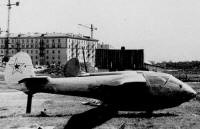
Once the tests were completed from the GK NII VVS Experimental Factory, improvements were made to the original design and the entire set of plans and technical diagrams was created to launch production. In Ryazan, Moscow, a small series was built in 1949. Its main destination was the flying clubs of the country. PAI-6 participated in several air parades for Aviation Day in Túshino.
An improved version of this glider known as PAI-6M was built in the early 1950s at the MAI. This aircraft was never flown and was destroyed as a result of the cooling towards the gliders that occurred in the USSR in those years.
PAI-6
Wingspan: 12.4 m
Wing area: 11.8 m²
Aspect ratio: 13
Length: 5.41 m
Height. 1.35 m
Glider weight: 193 kg
Wing loading: 24 kg / m²
Stabilizer surface: 0.9 m²
Elevator area: 0.75 m²
Keel surface: 0.17 m²
Rudder surface area: 0.85 m²
Spoiler area: 1.58 m²
Minimum descent speed: 0.82 m / s
Cruising speed: 85 km / h
Landing speed: 60 km / h
Max glide ratio: 24
Accommodation: 1
 All Aero