The Pietsuj PAI-3 (Russian: Пьецух ПАИ-3) was a glider designed and built by Alexei Ivanovich Pietsuj as a single-seater training apparatus for the preparation of Class B sport pilots and was built in 1937.
It was designed with the aim of replacing the Gribovski G-9 and Antonov BS-5 gliders, already outdated for the time. It was necessary to have a training glider capable of being towed from another plane and performing all kinds of high school stunts in all weather conditions.
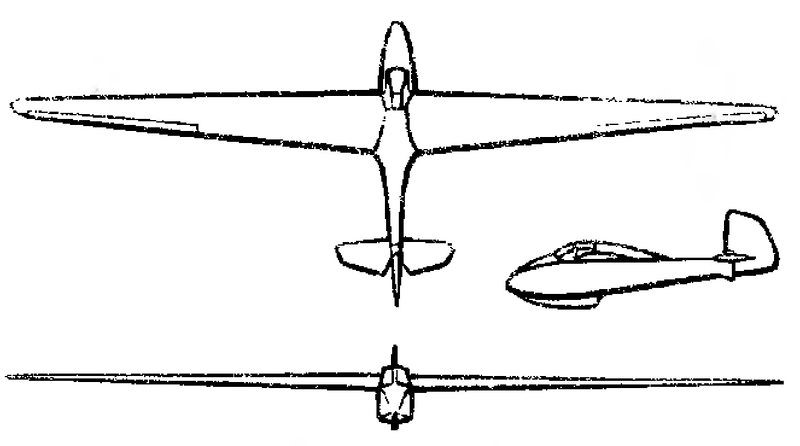
The PAI-3 was designed as a high-wing cantilever monoplane with a trapezoidal wing and high aspect ratio.
The fuselage had a simple construction made up of a series of frames joined by four stringers. The outer covering was made of 2 mm thick plywood covered with fabric.
The wing construction incorporated a single main spar, a secondary spar, and a set of ribs. To fix the ailerons another small auxiliary spar was used. The wing tip was covered with plywood, but the rest of the coating was made of fabric covered with several layers of paint.
The empennage featured a large rudder attached to the shallow keel at three points. The horizontal empennage featured two non-stabilized elevator rudders.
At the bottom of the fuselage there was a ski with a trunk structure, without amortization.
The spacious cabin featured an angular deck constructed of duralumin and celluloid.
From a production point of view the Pietsuj PA-3 glider was easier and cheaper to produce than the Gribovski G-9 and Antonov BS-5.
The flight tests of the PA-3 glider were developed by pilot PI Shelest. Despite showing good performance, series production was not approved. Only the one prototype was built.
 All Aero