
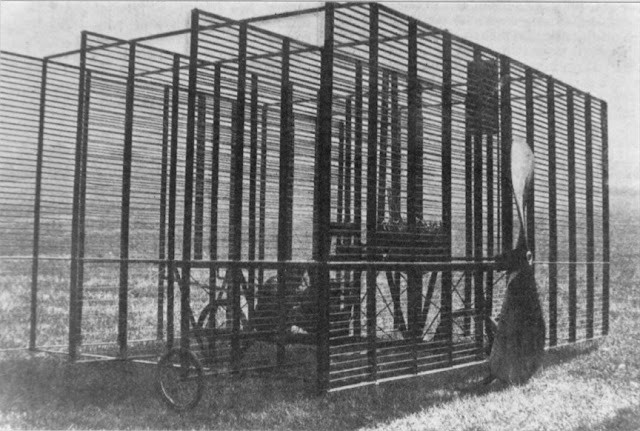
A second version of Horatio Phillips’ 1893 steam powered test-rig study model on its wooden 200 foot diameter circular test-track at Harrow, England, where, tied to a cable fixed on a central mast, its first test was made on June 19th. 9 ft 6 in tall and about 22 feet long, with 40 lifting surfaces arranged like Venetian blinds.
He continued to experiment with wing designs, and built another test rig in 1902, which had 120 wings and was powered by a gasoline engine.

Reaching a speed of 64 km/h with a total weight of 174 Kg, it rose to a height of 90 cm and covered a distance of 600 meters.
Phillips also built multiplane machines in 1904, 1907 and 1911; his elaborate multiwing approach – 40 double-surface airfoils grace this early example – is often referred to as the “Venetian Blind”.
The 1907 Phillips Multi-Wing Flying machine was designed and built by Horatio Phillips in the UK. It featured 20 rows of aerofoils and flew more than 500 yards.

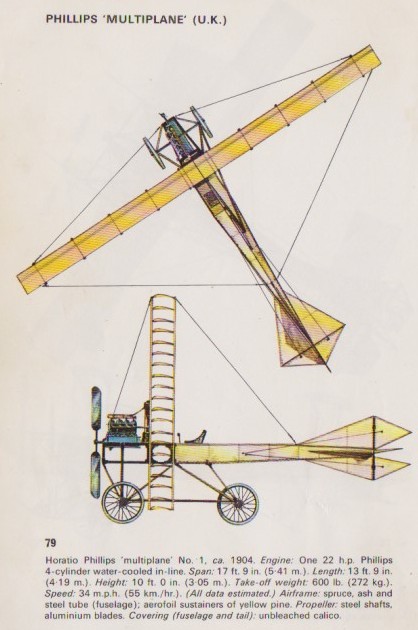
Phillips built his first man-carrying machine, with 20 lifting surfaces, in 1904, and was able to make at least one short hop of 50 feet. His 1907 machine had four banks of 50 wings each and an eight-foot propeller. In this machine Phillips made a powered, although uncontrolled, flight of about 500 feet.

Engine: Phillips 4-cyl inline, water-cooled, 22 hp
Wingspan: 17 ft 9 in / 5.41 m
Length: 13 ft 9 in / 4.19 m
Height: 10 ft 0 in / 3.05 m
TO weight: 600 lb / 272 kg
Speed: 34 mph / 55 kph

 All Aero