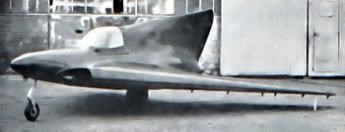
Designd by Nicolas Roland Payen, Flechair Sa built Payen’s Pa.49 experimental jet-powered delta-winged aircraft. In May 1951, three workers directed by Payen built the all-wood PA-49 in a month. Reportedly named after Roland Payen’s youngest daughter.
It has a triangular shape or Delta wing, 2.7 m swallow tail. The wing has 72 ° sweep, is 11,250 m² with a wingspan of 5.6 m. This wing has no dihedral. The average profile is a modified NACA the 230000 series. The structure of the wing is built in one piece. The trailing edge has flaps in the central part, equipped with tabs controlled in flight. The control surfaces are statically and dynamically balanced. The structure of the wing, is composed mainly of a working chamber, formed by the assembly of two perpendicular rails and oblique side rails symmetrically joined by two ribs. All wing spars or fins, main or joint, and ribs are made of box spruce (laminated strips) and birch plywood.

The Pa-49 strengthened surfaces ‘split’ open to act as air brakes. This solved the problem of interference between the braking and directional controls on an all-wing aircraft.
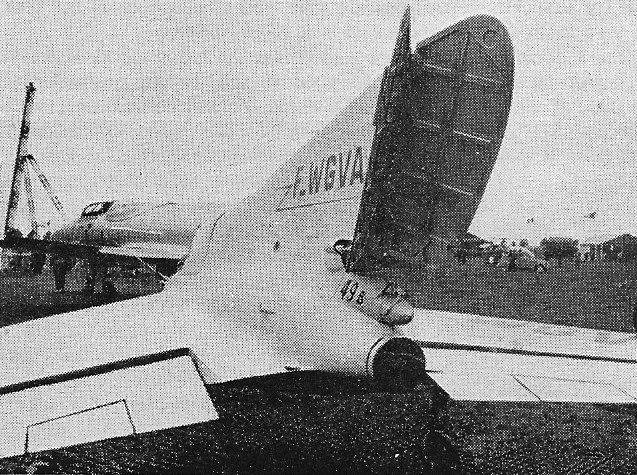
It is equipped with a Turbomeca Palas turbine engine. The Turbomeca Palas turbojet engine weighed 159 pounds and producied approximately 330 pounds of thrust, it drew air in through dual intakes at the junction of the wing’s leading edge and fuselage.
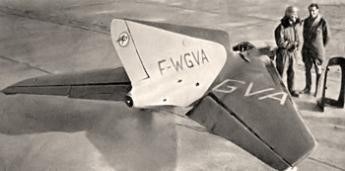
Originally designed with a bicycle landing gear that incorporated wing-tip skids, the Pa-49 ultimately flew with fixed tricycle gear.
It was not until the end of 1952 and negotiation for the PA-49 to undergo testing in the wind tunnel of ONERA Chalais-Meudon.
First flown on January 22, 1954, by Tony Ochsenbein, the PA49 was the first French delta-wing aircraft.
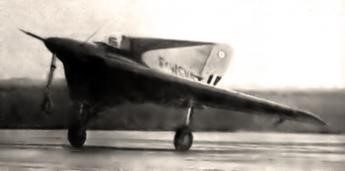
The endurance of just over one hou was entirely sufficient for short test flights. It was also sufficient for flights to various airshows and industry expositions, where the aircraft was photographed on several occasions, both on static display and in flight.
Between 1954 and the end of 1958, it made many flights before the project became inactive.
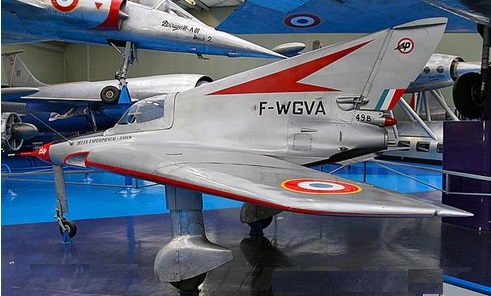
Fortunately, the Katy survived 300 test flights unscathed, and Payen ultimately donated it to the Musée de l’Air et de l’Espace in Paris, where it remains on display today.
Engine: one Turbomeca Palas of 330 lb thrust
Wingspan: 16 ft 11 in
Length: 16 ft 8 in
Height: 7 ft 2 in
Empty weights: 1,005 lb
Max all-up weight: 1,430 lb
Maximum speed: 310 mph
Cruise speed: 217 mph
Landing speed: 67 mph
Initial rate of climb: 1,150 ft/min
Ceiling: 27,880 ft
Endurance: just over 1 hr
Accommodation: single-seat

 All Aero