
In 1939 Pashinin was appointed chief builder of the OKB at Factory No.21. This small collective presented in November of that year the conceptual drawings of a new M-105 powered fighter, which in the factory was called IP-21 (Factory Pashinin Fighter 21 – И стребитель П ашинина завода № 21) or just I-21, a development of the Polikarpov I-16.
Using an M-105 engine, between 60 and 70% of the parts of the new fighter were similar to those used in the I-16, which was calculated to allow the new model to be quickly introduced into the production lines.
The calculations presented by the OKB recorded a takeoff weight of no more than 2400 kg. The calculated maximum speed at sea level reached 523 km/h and at 5000 meters it was 613 km/h (the NII VVS specialists set it at 605 km/h. The ceiling was calculated at 10,400 meters and the ascent time to 5,000 meters – 4.75 minutes.
This new fighter was designed with the M-107 liquid-cooled 1,650 hp inline enginebut the problems presented during the tuning of the engine delayed its production, so the project had to be redesigned to install the M-105 of 1050 hp.
Structurally the I-21 was designed as a conventional monoplane tail, low-wing fighter of mixed construction. The forward section of the fuselage up to the cockpit was based on a structure of welded steel tubes covered with duralumin slats. The tail section featured a monocoque structure covered with wood veneers on a pine wood structure. The frames were similar to those of the I-16 with a 3mm skin tapering to 1.5mm at the tail.
The three-section wings featured a centerplane constructed of chrome steel tubing with aluminum ribbing and covered with plywood. A totally new feature was the symmetrical wing configuration with NACA-0012-0009 profile (at the ends). This new wing theoretically allowed speeds of up to 950 km/h to be reached in a dive. Detachable consoles with rounded ends, were constructed of plywood-faced wood and featured control surfaces along the full span of the trailing edge.

The tail was of a conventional monoplane type. The empennage was made of wood and was removable. The stabilizers were also projected in wood. The control surfaces were similar to those of the Polikarpov I-16, constructed of cloth-covered duralumin.
The landing gear was of the conventional type with a tailwheel. The main units featured a single 600х180 mm wheel that retracted backwards making a 90º turn. Once stowed, the main units and wheels were covered by a cover that projected forward of the wing leading edge where the oil coolers were located.
The cockpit was enclosed and featured a closed bubble-type canopy, allowing visibility in all directions. The deck was unarmored.
The fuel system consisted of five 400-litre tanks, two in the fuselage and three in the midplane.
The I-21’s armament consisted of a ShBAK cannon firing through the engine shaft with 190 rounds and two ShKAS synchronized machine guns with 500 rounds each.
After some revisions, on January 3, 1940, the NKAP leadership approved the construction of the prototype at Factory No.21, granting it the manufacturing index “ Object 30 ”.
On April 4, 1940 the construction of a prototype of the I-21 single-engine fighter with M-105P power plant was approved (the first version produced in series. It could accommodate an automatic cannon between the two rows of cylinders), which was finished in June.
On July 11, 1940, the first prototype of the I-21 took flight for the first time with P. U Fokin at the controls in a flight that lasted 18 minutes. In the factory tests, 33 flights were carried out with a total of 16 hours and included the execution of acrobatics. Pavel Fokin considered that the plane behaved well during takeoff, responded well to controls, was stable in a dive, and both takeoff and landing was easier than the I-16. Preliminary data predicted a speed of 628 km/h and a range of 780 km/h. It was recommended to work on directional stability.
In August the I-21 was transferred to Moscow, being shown on 18 August 1940 at the air festival in Tushino and then delivered for state tests at the Moscow Central Airfield.
During the development of the tests carried out by the test pilots P. Stefanovsky and S. Suprún, it was found that the I-21 had little longitudinal stability in the air, so it was returned to the factory to correct the defect. It was also found that it had a tendency to dive on the wing at large angles of attack, which led to the redesign of the wing and the installation of automatic control surfaces.
However, the NKAP had high hopes for this fighter, so at the end of 1940 the people’s commissar AI Shajurin approved the construction of another pair of prototypes. They were to solve the problems raised by the military. The second example with factory number No.21A213 was ready by August 18, also with an M-105P engine instead of the M-107.
To reduce the stability problem, the builders on the second model introduced a wing with a small sagging on the leading edge.
On October 6 it was taken to the aerodrome and on October 8 the first flight took place, again piloted by Fokin and lasting 17 minutes. The second flight took place on September 12, followed by a third on the 17th with factory pilot Bolshakov and another two in September, finishing factory tests in October 1940. In all flights the plane behaved without difficulties. Weapons tests were at the Factory No.21 until November 14.
The first example was damaged during a landing in the factory tests and it was decided not to repair it, so the state tests were continued on November 21, 1940 with the second example and lasted until the end of 1940. The results obtained were disappointing. The noted defects had not been fixed and furthermore, the modifications had slowed down and other features had deteriorated. The test results showed a maximum speed at sea level of 488 km/h and 573 km/h at 5000 meters. The landing speed increased considerably.
Taking into account the indications of the NII VVS during the tests of the first two examples, a third I-21 prototype was built in January 1941, which flew for the first time on April 5 of that year.
This example had a wing with greater rake on the leading edge and rectangular endings. Each wing console was decreased by 78 cm. The two underwing oil radiators of the previous examples were replaced by a single radiator located in the lower part of the power plant. The height of the water radiator was decreased. On the engine, instead of the independent exhausts, a manifold was located. The surface of the empennage was slightly increased (0.21 sq.m).
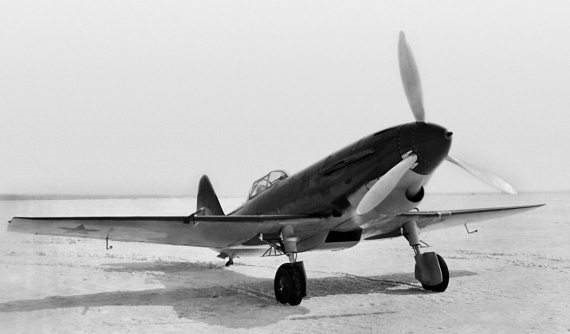
The armament of the third prototype was strengthened by replacing the 20 mm ShBAK cannon with a 23 mm BT- 23 cannon in the engine, keeping the two synchronized ShKAS machine guns.

By that time, NN Polikarpov had already developed his modernized version of the I-16, which was released as I-180 and had features not inferior to those of the I-21. Factory No.21 had been selected for series production, but despite the order being given, Pashinin diverted a large number of engineers to development of the I-21, virtually preventing the introduction of Polikarpov’s model into production. The factory management supported Pashinin ‘s work and by 1941 production plans were prepared for the I-21 instead of the I-180. This “misstep” prepared by Pashinin would soon turn against him, and while Nikolai Polikarpov managed to produce at least a few pre-series aircraft, Pashinin’s luck was not on his side.
On November 10, 1940, by order of the NKAP, Semyon Lavochkin ‘s OKB was transferred to Factory No.21. In this document itself, the construction and testing of the I-21-3 was completed.
Between May and June 1941, the I-21-3 was delivered to the LII for tests, in which a speed of 506 km/h and 580 km/h at 4750 meters was reached, which meant 66 km/h more at sea level and 34 km/h higher than the Messerschmitt Bf-109E, the main German fighter at the time. The I-21 also had more firepower than the German fighter, due to the caliber of the cannon being higher, as was the initial velocity of the bullets. The I-21-3 presented better stability and handling, as well as simplicity in piloting, but its landing characteristics required long runways.
The report with the results of these tests was sent by the LII to the Deputy People’s Commissar for the Aircraft Industry AS Yakovlev. It highlighted:
“The I-21 was tested twice at the NII VVS, where it presented several defects for which the tests were interrupted and the prototype was returned to the factory for modifications. For the third time the I-21 with improvements was delivered for control tests to the LII, as a result of which the main conclusions obtained by the NII VVS are confirmed”.
As a result, it was decided not to submit the I-21 to state tests. With this, the development of the model came to an end. The development of a pre-series of 5 copies was stopped.
I-21-3
Powerplant: 1 x 1050 hp M-105P
Wingspan: 9.40 m
Wing area: 15.46 m²
Length: 8.29m
Height: 3.24m
Empty weight: 1210 kg
Takeoff weight: 2670 kg
Wing loading: 173 kg/m²
Power load: 2.5 kg/hp
Maximum speed at sea level: 488 km/h
Speed at altitude: 573 km/h
Landing speed: 165 km/h
Practical range: 760 km
Endurance: 2 hours
Turning time: 25 sec.
Ascent time to 5000 m: 6 min
Take-off run: 282 m
Maximum rate of climb: 1260 m/min (21 m/sec)
Service ceiling: 10600 m
Accommodation: 1
Armament: One 23mm BT-23 cannon and two 7.62mm ShKAS machine guns

 All Aero