In 1943, aware of Nazi Germany’s advances in the field of jet propulsion, the Army Air Forces (AAF) asked the General Electric Company to devise a more powerful engine than its prospective axial turboprop. This eventually brought about the production of the J35 and J47 turbojets. In 1944, 1 year after the jet engine requirements were established, the War Department requested the aircraft industry to submit proposals for various jet bombers, with gross weights ranging from 80,000 to more than 200,000 pounds, and only 4 contractors answered the call. The design was frozen in early 1945.
North American B-45 Tornado Article
Pressed for time, the AAF in 1946 decided to skip the usual contractor competition, review the designs, and choose among the proposed aircraft that could be obtained first. The multi-jet engine B-45, with the understanding that if a less readily available bomber was to prove superior enough to supplant it (which the Boeing XB-47 did), that aircraft would also be purchased.
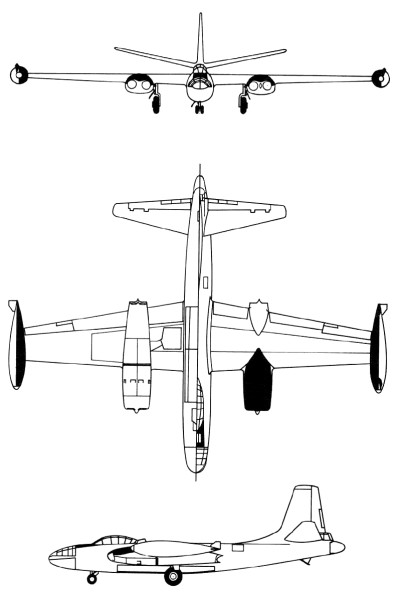
The design was generally conventional, though the main gears had very large single wheels which retracted sideways into the wing roots. In normal bomber versions the bomb aimer/navigator occupied the capacious pressurized nose, the two pilots sitting in a tandem fighter like cockpit farther aft and above, with a large multi pane canopy. The crew door was on the left side of the forward fuselage. A gunner was housed in a pressurized tail compartment.
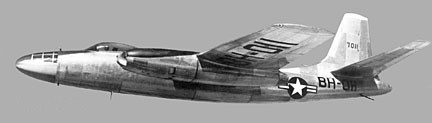
The first flight was on 17 March 1947 (piloted by George Krebs) and testing of the XB-45 prompted pre-production changes. North American Aviation redesigned the nose panel, increased the aircraft’s stabilizer area, and lengthened the tailplane by nearly 7 feet.
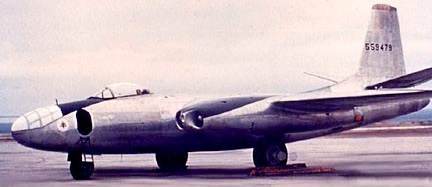
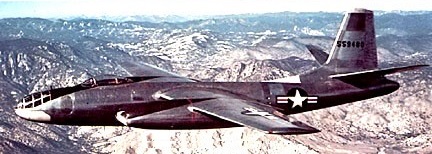
In August 1948, 22 of the 90 B-45s, ordered less than 2 years before, reached the newly independent Air Force. However, the B-45’s weight and takeoff distances had increased, and numerous structural and mechanical defects appeared.
In November 1948 the B 45A (NA-147) went into service with the 47th Bombardment Group of the USAF, later based in England. Ninety-six were built (47-001/097, the last one of which was a static test-frame.
In June 1951 an RB-45 became the first jet bomber to be refuelled in flight by a Boeing KB-29.
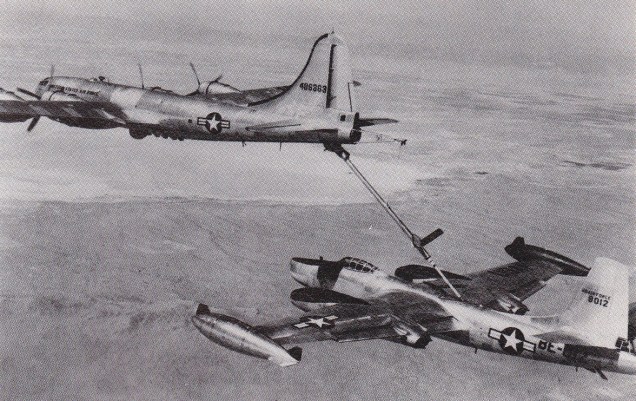
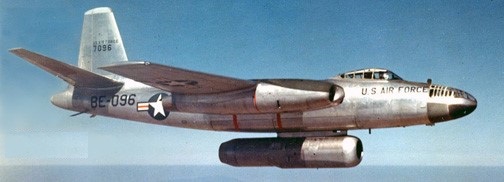
The DB-45A were conversion of B-45A as guided missile director. The JB-45A 47-096 and JB-45C of 1950 were engine test beds for Westinghouse and General Electric.
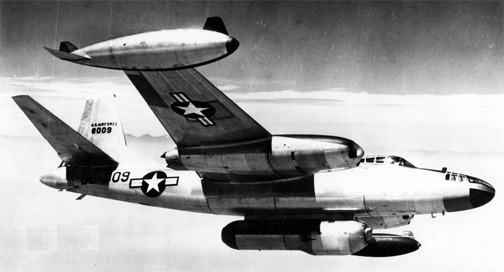
The fourteen TB-45A were target tugs modified from B-45A.
The B-45B was a project only, none were built.
Ten B-45C (NA-153 48-001/010) were built in 1950. The DB-45C were conversions of B-45A as guided missile director.
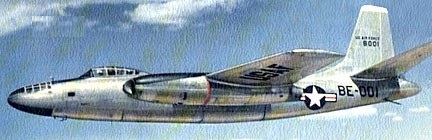
Thirty-three RB-45C and JRB-45C (NA-153 48-011/043) were built in 1949 for Photo-recon.
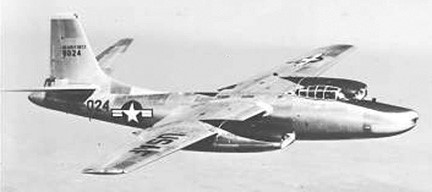
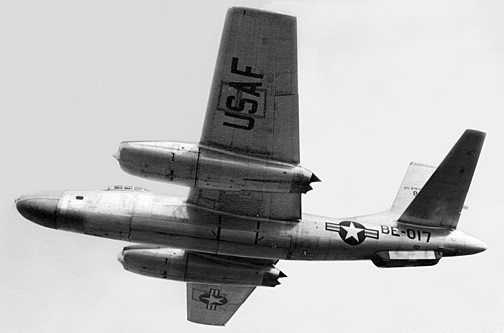
As the B-47’s future production had become certain, in mid-1948 the Air Staff questioned the B-45’s value as well as its potential use. As President Truman slashed Air Force expenditures, the programmed production of B-45s was reduced to a total of 142 aircraft at a unit cost of US$1,081,000.
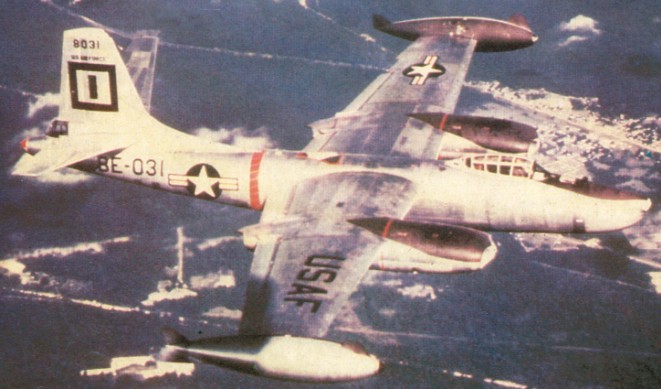
Only 96 B 45As were built, plus 10 of the stronger and more powerful B 45C which was disting¬uished by large wingtip tanks. Many A models were modified to B 45C standard. The final 33 aircraft were RB-¬45C camera aircraft, some of which (unlike the bomber versions) operated over Korea. Some had water injection tanks hung under the twin engine nacelles, jettisoned after take off.
Although continuously plagued by engine problems, component malfunctions, lack of spare parts, and numerous minor flaws, the B-45 regained importance. The B-45 was designed to carry both conventional and atomic bombs. Under the code name of Backbreaker, several distinct atomic bomb types and large amounts of new electronics support equipment had to be fitted in place of the standard components. In addition, the 40 B-45s allocated to the Backbreaker program also had to be equipped with a new defensive system and extra fuel tanks. Despite the magnitude of the modification project, plus recurring engine problems, atomic-capable B-45s began reaching the United Kingdom in May 1952, and deployment of the 40 aircraft was completed in mid-June, barely 30 days behind the Air Staff deadline.
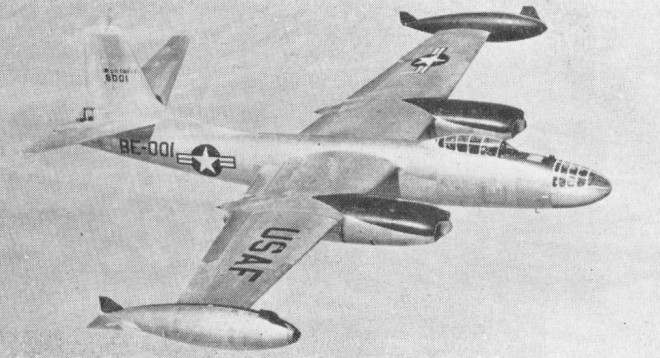
The British and American military intelligence services collaborated under utmost secrecy. Thus in 1952 four American RB-45C reconnaissance aircraft, wearing British colours but without registration marks, operated from RAF Sculthorpe on photo-missions over East Germany and other Eastern-bloc countries. Very up-to-date for the time, the RB-45C was equipped with 12 cameras. The aircraft were based at Sculthorpe in January 1952 as a detachment of the 91st Strategic Reconnaissance Wing of SAC.
The last B 45s were withdrawn from combat duty in mid-1958. The entire contingent, Backbreaker and reconnaissance models included, was phased out by 1959. Yet, the B-45 was the Air Force’s first jet bomber and as the first atomic carrier of the tactical forces.
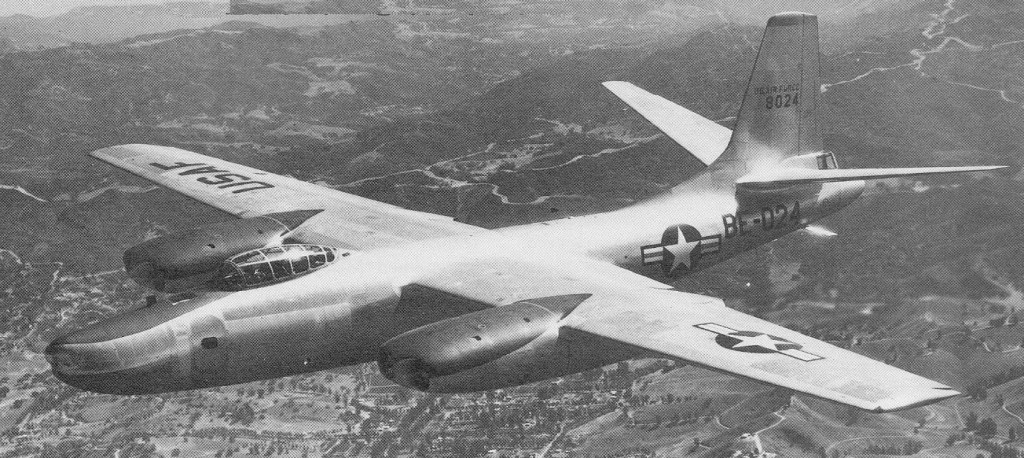
XB-45 / NA-130
Engines: 4 x GE TG180, 4000 lb
Speed: 536 mph
B-45A Tornado
Engines: 4 x GE J47, 5200 lb
Wingspan: 89’1″
Length: 75’4″
Max speed: 575 mph
Cruise speed: 455 mp
Crew: 3-4
B 45C Tornado / NA-153
Engines: four 2359 kg (5,200 lb) thrust General Electric J47 GE 13/15 turbojets (some with water injection 2722 kg/6,000 lb)
Wing span over tip tanks: 29.26 m (96 ft 0 in)
Length: 22.96 m (75 ft 4 in)
Height 7.68 m (25 ft 2 in)
Wing area: 109.2 sq.m (1,175.0 sq ft)
Empty weight 22182 kg (48,903 lb)
MTOW: 51235 kg (112,952 lb)
Max speed 932 km/h (579 mph) at low level
Service ceiling: 13165 m (43,200 ft)
Range 3074 km (1,910 miles)
Armament: two 12.7 mm (0.5 in) machine guns in tail turret
Internal bombload of up to 9979 kg (22000 lb).
Crew: 3
 All Aero