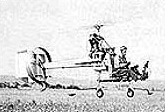
The N.1700 was a two-place aircraft; the rotor had two blades with a stabilizer bar. The engineer Andre Bruel wanted to get rid of the cyclic control, considered too complex. The rotor head was installed on an articulated parallelogram, allowing lateral motions. The lateral control was obtained by relative displacement of the rotor head in relation to the center of gravity.
The 160hp Mathis GR7 engine directly powered a rear axial helix which blew on two flap shutter systems, some horizontal, some vertical, to control pitch and yaw. The aircraft was damaged at first, due to violent vibrations of transmission, induced by brutal clutching. Alter repairing it, they resumed power checks but, in the hands of an inexperienced pilot, it hit an obstacle.

Management decided then to abandon the N.1700 and to turn to a smaller aircraft, the 1950 single seat N.1710, built in accordance with the same principle. SNCAN asked SNCASE to send Jean Boulet to test this machine:
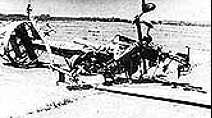
“The first free flight took place on July 1, 1950. After several difficult hovers (all controls had very larges forces that we tried to compensate somehow by elastic cords), I performed the first forward flight on July 22. The longitudinal control appeared to be very insufficient. Modifications were then made, above all we increased the deflection of the horizontal flap shutters. On September 20, 1950, I took off again to make a forward flight under these new circumstances, but the effect of the modifications appeared to be just the contrary of what we expected: the longitudinal control was even less efficient and moreover the yaw control had lost its efficiency (the horizontal flaps were over deflected and it is probably they stalled and banked the vertical flap shutters). I very quickly found myself flying forward more and more rapidly and banking to the left, with the controls in an extreme position. I had to end this terrible merry-go-round. I reduced the pitch to touch the ground, but the aircraft overturned immediately. I was thrown to the ground and was very lucky not to be killed by a blade. The aircraft was repaired, and we lengthened the tail to improve the efficiency of the control surfaces. In the spring of 1951, I made several more flights, then as my company sent me to Marignane.”

 All Aero