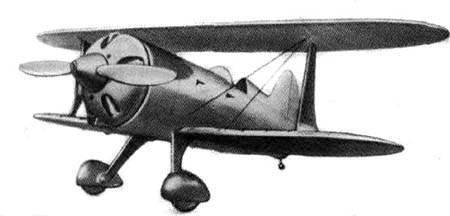
The last of the NV family of trainers was the NV-6 (UTI-6) (Russian: Никитин НВ-6 (УТИ-6)) designed as an advanced aerobatic trainer.
The NV-6 had a biplane configuration with a straight lower wing and an 8º raked upper wing and a slightly larger wingspan. Both wings were braced by a single I-pillar and tension cables. Ailerons were only included on the lower wing.
The construction was mixed. The fuselage featured a welded JMA tube structure, while the wings were made of wood with fabric covering. The center section of the fuselage and the wing of the NV-1 were used, which in this case was installed as the lower wing.
The tail unit was of the monoplane type with the stabilizers constructed of fabric-wrapped duralumin.
The landing gear was of the conventional type, with a tail wheel. The cantilever main landers featured simple balloon wheels with teardrop-shaped streamlined fairings.
The power plant consisted of an MG-11F engine with a special carburettor designed by MA Kossov to be able to perform inverted flight and a two-blade propeller.
The NV-6 was built at the request of the OSOVIAJIM at the OKB-30 facilities during 1939, but it would not be until December 1940 that an engine could be obtained. In that winter several flights were carried out by Nikitin and the pilot VV Shevchenko, which demonstrated good behavior of the aircraft. Unfortunately, the static resistance tests had not been carried out and the TsAGI, under these conditions, did not give authorization for the development of official flights. This problem lasted until the start of the war and from then on it became impossible to pursue further development.
Powerplant: One 165 hp MG-11F
Wingspan: 7.0m
Wing area: 14.0m²
Length: 5.8m
Empty weight: 560 kg
Loaded weight: 750 kg
Wing loading: 53.6 kg/m²
Power Load: 4.5kg/hp
Fuel and oil capacity: 80+20 kg
Speed at sea level: 270 km/h
Landing speed: 75 km/h
Landing run: 170 m
Take-off run: 50 m
Endurance: 2.5 hours
Ceiling: 4500m
Accommodation: 1
 All Aero