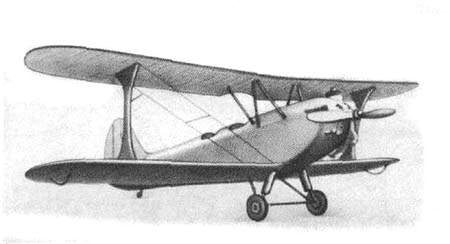
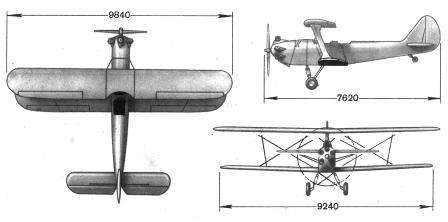
The central direction of the OSOVIAJIM and the Technical Scientific Society of Aviation (Aviavnito) presented a joint contest in 1934 for a training aircraft. Among all the designs submitted, the proposal by VV Nikitin with a scheme similar to that of Polikarpov ‘s classic U-2 was selected as the winner, although with only ¾ wingspan and improved aerodynamics. This model received the designation NV-5 (Russian: Никитин НВ-5).
The NV-5 had a structure very similar to the Polikarpov U-2 and was basically built in wood with fabric covering.
The wings on the biplane wingbox were attached by I-stanchions with cable turnbuckles. On the NV-5 prototype the ailerons were designed similar to those on the U-2, but were later replaced by louvered ones.
The landing gear, with a conventional structure, had a tail skid in its initial version, soon being replaced by a tail wheel. The main landers featured 500 mm diameter balloon wheels, but with the possibility of substituting them for the nominal ones used on the U-2.
The prototype was developed using MA Kossov’s MG-40 engine and a propeller designed by Kuznietsov for use in light aircraft, which proved highly effective. The engine featured a mount with rubber damping.
The NV-5 was designed as a primary training aircraft and the first example saw the light of day only in 1937. The aircraft passed flight tests without difficulties, which were carried out by 15 different pilots, covering a total of 250 flights, in which landings were made with both wheels and skis. As a conclusion, it was determined that the aircraft responded to all flight safety requirements, also presenting a simple construction.
The biggest problem was related to the engine. The MG-40 did not go beyond being an experimental example because it was decided not to produce it. Under these conditions, the determination was made in 1938 to test the 165 hp MG-11F engine, with which the characteristics of the device showed a noticeable increase. This version was called NV-5bis and after the tests the Osoaaviajim request for its serial production was received and later also that of the UVVS.
The only example built was disassembled with the objective of preparing the plans for the series production of the training model that was renamed U-5.
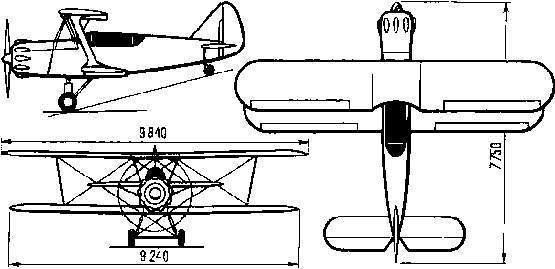
Overall the U-5 was a development of the NV-5bis primary trainer with a new metal blade, simplified fuselage structure, and TsAGI-876 profiled wings instead of the earlier Hettingen-476. The ailerons and tail control surfaces featured duralumin structures with a new rigid control system.
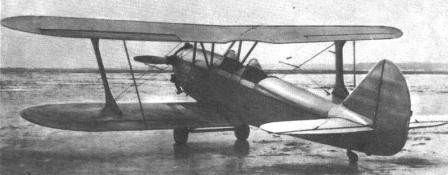
In 1937 the first machine, named U-5, began tests, which fully confirmed the builders’ calculations. In both factory and state tests, more than 60 people participated and all expressed positive opinions about the new aircraft.
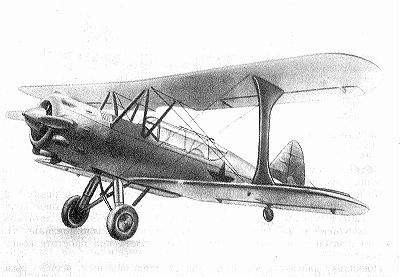
Series production of the model was planned with a 100 hp M-11 powerplant, but only three prototypes were developed in 1938, which were followed by four pre-production aircraft between 1938 and 1939, some of which used the improved M-11 powerplant. 120hp 11G.
One example of the U-5, used as a transitional trainer, featured a fixed ShKAS machine gun located on the intrados of the lower right wing, firing forwards outside the propeller disc and the capacity to carry four RS non-guided reactive rockets. This allowed the pilots, in addition to the development of the piloting technique, to practice aerial fire.
The U-5bis was generally similar to the U-5 but with a 165-180 hp MG-11F powerplant. At the request of the UVVS, a prototype and four pre-series examples were produced in 1939, which also passed the tests successfully.
In general, 12 examples of the U-5 were built at OKB-30 between the prototypes and the series heads. The planned serial production was never executed because despite the excellent performance obtained, the U-5 could not displace the U-2 and UT-2 that were already in full production process.
A special version of the U-5 was built in 1942 at the request of the Moscow Air Defense Command (MVO). The modification was carried out in the MVO system repair shops, where VV Nikitin had started working as the main builder and technologist.
The main difference consisted in the installation of a 330 hp MG-31F engine, which brought with it the need to reinforce the entire structure. The upper wing was taken from a Polikarpov I-153 fighter, which was trimmed at its base to achieve the same wingspan as the original U-5s. The fuselage in this version was conceived in skeletal form using welded ZOXGSA steel tubes and covered with plywood.
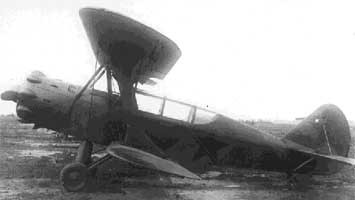
The new model known as LSh according to the initials of L ioxki Shtabnoi or Light for staffs (in the literature the name U-5 MG-31F is commonly used), was conceived as a three-seater liaison aircraft with a fully glazed closed cockpit. The pilot was located in front with the two passengers located on a board in the form of a longitudinal bench behind.
The weight of this empty version reached 800 kg with a takeoff weight of 1400 kg. Cruising speed was around 240 km/h with a top speed of 272 km/h. The range with reserves for 4.5 hours was about 1000 km.
The LSh was an excellent aircraft that was widely used in the period 1942-1945, making more than 600 flights on the Leningrad to Stalingrad fronts. During this period, it carried out operations in the midst of combat situations, receiving direct bullet hits, which caused it to have to be repaired several times, but the engine never stopped responding.
NV-5
Powerplant: One 140 hp Kossov MG-40
Wingspan: 9.82 m
Wing area: 25.0 sq.m
Length: 7.7m
Empty weight: 612 kg
Loaded weight: 850 kg
Wing loading: 34 kg/sq.m
Power load: 6.1 kg/hp
Fuel and oil capacity: 75+12 kg
Speed at sea level: 202 km/h
Landing speed: 60 km/h
Landing run: 110 m
Take-off run: 120 m
Endurance: 5.5h
Ceiling: 6000m
Time to 1000m: 3min
Time to 3000m: 12min
Accommodation: 2
NV-5bis
Powerplant: One 165 hp MG-11F
Wingspan: 9.82 m
Wing area: 25.0 sq.m
Length: 7.7m
Speed at sea level: 220 km/h
Landing speed: 60 km/h
Endurance: 4 hours
Time to 1000m: 3min
Time to 3000m:11min
Fuel and oil capacity: 75+12 kg
Accommodation: 2
U-5 prototype
Powerplant: One 100 hp M-11
Wingspan: 9.84 m
Wing area: 25.53 sq.m
Length: 7.62m
Empty weight: 700 kg
Speed at sea level: 170 km/h
Landing speed: 60 km/h
Fuel and oil capacity: 75+12 kg
Accommodation: 2
Pre-production U-5
Powerplant: One 120 hp M-11G
Wingspan: 9.84 m
Wing area: 25.53 sq.m
Length: 7.62m
Empty weight: 711 kg
Loaded weight: 974 kg
Wing loading: 37.8 kg/sq.m
Power load: 8.7 kg/hp
Fuel and oil capacity: 75+12 kg
Speed at sea level: 170 km/h
Maximum speed on the road: 181 km/h
Landing speed: 65 km/h
Landing run: 65 m (10 s)
Take-off run: 70 m (9 s)
Endurance: 3.0h
Ceiling: 3750m
Time to 1000 m: 5 min
Accommodation: 2
U-5bis
Powerplant: 180 hp MG-11F
Wingspan of upper plane: 9.84 m
Wingspan of lower plane: 9.24 m
Wing area: 25.53 sq.m
Length: 7.62m
Empty weight: 773 kg
Loaded weight: 1036 kg
Wing loading: 40.6 kg/sq.m
Power Load: 7.5kg/hp
Fuel and oil capacity: 75+12 kg
Speed at sea level: 205 km/h
Landing speed: 70 km/h
Landing run: 120 m (10 s)
Take-off run: 70 m (7 s)
Endurance: 2.5 hours
Ceiling: 4500m
Time to 1000 m: 3.8 min
Time to 3000 m: 18.4 min
Accommodation: 2
U-5 LSh
Powerplant: One 330 hp MG-31F
Wingspan: 9.84 m
Wing area: 25.53 sq.m
Length: 7.75m
Empty weight: 880 kg
Normal flight weight: 974 kg
Maximum takeoff weight: 1400 kg
Wing loading: 54.8 kg/sq.m
Power load: 4.25 kg/hp
Fuel and oil capacity: 250+30 kg
Maximum speed at sea level: 272 km/h
Cruising speed: 240 km/h
Landing speed: 75 km/h
Landing roll: 130m (11sec)
Takeoff Run: 40m (6sec)
Practical range: 1000 km
Practical ceiling: 4500 m
Crew: 1
Payload capacity: 2 passengers
 All Aero