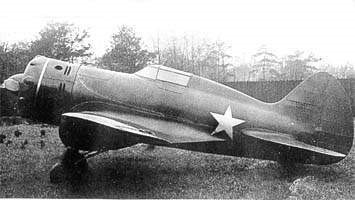
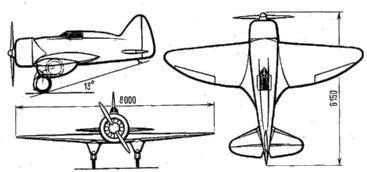
Among VV Nikitin’s designs, the NV-2 (Russian: Никитин НВ-2) single-seat training aircraft developed in 1935 as a low-wing single-seat monoplane, the NV-2 was a fairly advanced development of the 1933 NV-1 sport plane.
Structurally it was a single-seater with a low wing made of wood. Its monocoque fuselage was constructed of glued wood and covered with fabric. Like most of this manufacturer’s aircraft, the NV-2 was characterized by its excellent finish.
The wing, built in an integral way, had an area of 11 square meters and its construction was also made of wood covered with 2 mm plywood up to the last spar and covered with glued fabric.
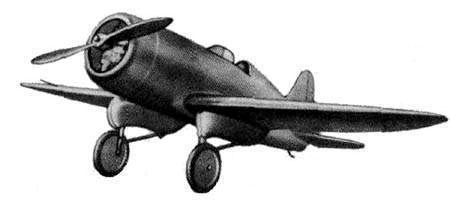
The NV-2 introduced retractable landing gear with the main landing gear retracting into the underwing pants. The tail skid was located in the lower rear area of the fuselage.
The power plant used was the 100 hp M-11 under a NACA cowl that allowed it to reach a speed of 230 km/h and an operating ceiling of 5800 meters.
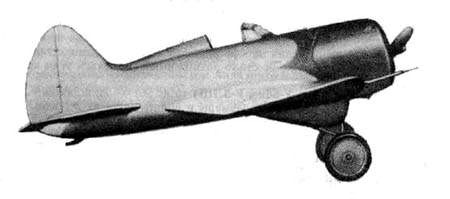
The prototype was manufactured mainly by students of the Moscow Aviation Technological Institute (OKB-30), based on resources provided by OSOVIAJIM and saw the light of day in 1935.
The flight characteristics were excellent and leading pilot instructors from Moscow flying clubs flew on the NV-2. Its operational life exceeded 150 flights.
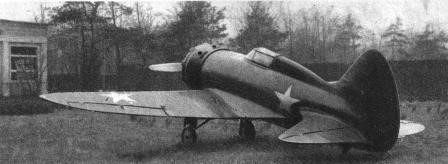
In 1938 the OKB-30 developed an improved version powered by the 165 hp MG-11. Named NV-2bis, this model successfully passed the state tests and the VVS became interested in the model, ordering the production of a small series under the name UTI-5.
The UTI-15 was designed in general similar to the NV-2 but presented structural reinforcement to introduce the more powerful MG-31 engine. The construction of the model was very clean, being even superior to the stock I-16 in this aspect.
The request for its construction came from the leadership of the VVS, but the prototype was flown in 1938 by pilots from the NII VVS, the GVF and the OSOVIAJIM. Overall, the UTI-5 was flown by more than 40 pilots. It was concluded that the aircraft was quite good and met the requirements for a training aircraft for fighter functions and on the other hand, the decision to install a ShKAS synchronized machine gun with 250 rounds on the model, facilitated the possibility of combat training.
The VVS requested a series of 20 copies. Construction started, but was cancelled when the Yakovlev UT-2 was ordered for production at the same factory.
NV-2
Powerplant: 1 x 100 hp M-11
Wingspan: 8.0m
Wing area: 11.0 m²
Length: 6.15m
Height: 2.14m
Tail span: 2.85 m
Empty weight: 385 kg
Loaded weight: 750 kg
Power load: 7.50 kg/hp
Fuel and oil capacity: 250+25 kg
Wing loading: 68.0 kg/m²
Speed at sea level: 230 km/h
Cruising speed: 205 km/h
Landing speed: 75 km/h
Practical range: 320 km
Endurance: 10 hr
Ceiling: 5800m
Accommodation: 1
NV-2bis
Powerplant: 165 hp MG-11
Wingspan: 8.0m
Wing area: 11.0m²
Length: 6.15m
Height: 2.14m
Empty weight: 435 kg
Loaded weight: 800 kg
Power load: 4.85 kg/hp
Fuel and oil capacity: 250+25 kg
Wing loading: 72.7 kg/m²
Speed at sea level: 260 km/h
Landing speed: 75 km/h
Endurance: 7h
Ceiling: 7000m
Accommodation: 1
UTI-5
Powerplant: One 300 hp MG-31
Wingspan: 8.0m
Wing area: 11.0 m²
Length: 6.3m
Height: 2.14m
Empty weight: 560 kg
Loaded weight: 950 kg
Power Load: 3.2kg/hp
Fuel and oil capacity: 250+30 kg
Wing loading: 86 kg/m²
Speed at sea level: 350 km/h
Landing speed: 75 km/h
Endurance: 4.5 hr
Ceiling: 8000m
Armament: One 7.62mm ShKAS machine gun / 250 rounds.
Accommodation: 1
 All Aero