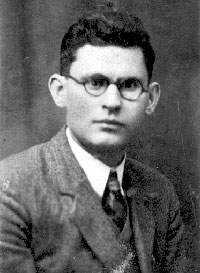
Yosif Grigorievich Nieman (Russian: Иосиф Григорьевич Неман) was born in 1903 in Bielostok, a Polish city in the Grodnienski Governorate into a Jewish family.
In August 1920, during the Civil War, he volunteered for the Red Army. He served as a politician in the department of the 4th Army and then in the political leadership of the Kharkiv Military Region and the Ukrainian Military Region. In 1922 he was demobilized and sent to study at the Kharkiv Technical Institute, which he finished in 1929.
He began his aeronautical career in the construction bureau of KA Kalinin in 1926, participating in the development of the Kalinin К-3, К-4 and К-5 models.
In 1930, he became head of the aeronautical construction chair at the Kharkov Aviation Institute, where he was able to develop his conception of creating airplanes with high aerodynamic characteristics. With the support of the director PP Krasilnikov he organized the aeronautical projection within the research scientific sector (NIS) of the center. The actual projection, proposed by Nieman as a method of preparing future specialists, was based on the work of brigades of NIS students and professors.
In 1930 YG Nieman was selected as JHA’s head of the aircraft construction chair despite not having the necessary scientific degree. He held this post until his arrest in December 1938. From 1944 he returned to occupy the position, this time until his death.
The first JAI project using the Nieman method was called JAI-1 and originated as a diploma paper from the institute.
In March 1933, after the serial production of the JAI-1 was approved, Nieman’s construction brigade received official status. Thereafter it was named the NIS JHA Project Group and received as its base two small rooms on the fourth floor of the aerodynamics corps of the old Technological Institute, near the wind tunnel. Nieman was named lead builder and engineer S. Ya as replacement. Zholkovsky.
As a productive base for the development of the experimental models, the Central Experimental Workshops of the JHA – TsOM JHA (in Russian: Ц ентральные о пытные м астерские (ЦОМ) ХАИ) directed by the engineer Galietko, were organized. Several specialists from KA Kalinin ‘s KB with extensive experience in aeronautical development entered the projection group.
In September 1934, the specialized magazine Samoliot described the JHA aeronautical construction group as a leader in the USSR “in the openness of aeronautical thinking, courage in solving problems and culture in the production of airplanes.”
In the course of the years 1932 – 1938 and under his direction, a whole family of high-speed aircraft (for the time) was developed at the JAI, which included civil transport, reconnaissance and bomber aircraft, designed to be developed as part of the practical activity by students and teachers of the institute, among which the models JAI-1, JAI-3, JAI-5, JAI-6, JAI-51 and JAI-52 (Ivanov) stood out.
On August 17, 1933, he was awarded the Order of the Red Star for the creation of the JAI-1 airliner.
Once the JHA-5 project was approved in January 1935, Nieman was appointed lead builder of an OKO-135 design bureau based at the Kharkov Aviation Factory.
The title of Professor was received in 1938 by virtue of his achievements in organizing the educational process.
Four years later, on December 11, 1938, Nieman was arrested and sentenced to 15 years of labor in a camp, charged with “organizing subversion in the factory and being an agent of foreign espionage.” The OKO-135 design bureau continued without leadership, working on improvements to the stock R-10 aircraft.
In May 1939 Nieman was posted to the Tupolev “Sharaga” in the NKVD TsKB -29, where he worked under Myasichev on the development of the Pe-2. A year later he was appointed head of the Tupolev Tu-2 construction brigade.
On July 19, 1941, by resolution of the Presidium of the Supreme Soviet of the USSR, Nieman was released and all charges against him were dropped.
After his release Nieman worked in the OKB at the Omsk Aviation Factory. From 1942 he became Myasichev ‘s replacement at Factory No.22 in Kazan.
He died of leukemia on November 18, 1952, his body being buried in Kharkiv City Cemetery 2.
In November 1952 he was preparing for the defense of his doctoral thesis, which did not take place due to his sudden death.
The Supreme Court of the USSR fully rehabilitated him on November 5, 1955, postmortem.
 All Aero