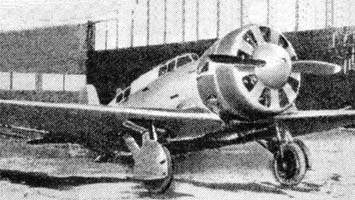
In parallel with the request for the development of a single-engine, scout aircraft, the collective led by Yosif Nieman received a request to develop a prototype aircraft: a high speed unarmed photographic reconnaissance aircraft and, named Nieman SFR (JAI-6) (Russian: Неман СФР (ХАИ-6) ) under the NIS JAI Projects Group. The main defense of this new type of aircraft would be its high speed. Officially the VVS designated the SFR model which corresponds to the acronym of Fast Photographic Reconnaissance Aircraft (in Russian: С коростной Ф отоР азведчик – СФР).
Delivery of the JAI-6 for testing was scheduled for September 1, 1934.
The concept project of the JAI-6 high-speed two-seat reconnaissance aircraft, with an air-cooled engine -58 (M-22U), was developed by the builder brigade S. Ya. Zholkovsky at the end of 1933. The general structure was similar to that of the JAI-1.
In January 1934 the project was handed over to the NII VVS for analysis, but it was quickly returned as the calculation data was considered extremely low and the M-58 engine was not available for production. On recommendations from SV Ilyushin, the project was modified to accommodate a 712 hp Wright Cyclone SGR-1820 F3 engine.
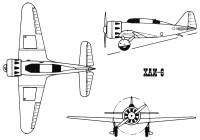
The JAI-6 was designed as an all-wood cantilever low-wing monoplane with an aerodynamically clean fuselage. The retractable type landing gear, manually retractable.
All rudders featured duralumin structure. The wings and stabilizer were made of plywood-clad wood, the aerodynamic brakes of aluminium.
Many elements in the plane were used by the builders for the first time. In order to obtain the highest possible speed, wing mechanization was increased, adding flaps, in addition to the ailerons. The wing was planned as an integral unit (consoles and centerplane in one whole). A curious feature was the use of wooden fuel tanks. During the Great Patriotic War this experience would be applied to the Yakovlev and Lavochkin fighter models with the aim of saving metal.
In the course of the development process of the JAI-6, the retractable landing gear had major problems. The retraction of the gear was done manually and the process was generally similar to that of the JAI-1, but in this case the construction of the gear was very complex. The development of this landing gear was the diploma work of 5th year JHA students PG Shishov and ID Kravchenko.
A methodology for calculating this type of complex landing gear had not yet been developed. All the calculations that were made did not show the necessary resistance and during the static tests in the JHA laboratory the undercarriage was destroyed because it could not support the fixing point. Nieman, after reviewing what happened, proposed a distribution of fixation points that should lead to a decrease in elastic deformation. Finally the wheels passed the physical resistance test, but no way was found to demonstrate the design mathematically. In the project submitted to the state commission these calculations were not included.
In the JAI-6 a photographic turret was located in the central region of the fuselage, behind the observer’s cabin. Hatches for the AFA-13 camera were located on the floor and on the sides. Through these hatches, photographs were taken at an angle of up to 80º and distances of up to 40 – 50 km to the sides. For the first time, a remote control system was also developed to rotate the camera and open the gates.
The military received the project with the new power plant in February 1934 and by May they approved a life-size wooden model, presented by the JAI. The calculations gave a speed of 450 km/h at 4,000 meters and 435 km/h at 2,000 m. The climb time to 5,000 meters was calculated at 8 minutes, the ceiling at 10,000 meters, and the range at 1,000 km. Those data were impressive for the time. The use of TsAP type aerodynamic brakes was foreseen in the wing.
Complications in development delayed the delivery date. The date was first moved from September 1 to November 1, 1934 and then to March 1, 1935, but for this date they were not yet ready.
In January 1935, the aircraft was delivered to production at the newly created TsOM JAI building (JAI Central Experimental Workshops, directed by Galietko. With the hope of being able to develop the static and resistance tests, the production of three copies was ordered in parallel. At the beginning of June 1935 the first prototype was ready and it was sent to the airfield of the Kharkiv Aviation Factory in Sokolniki for testing.
Everything was ready for the first flight when the aircraft mechanic SV Kieglievich received the information that the Wright Cyclone engine needed high octane gasoline. The JAI did not have it so they had to look for it in a military aviation unit. On June 15, test pilot BN Kudrin and designated test engineer Ye. I. Baru made the first flight.
The JAI-6 successfully passed the factory tests, reaching a speed of 429 km/h at an altitude of 2,500 meters, which can be considered a world record for this type of aircraft, although it was never registered.
Everything seemed to be going smoothly, but soon the problems began. The idea of an unarmed fast aircraft had its detractors within the VVS. During Nieman ‘s trip to the United States as part of a state commission, the VVS instruction was received to set up a defensive point in the observer’s cabin. From the NII VVS was sent, to the JAI, “Top Secret” blueprint of a new basket-shaped machine gun installation protruding from the fuselage. Builders were allowed to review plans only in a special department and under the supervision of security personnel. The calculations showed that the central fuselage of the JAI-6 was so narrow that it did not admit a normal machine gun installation, much less that enormous basket.
Soon the builders were informed of the early visit to the institute of the chief of armaments of the Red Army, Marshal MM Tukhachevki, with the aim of defining the fate of the JAI-6. On the morning of the day after the notification, Tukhachevsky arrived at the TsOM accompanied by the aircraft manufacturer AI Putilov, requesting to be shown the plane, the plans, the weapon installation model and the problems for its construction.
Next to the plane the marshal found the director of the JHA PP Krasilnikov, the chief builder LD Arson, the chief test engineer Ye. I. Baru and the head of the weapons brigade I. Dyachenko. About the installation of weapons on the JAI-6 personally stated the head of the project S. Ya. Zholkovsky. Putting a plywood sheet on the ground, Tukhachevsky took off his greatcoat and lay down under the aircraft. There he evaluated the different models and installation variants, reaching the conclusion that it was impossible to carry out any installation without affecting the speed advantages of the aircraft. Tukhachevsky got up, confirmed the builders’ proposals, congratulated them on his work, and left.
The change in military requirements crucified the future of the JAI-6. A few months after Tukhachevsky ‘s visit, the institute was visited by the head of the GUAP aviation department, SV Ilyushin, and reported that the VVS leadership refused to obtain an unarmed scout plane and that the purpose of his visit was to be able to confirm this decision.
At the beginning of November 1935, the JAI-6 prototype was delivered to the NII VVS, where tests were carried out, including the use of a ski undercariage. The test program was led by PM Stefanovski. With this, the issue of the JAI-6 was closed and its builders began to dedicate themselves entirely to the development of the JAI-5.
JHA-6
Engine: 1 x 712 hp Wright Cyclone SGR-1820 F3
Wingspan: 9.20
Wing area: 14.00 m²
Length: 7.3m
Empty weight: 1020 kg
Maximum takeoff weight: 1730 kg
Maximum speed: km/h 429
Practical range: km 980
Service ceiling: 9800 m
Accommodation: 2
 All Aero