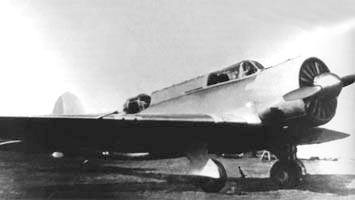
The idea of converting the Nieman R-10 into an attack aircraft led to the development by the Nieman collective of a new model airplane with the M-62 powerplant. The attack aircraft development process was divided into two stages. First, an experimental specimen called JAI-51 was developed in which the new systems and construction elements would be developed and tested. This copy was also to be used to polish all flight problems. The second stage would be called the Nieman JAI-52 (Russian: Неман ХАИ-52) and would be the final product, intended to serve as the basis for series production as a follow-up to the Nieman R-10.
Nieman assigned his best specialists to the attack aircraft project. The project was led by main builder LD Arson until his departure to prepare for production of the Nieman R-10 at the Saratov factory in January 1938, and he was succeeded by IP Zhiganov. At the beginning of 1937, of the 60 specialists in construction and calculations of the OKO-137, 37 were working on the new project and by November of that year practically all of them had joined.
Still without finishing the project, in August 1937, the construction of three copies began in the TsOM workshops, one JAI-51 and two JAI-52. The last plans for the JAI-51 were delivered to the factory in December 1937. The second example of the JAI-52 (known as JAI-521) was built with a new pine plywood, instead of birch.
The delivery of the JAI-52 to the tests could have allowed Nieman victory, but in December 1938 he was arrested.
The new general builder of the OKO-135, AA Dubrovin, did his best to continue modernization work on the Nieman R-10, with an emphasis on the JAI-52. Not having time to prepare the plans for the JAI-52, it was decided to build it using the plans for the JAI-51 with the direct introduction of the modifications.
At this time, on March 20, 1938, the VVS released new technical specifications for the JAI-52 in which a new top speed of 450 – 470 km/h was set instead of the original 390 – 400 km/h. This required significant modifications to the project, which resulted in new delays in the delivery of the model to the tests.
The JAI-52 attack aircraft were designed to use the 930 hp M-63 engine with a BISh-28 propeller. Maintaining the structure of the JAI-51, a duplicate flight control system was installed in the gunner’s cabin and the armament was reinforced. In addition to the four ShKAS machine guns on the wings, two new synchronized ShKAS were installed. Under the wings were installed mounts Der-31.
In this configuration and without having passed the tests yet, in January 1939 by decision of the NKAP, series production of the model was launched at Factory No.135. The Kharkov factory “Hammer and Sickle” also participated in the production of the first series of 10 copies, where wooden parts and components were prepared. The delivery of the first series copies was planned between August and September 1939. Preparation of the JAI-52 prototype was completed on March 15, 1939 (the commitment date had been December 1938). The M-63 engine was still not ready, so an M-62 with a BISh-26 propeller was installed.

On April 6, 1939 at 8:30 am, the factory test pilot, Colonel Darski, raised the JAI-52 on its first flight, which lasted 30 minutes. The behavior of the aircraft in the air was excellent, which allowed it to carry out a second, longer flight in the second part of the day. Engineer Semionov, the NKAP representative at the tests wrote:
“Despite a large number of construction defects, this M-63-powered aircraft is truly modern and if a turbocharger is installed, the VVS will be able to have in service by 1940 a machine superior to that of our potential enemies.”
In spite of this, the direction of the Commissariat received an unexpected letter at the end of April where it was established to take the plane of the Nieman saboteur out of production and to begin production of the Sukhoi BB-1 model, which on April 6, 1939 had successfully completed the state tests. The M-87 engine fitted to the Sukhoi BB-1 did not fail the builders and the aircraft performed better than the JAI-52.
AA Dubrovin refused to continue the development of the JAI-52 and went to Moscow. The continuation of work on the JHA-52 was carried out by IP Zhiganov. The OKO-135 collective still had hopes of saving the JAI-52 and proving that it was superior to Sukhoi’s aircraft.
In May 1939, the JAI-52, during factory tests and with a weight of 3,220 kg, showed a maximum speed at sea level of 374 km/h and at 4,500 meters of 410 km/h. Ascent time to 5,000 meters was 16 minutes. These results allowed the model to be accepted for state tests, so the plane was prepared for its trip to Moscow.
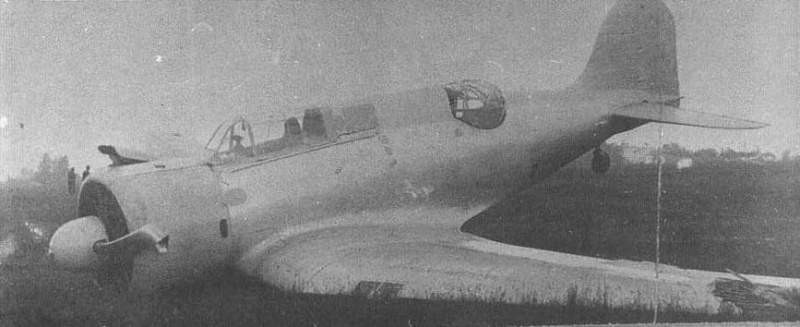
On May 18, the JAI-52, flown by Major Indyushkin, during a familiarization flight with the plane, lost speed at a very low altitude, dived over the wing and fell to the ground. The damaged plane was returned to the TsOM where, together with the repairs, they introduced new modifications. First of all, a freshly received M-63 engine from the Perm factory and a BISh-28 propeller were installed, which resulted in the redesign of a new cowl and propeller hub. To improve stability, the wingspan and wing area were increased.
In these modifications, two months of precious time were gone. Only on August 5, 1939, joint factory and state tests of the JAI-52 attack aircraft began. These tests were executed by the NII VVS test pilot AK Dolgov.
As a result, it was found that the new model was superior to the Nieman R-10 in terms of stability and had better visibility from the cockpit. As a negative point, the displacement of the center of weight forwards was highlighted. Airborne tests showed that not all of the problems had been fixed. With a takeoff weight of 3,376 kg, a speed at ground level of 356 km/h and at 4,500 meters of 410 km/h was reached.
The M-63 engine presented problems so that only 5 test flights could be carried out. The tests were interrupted and with this the history of the developments of the Nieman R-10 ended.
JHA-52
Powerplant: 1 x 930 hp M-63
Propeller: BISh-28
Wingspan: 9.60 m
Wing area: 25.60 m²
Length: 12,208 m
Height: 3.80m
Takeoff weight: 3376 kg
Maximum speed sea level: 356 km/h
Maximum speed 4500m: 470 km/h
Armament: six 7.62 mm ShKAS machine guns with 500 shots each (4 in the wings and another two synchronous in the fuselage). A 600 round ShKAS 7.62mm machine gun in an MV-5 turret. 400 kg of bombs.
 All Aero