
In the summer of 1960, Neil Armstrong and Milt Thompson had heard a talk by NASA’s Langley Research Center aeronautical engineer Frank M. Rogallo. Rogallo explained the advantage of using a controllable parachute for the recovery of space vehicles.
Armstrong and Thompson asked director Paul Bikle for permission to build a simple research vehicle to test Rogallo’s concept. When Bikle refused citing commitments to the X-15 and other NASA programs, Armstrong and Thompson continued working on the design in their free time. Eventually, they arrived at a Parasev design that had a little platform slung beneath it.
Flying a Cessna L-19 on 28 June 1962, Armstrong took off with the Parasev in tow over Rogers Dry Lake and turned so sharply at the edge of the lake that the towline went slack, causing Thompson to crash land on one of the really small dry lakes east of Rogers. Armstrong was not even aware there was a problem until Bruce Peerson came into the pilots’ room and asked ‘Where’s Milt?”. From a DC-3 they saw him sitting down, shaking his fist at them. Thompson admitted “we encountered numerous problems developing a good airworthy vehicle.”
By this time, Bikle had authorised their Parasev work. Construction of the Parasev moved to Dryden’s shops, where simple light-aircraft fabrication techniques led to a functional prototype in a matter of weeks.
The first free flight was made by Thompson on 12 March 1962. Armstrong flew the vehicle on 24 September 1962. He went on to fly the Parasev on the 24th, 25th and 26th of September. They were short flights, but twenty flights.
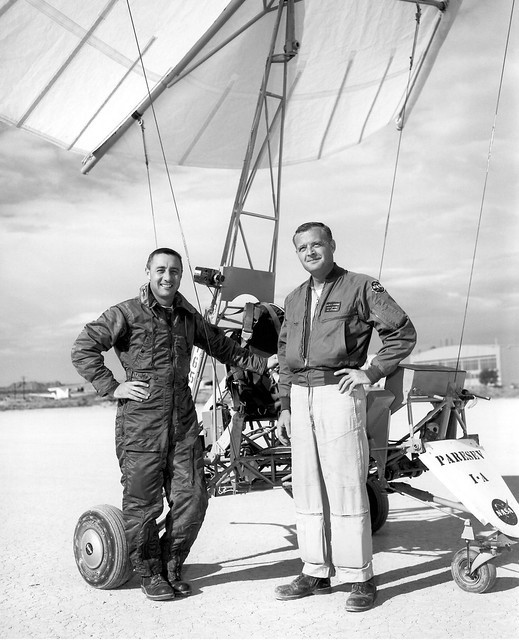
Between 1961 and 1965 the ability of the Rogallo wing (also called “Parawing”) to descend a payload such as the Gemini space capsule safely from high altitude to ground was studied. The Paresev (Paraglider Research Vehicle) was an experimental NASA glider aircraft based upon the kite-parachute studies by NASA engineer Francis Rogallo. The Paresev was a test vehicle used to learn how to control this parachute-wing for a safe landing at a normal airfield.
NASA experimented with the flexible Rogallo wing, which they renamed the Parawing, in order to evaluate it as a recovery system for the Gemini space capsules and recovery of used Saturn rocket stages. Data developed by NASA in the late 1950s fed both the Charles Richards team and a different Ryan Aeronautical team that produced the Fleep. The Paresev used a cantilevered cross-beam but did not use a kingpost. Under a directive by Paul Bikle, NASA engineer Charles Richards in 1961–1962 designed the collapsible four-tube Rogallo wing used in the Paresev. The Paresev series included wing configurations that were tightly foldable from the nose plate for easy transport, using initially a cloth sail and later one of Dacron.
The Paresev was controlled by moving the tensionally hung pilot’s and fuselage’s mass relative to the position of the wing. This mass-shifting was effected by tilting the wing from side to side and fore and aft by using a control stick in front of the pilot that descended from the wing above. Another version translated the same weight-shift control via cables. As the Paresev was towed in a kite mode, it usually rose from the ground at about 46 mph (74 km/h) and had a maximum air speed of about 65 mph (105 km/h).
Neil Armstrong acknowledges that controlling the glider was extremely tricky; “the acceptable centre of gravity box was pretty small, and the control forces could be surprisingly big. Its speed range was very narrow, and its L/D was substantially less than a pilot would like. Yet for a first effort, the paraglider was surprisingly successful.”
The Paresev control pendulum weight-shift control system was presaged by a published patent, an early use of the hung pilot behind a cable-stayed triangle control bar in 1908 in the territory of Breslau, and then also by the “control wing” of George Spratt in the 1920s.
The Paresev 1A and 1B were unpowered; the “fuselage” was an open framework fabricated of welded SAE 4130 steel tubing, called a “space frame”. The keel and leading edges of the wing were constructed of 2.5-inch-diameter (64 mm) aluminium tubing. The leading edge sweepback angle was held at 50 degrees by a rigid spreader bar. Additional wing structure fabricated from steel tubing ensured structural integrity.

The basic vehicle was slightly more than 11 ft (3.4 m) high from the top of the paraglider’s wing to the ground, while the length of the center keel was 15 ft (4.6 m). Total weight was about 600 lb (270 kg) On August 24, 1962, seven weeks after the project was initiated, the team rolled out the Paresev 1.

The Paresev 1, first flight on January 25, 1962, crashed on March 14, 1962. The frame was fitted with a linen membrane wing and the control stick coming from overhead in front of the pilot’s seat.
The Paresev 1A used a rebuilt frame from the Paresev 1, but had a control stick and a Dacron membrane wing. First flown on May 18, 1962, the last flight was on June 28, 1962.
The Paresev 1B first flew on July 27, 1962 and the last flight was on Feb 20, 1963.
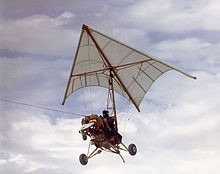
The Paresev 1C had a modified frame with a half-scale version of an inflatable parawing. The first flight was on March 4, 1963 and last flight on April 14, 1964.
Towed aloft by a helicopter, the 1C was meant to inflate at 35,000 ft.

With North American test pilot E.R.Hetzel at the controls of a simulated Gemini capsule the Paresev made its first manned flight in 1965. Towed to 2600 ft by helicopter for check of the glider’s control system, Hetzel made turns during the 20.5 minute flight, landing at Edwards Air Force Base. The next test was scheduled from 12,000 ft.
The Paresev vehicle was flown 341 times during a research program that ran from 1962 until 1964. Thompson made numerous ground-tow flights and claimed about 60 air-tow flights. Peterson claimed 228 flights (ground and air tows). Grissom made two flights. Champine made four flights. Kleuver made at least eight flights. It is unknown how many times Armstrong, Hetzel, and Slayton flew.

Publicity on the Paresev and the Ryan XV-8 “Flying Jeep” aircraft inspired hobbyists to adapt Rogallo’s flexible wing airfoil onto elementary hang gliders leading to the most successful hang glider configuration in history.
Using the fully flexible parawing or the tube-stiffened paraglider of the Paresev 1A, 1B, 1C as an alternate to spacecraft recovery was deemed too unreliable upon unfolding so round parachutes for water landings were used instead. The Paresev and other flexible-wing projects such as the Ryan XV-8 stopped being funded by NASA on 1965.
The Paresev was transferred to the Smithsonian National Air and Space Museum located in Washington, D.C. for display.

Built and rebuilt several times, the Parasev eventually made more than 100 flights at Edwards. Among the pilots who flew it were astronaut Gus Grissom, who, during a flight at Edwards on 17 October 1962, broke its nose gear on landing. The parawing might have proven feasible for capsule re-entry but time was not available. In 1964, with both the Gemini and Apollo programs committed to water landings, NASA cancelled all of its paraglider work.
Test pilots
Milton Orville Thompson, NASA FRC
Robert Apgar Champine, NASA LRC
Neil A. Armstrong, NASA FRC
Bruce A. Peterson, NASA FRC
Charles Hetzel, North American Aviation
Maj. Emil “Jack” Kluever, U.S. Army
Donald K. “Deke” Slayton, NASA MSC
Virgil I. “Gus” Grissom, NASA MSC
Tow aircraft
Piper PA-18 Super Cub (N-68P)
Cessna O-1 Bird Dog (50-1675)
Stearman (N69056)
Boeing HC-1A helicopter (58-5515)
Crew: One pilot
Length: 15 ft 0 in (4.57 m)
Height: 11 ft 0 in (3.35 m)
Wing area: 179 ft2 (16.6 m2)
Gross weight: 600 lb (270 kg)
Maximum speed: 65 mph (100 km/h)
 All Aero