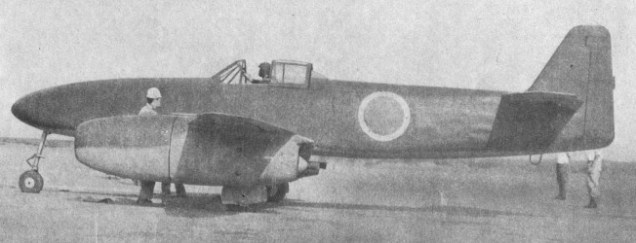
Japan’s interest in jets increased in September 1944, when the Japanese air Attache in Berlin sent a large number of detailed reports on the German Me262 program. The Japanese naval staff instructed Nakajima to develop a single seat attack bomber based on the Me 262, capable of a speed of 690 km/h (430 mph) and able to carry a small bombload.
Design started in Septem¬ber 1944 under the direction of Kazuo Ohno and Kenichi Matsumur, and the resulting aircraft resembled the Ger¬man design although somewhat smal¬ler owing to the very low power avail¬able from the early Japanese jet en¬gines. The Kikka first design studies envisaged the use of 440 lb. thrust TSU-11 units which were based on the Campini principles and employed the Hitachi Hatsukaze (Fresh wind) piston engine to drive a ducted fan compressor. However, at an early design stage the Tsu-11 was dropped in favour of the Ne-10 (TR-10) centrifugal-flow turbojet, and the 340 kg (750¬lb) thrust NE-12 (TR-12), which added a four-stage axial compressor to the front of the Ne-10. The first mock-up of the Kikka was inspected by Naval Officials on January 28, 1945, but estimated performance with the NE-12 turbo jet was uninspiring, and it was decided to make a further power plant change, supplanting the NE-12 with two 475 kg (1,047 1b) thrust powerful NE-20.
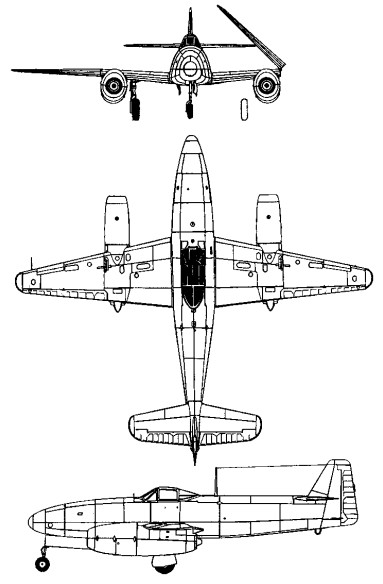
The Kikke was a single-seat twin-jet attack bomber, of all-metal construction with fabric-covered tail surfaces.
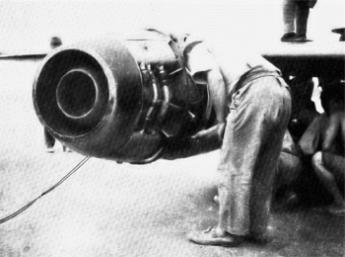
These also proved inadequate and for the first flight Ne 20 axial flow turbojets were fitted; however, it was still necessary to employ an auxiliary rocket for assisted take off.
The prototype commenced ground tests at the Nakajima factory on 20th may 1945, and on 25th June the first Kikka was completed. The following month it was dismantled and delivered to Kisarazu Naval Air base where it was re-assembled and prepared for flight testing. Ground tests continued on this airfield until 13th July.

On the 7th August 1945, Lieutenant Commander Susumu Takaoka made the first flight, with a duration of 11 minutes at Kisarazu Naval Air Base. His take-off run of 2,380 ft. took 25 seconds at an all-up weight of 6,945 lb. Wind speed was 23 ft.per second. He landed in 3,280 ft.
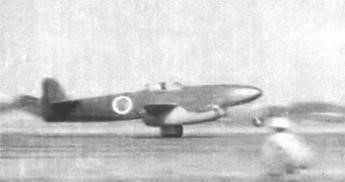
A ceremonial official “initial” test flight was made on 11th August, four days later. For this flight, rocket assisted take off (RATO) units were fitted to the aircraft. Because their alignment had been miscalculated, the acceleration was so heavy that the nose of the aircraft came up, the tail went down and skidded along the runway. Tanaoka abandoned the take off and the aircraft was damaged when it ran off the end of the runway. Before it could be repaired Japan had surrendered and the war was over.
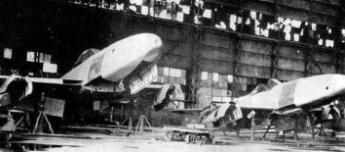
A second prototype was then nearing completion and manufacture of between 18 and 25 further aircraft had started.
Some of these were two-seat trainers. On 15 August, the entire programme was abandoned. Production, which included versions for training, reconnaissance and air combat, had also been planned.
Kikka (1st prototype)
Powerplant: two Ishikawajima Ne 20 axial flow turbojets, 475 kg (1,047 1b) thrust
Wing span 10.00 m (32 ft 10 in)
Length 8.125 m (26 ft 8 in)
Height 2.95 m (9 ft 8 in)
Wing area 13.2 sq.m (142.08 sq.ft)
Empty weight 2300 kg (5,071 lb)
Maximum take off weight 4080 kg (8,995 lb)
Wing loading: 54.3 lb./sq. ft.
Power loading: 3.7 lb./lb. s. t.
Max speed sea level (est): 387mph
Max speed 697 km/h (433 mph) at 10000 m (32,810 ft)
Climb to 10000 m (32,810 ft) in 26 min
Service ceiling 12000 m (39,370 ft)
Range 940 km (586 miles)
Armament: one 800 kg (1,764 lb) bomb
Crew: 1
 All Aero