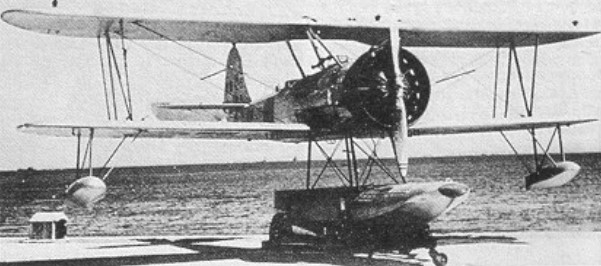
Nakajima’s first attempt to satisfy the Navy requirement was the E4N1 biplane. This aircraft had a welded chromium molybdenum steel tube structure with fabric covering at the rear and aluminium sheet covering at the front. It was a standard biplane, with fabric covered wings with a wooden structure. The E4N1 was a twin float aircraft, but the two floats were very similar to the Vought design. Bombs were carried on the underside of the fuselage. It was powered by a 420-520hp Nakajima Jupiter VI radial engine, and reached 130mph.
The first prototype Type 90-2 Reconnaissance Seaplane, or E4N1, equal-span biplane reconnaissance aircraft first flew in 1930, company designation NZ. Intended for navy service as the Nakajima E4N1, it had twin floats and an uncowled Kotobuki radial engine.
Two prototypes of the E4N1 were built. They were given the official designation Navy Type 90-2-1 Reconnaissance Seaplane – Aichi had already had a reconnaissance seaplane accepted in 1930, and that became the Type 90-1. The E4N1 was tested by the Japanese Navy early in 1931, but the design was rejected because it wasn’t very manoeuvrable.
A stronger version was produced and in December 1941 was accepted as the Type 90-2-2 Reconnaissance Seaplane, E4N2. It could also be used with wheels, when it became the Type 90-2-3 E4N3.
The NJ or Navy Type 90-2-2 or E4N2, Reconnaissance Floatplane was a complete redesign, with a single main float and twin wingtip stabilising floats and introduced a cowled engine. It closely resembles the US Vought O3U-1 Corsair biplane and, like it, was intended for shipboard use and catapult launching. This time the fuselage structure was a mix of wood and metal. Once again the forward fuselage was metal covered but the rest of the fuselage and the wings were fabric covered. The wings had a wooden structure and were rearward folding.
The E4N2 was much more manoeuvrable than the E4N1. The first prototype was tested late in 1930, suggesting that it was already under development before the E4N1 had been rejected.
Powered by a 336kW Nakajima Kotobuki radial engine, the Type 90-2-2 had a maximum speed of 222km/h and 85 went into service with the Japanese navy as the E4N2 between 1931 and 1933, a version with fixed wheel landing gear going into service as the E4N2-C; 67 of the latter were completed.
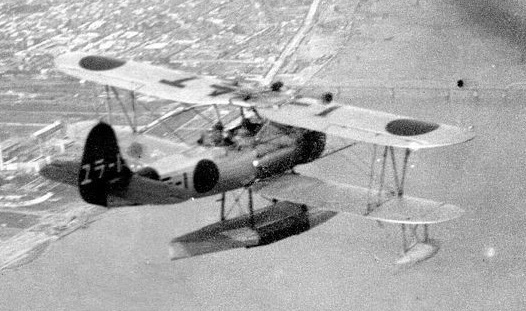
Nakajima produced eighty E4N2s between 1931 and 1936 and Kawanishi produced another 67 aircraft between 1932 and 1934.
Nakajima also produced five of the E4N2-C carrier variant. This had wheels and carrier arrestor gear. They underwent service trials but weren’t accepted.
In total 153 were built.
In 1933 nine of the E4N2-C landplanes were converted as night mail carriers designated P-1 Mail, for use between the main islands of Japan. A single-seater with the pilot accommodated in an enclosed cockpit.
The E4N2 was the Japanese Navy’s main ship-borne reconnaissance aircraft from 1932 until it was replaced by the Nakajima Type 95 Reconnaissance Seaplane (E8N) in the mid 1930s. It was used on battleships and cruisers and was a popular aircraft with a good combination of manoeuvrability and strength. It saw combat during the Shanghai Incident
In January 1933 Nakajima won a contract for eight mailplanes from Nihon Koku Yuso to fly a new night mail service. Their design, the Nakajima P-1, was based on that of the Nakajima E4N3 (Navy Type 90-2-3), a reconnaissance seaplane. The P-1 was a single seat, landplane biplane of mixed wood and metal structure with fabric covering.
It had two spar, single bay wings with N-form interplane struts between the spars aided by wire-bracing. The central upper wing was joined to the fuselage with outward-leaning cabane struts, inverted Vs to the forward spar and single struts to the rear. The lower wing, slightly shorter in span, was joined directly to the lowest fuselage longerons.
The P-1 was powered by a nose-mounted 420–450 hp (310–340 kW) Nakajima Jupiter VI nine cylinder radial engine though some were later re-engined with the 585 hp (436 kW) Nakajima Kotobuki 2-kai-1, a related nine cylinder radial which had powered the Nakajima E4N3. Both had narrow-chord Townend cowlings. Its cockpit, initially open but enclosed on later aircraft with glazing running aft into a turtle back fairing, placed the pilot well behind the wings. Night flight safety was increased by two landing lights under mid-span and parachute flares. It also had a radio receiver and a radio beacon.
The fuselage was circular immediately behind the large radial engine but became more flat-sided rearwards. The tail was conventional with the tailplane mounted on top of the fuselage carrying elevators with rounded tips and cut-outs for rudder movement. The vertical tail was also rounded, with a full rudder that reached down to the keel.
The P-1 had fixed landing gear with wheels on divided axles, their centres hinged on a short, under-fuselage V-strut pylon. Splayed landing struts and rearward drag struts were mounted on the lower fuselage longerons. The wheels were largely enclosed under narrow helmet fairings.
The first of Nihon Koku Yuso’s eight aircraft was completed in May 1933. The standard night mail route connected Tokyo, Osaka and Fukuoka and began operations in August 1933. Though this service was successful in the sense of increasing mail volume it showed that these night flights were stressful for a single pilot in a single-engined aircraft, especially in bad weather. As a result, the P-1s were gradually retired over two pioneering years, replaced by larger, twin-engined aircraft with a larger crew.
A ninth, specially built, P-1 was used by the Ministry of Communications.
E4N1 / Navy Type 90-2-1 / NZ
two prototypes
twin-float seaplane
Engine: Nakajima Jupiter VI, 420-520hp
Speed: 130mph
E4N2 / Type 90-2-2 / NJ
Engine: 1 x Nakajima “Kotobuki”, 433 kW (580 hp)
Wingspan: 10.98 m (36 ft 0 in)
Wing area: 29.7 m² (319 ft²)
Length: 8.87 m (29 ft 1¼ in)
Height: 3.97 m (13 ft 0 in)
Empty weight: 1,252 kg (2,760 lb)
Loaded weight: 1,800 kg (3,968 lb)
Max speed: 222 km/h / 138 mph
Cruise speed: 148 km/h (80 kn, 92 mph)
Range: 1,019 km (550 nmi, 633 mi)
Climb Rate: 10 min 34 sec to 9,843ft
Service ceiling: 5,740 m (18,830 ft)
Crew: 2
Armament: 1 × fixed 7.7 mm machine gun & 1 × flexible 7.7 mm machine gun
Bombload: 2 × 30 kg (66 lb) bombs
single-float seaplane
85 built
E4N2-C / Navy Type 90-2-3 / NJ
landplane
arresting gear and fixed-undercarriage
67 built
E4N3 / Navy Type 90-2-3 / NJ
Reconnaissance Seaplane
P-1 Mail
9 converted from E4N2-C airframes
Powerplant: 1 × Nakajima Jupiter VI
Propeller: Hamilton Standard fixed pitch metal
Wingspan: 10.97 m (36 ft 0 in)
Wing area: 32.57 m2 (350.6 sq ft)
Airfoil: N-22 upper wing, Clark Y lower
Length: 7.66 m (25 ft 2 in)
Height: 3.70 m (12 ft 2 in)
Empty weight: 1,225 kg (2,701 lb)
Gross weight: 1,992 kg (4,392 lb)
Maximum speed: 243 km/h (151 mph, 131 kn)
Cruise speed: 194 km/h (121 mph, 105 kn)
Range: 1,000 km (620 mi, 540 nmi)
Time to 3,000 m (9,800 ft): 9 m 27 s
Crew: one
Giyu-11
One of the two E4N1 seaplanes converted with a cabin for use by Tokyo Koku Yuso Kaisha between Haneda airport, Shimizu and Shimoda.
 All Aero