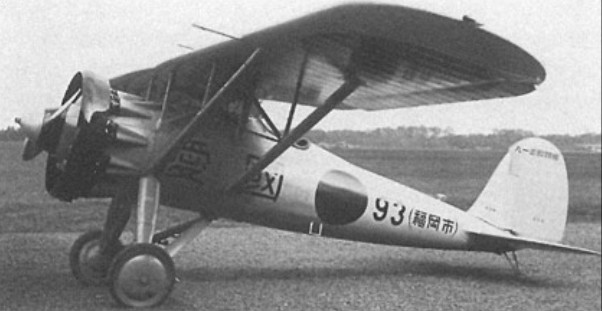
A Japanese army requirement of March 1927 for a new single-seat fighter successor for the Ko-4 (Nieuport-Delage NiD 29) was contested by Nakajima, Kawasaki and Mitsubishi. All the designs were parasol-wing monoplanes developed in Japan by teams wholly or partly led by Europeans, in the case of Nakajima the French engineers Mary and Robin from Dewoitine leading designers Shigejiro Owada and Tei Koyama. Structural failure of the Mitsubishi prototype led to severe testing of the survivors, which were then also eliminated.
The Nakajima: prototype, company designation NC, had a slim tapering monocoque fuselage, an uncowled Jupiter VI nine-cylinder radial engine, and elaborate strut bracing connecting wings, fuselage and the wide-track landing gear. Two prototypes were completed in May and June 1928 respectively, but structural testing led to rejection by the Army. The contest was, in the event, cancelled but Nakajima persevered with the design as a company-funded venture and built six more prototypes armed with two 7,7-mm machine guns be¬tween 1929 and 1931.
The final two of these prototypes were, in fact, of an essentially new design, retaining no more than the rear fuselage of the preceding prototypes. These were to serve as a basis for the series Type 91 fighter. The last of the series being tested extensively by the Japanese army and accepted for production as the Army Type 91 Fighter Model 1.
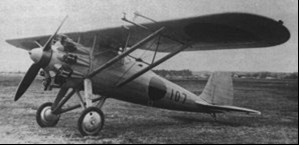
Retaining the company appellation NC, the sixth prototype so designated was of fundamentally different design and powered by a supercharged 520 hp Bristol Jupiter VII radial. New wings of smaller area incorporated an internal (jettisonable) fuel tank to port replacing the podded tank of preceding prototypes. The engine was enclosed by a Townend ring, the diameter of the forward fuselage was increased, both fore and aft main bracing struts were attached to the fuselage, the tail surfaces were redesigned, the cross-axle gave place to one of split type and the guns were repositioned.
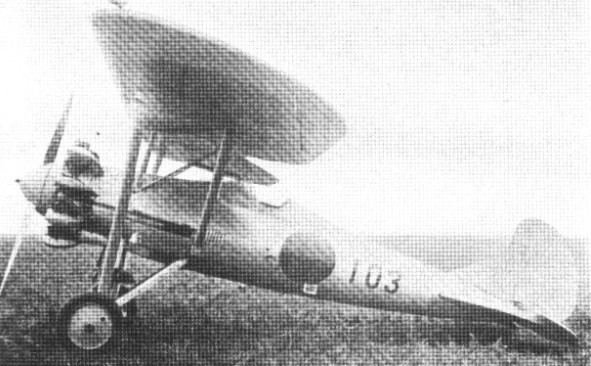
This was ordered into production by the Army as the Type 91, deliveries commencing late 1931, but service introduction being delayed by C of G and directional stability problems. A total of 320 fighters of this type was built by the parent company (and approximately 100 more by Tachikawa), the initial version subsequently becoming the Type 91-1 with the appearance of a version powered by a Jupiter derivative, the Nakajima Kotobuki 2 of 580 hp. A prototype of this variant, the Type 91-2, was completed in July 1934, this being followed by 22 series aircraft, production terminating in September 1934 with the 450th aircraft.
Introduced from 1932 onwards, the Type 91s were deployed in action with the four squadrons of the 11th Air Battalion operating with the army Kanto Command in Manchuria against the Chinese. In. 1933 the Type 91 was the principal army fighter and constituted the standard equipment for the newly formed air wings (or Hiko Rentai). The Type 91 remained in service until succeeded by the Kawasaki Type 95 in 1936-37.
A Type 91 was converted for carrier operations and with spatted wheel fairings was submitted for the navy 7-Shi experimental fighter competition, but was rejected. The only other modification from standard army configuration was the use of a three-bladed propeller.
One experimental example was fitted with a Kotobuki 5 engine.
Type 91-1
Engine: Bristol Jupiter VII, 520 hp.
Max speed: 186 mph (300 km/h).
Endurance: 2 hrs.
Time to 9,845ft (3000m): 40 min.
Empty weight: 2,370 lb (1 075 kg).
Loaded weight: 3,373 lb (1 530 kg).
Span: 36 ft 1 in (11.00 m).
Length: 23 ft 9.75 in (7.26 m).
Height: 9 ft 1.8 in (2,79 m).
Wing area: 215.28 sq ft (20,00 sq.m).
Type 91-2
Engine: Nakajima Kotobuki 2, 580 hp / 433kW
Wingspan: 11 m / 36 ft 1 in
Length: 7.3 m / 23 ft 11 in
Height: 3 m / 9 ft 10 in
Wing area: 20 sq.m / 215.28 sq ft
Max take-off weight: 1500 kg / 3307 lb
Empty weight: 1075 kg / 2370 lb
Max. speed: 300 km/h / 186 mph
Ceiling: 9000 m / 29550 ft
Range: 500 km / 311 miles
Armament: 2 x 7.7mm machine-guns
Crew: 1
 All Aero