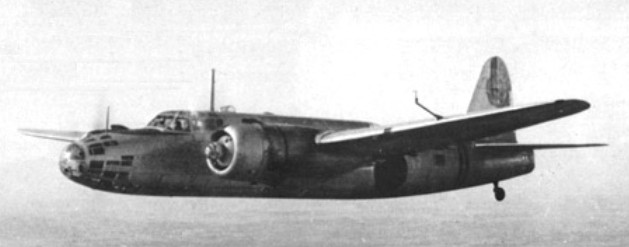
Even as the Mitsubishi Ki 21 was entering service, the Nakajima company was issued with the Ki 49 specification early in 1938 calling for an aircraft to replace the Ki-21, capable of reaching 500 km/h (311 mph) with a range of 3000 km (1860 miles) and a bombload of 1000 kg (2200 lb). Defensive armament was to include a free 20mm (0.79 in) cannon on a dorsal mounting and a tail gun turret the latter for the first time on a Japanese landplane. It was also laid down that adequate protection for the crew members and the fuel load was to be provided.
Nakajima set to work in mid 1938 with a top level design team led by Yasumi Koyama. A mid-wing layout was selected, with a considerable dihedral on the low aspect ratio wing. The wide chord centre section accommodated six fuel tanks, three on each side of the fuselage. Good takeoff and climb were guaranteed by large Fowler type flaps. A 20 mm (0.79 in) Ho 1 cannon was mounted in the dorsal position, while single 7.7 mm (0.303 in) Type 89 guns were fitted in the nose, ventral and port and starboard beam positions and in the powered tail turret.
The first prototype flew in August 1939. Its two 708kW / 1080 hp Nakajima Ha 5 Kai 14 cylinder radial engines were replaced by Nakajima Ha 41s of 932kW / 1250 hp each on the remaining two prototypes and seven evaluation aircraft delivered late in 1939. Constant speed three-bladed propellers were introduced in place of the original Hamilton Standard two pitch propellers.
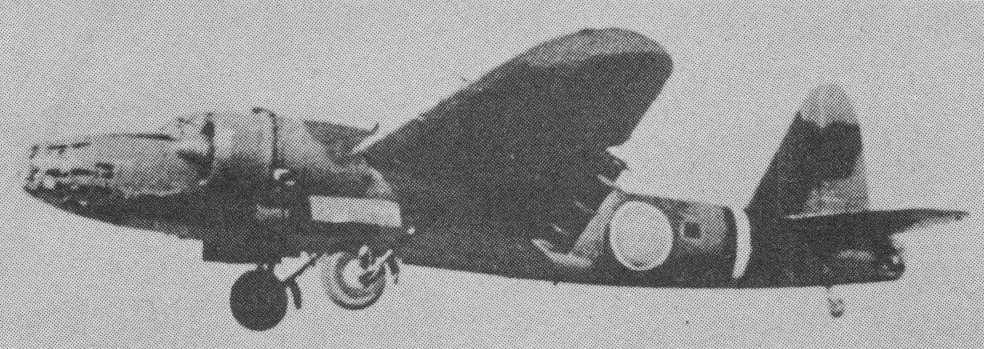
The Ki 49 was accepted for service as the Army Type 100 Heavy Bomber in March the following year and made its operational debut in February 1942. Later code-named ‘Helen’ when the initial production Ki-49-I (Army Type 100 Heavy Bomber Model 1) started operations with the 61st Hikosentai in China (powered with Ha-41 radial engines).
The army, fearing heavy losses in unescorted daylight raids, tested three modified Ki 49s, intended as escort fighters. Designated Ki 58, they were fitted with improved armament and crew protection but with the bomb bays deleted. Progress was disappointing and then the Ki 43 fighter, possessing sufficient range for escort work, became available in quantity and the Ki 58 programme was abandoned. Two Ki 49 variants, designated Ki 80, were intended as prototype formation leader aircraft, but this idea was also abandoned, and these aircraft were then used to test the powerful new 2420 hp Nakajima Ha 117 radial engines.
Known in Japan as Donryu (Storm Dragon), Ki 49 Is went first to equip the 61st Sentai operating in China. During the Pacific war Ki-49s, coded Helen by the Allies, flew frequent raids over New Britain and New Guinea, also making a large proportion of the attacks on Port Darwin and Australia’s Northern Territory.
Two preproduction Ki 49 IIs appeared in September 1942, powered by twin 1450 hp Nakajima Ha 109 radials. In the spring of 1942 the steps were taken to increase performance, protection and defensive firepower. The Nakajima Ki-49-IIa (Army Type 100 Heavy Bomber Model 2A), the first of the new series, was powered by two Nakajima Ha-109 radial engines with increased ratings. The aircraft was fast, well protected by 5mm armour plating and rubberized fuel cells, and heavily armed. The Ki 49 IIa was delivered to the Sentais from August 1942 onwards and the later Ki 49 IIb variant had 12.7 mm (0.5 in) Ho 103 machinguns replacing the light machine guns formerly installed in the nose, ventral and tail positions. The Ki 49 II operated mainly over New Guinea and in China, as well as being assigned to units deployed in Manchuria against an anticipated Soviet attack.
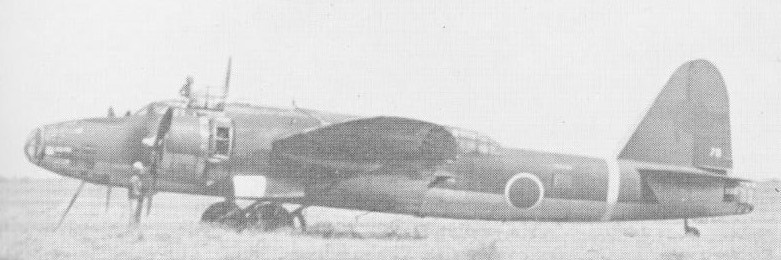
Both the Ki-49-IIa and Ki-49-IIb were in action with the 7th and 61st Sentais based in China in the summer of 1942, and made many attacks on Chungking and air bases of General C. L. Chennault’s China Air Task Force. ‘Helen’ bombers equipped the 12th Sentai, based at Medan and Sabang (Sumatra) under the 3rd Air Army, and these attacked objectives in Burma and eastern India, joining Ki-21s on some occasions in raids on Calcutta. In 1943 the Ki-49s of the 7th and 61st Sentais, now operating from Timor, attacked Darwin to face strong reaction by the Supermarine Spitfire Mk.Vs of No.1 Fighter Wing. Units equipped with Ki-49s suffered most in New Guinea, where 4th Air Army came under constant attack on its airfields at Wewak, But and Dagua after August 1943, when the RAAF and the US 5th Air Force went onto the offensive.
Ki 49s also flew many missions during the desperate Japanese defence of the Philip¬pines, and surviving aircraft, with a reduced crew of two, made suicide attacks on Allied ships. Some Ki 49 Is were fitted with detec¬tion equipment and used as antisubmarine aircraft, while others were pressed into ser¬vice as troop transports.
Six examples of the final version, Ki 49-III, were built, powered by Nakajima Ha 117 radials, each intended to provide 1805kW / 2420 hp. The engines were never really more than experimental, however, and technical prob¬lems remained unsolved. Plans for mass production of the Ki 49 III came to nothing.
In all, 819 Ki 49s of all variants were built, 769 by Nakajima at its Ota factory in Gumma Pre¬fecture and the remaining 50 by the Tachi¬kawa company.
Total production amounted to 819 aircraft.
Ki-49 prototype
Engines: 2 x 708kW / 1080 hp Nakajima Ha 5 Kai 14 cylinder radial engines
Hamilton Standard two pitch propellers
Armament: 1 x 20 mm (0.79 in) Ho 1 cannon, 5 x 7.7 mm (0.303 in) Type 89 machine guns
Ki-49 prototype
Engines: 2 x Nakajima Ha 41s of 932kW / 1250 hp
Props: Constant speed three-¬bladed
Ki-49-I / Army Type 100 Heavy Bomber Model 1
Engines: 2 x Ha-41 radial, 932kW / 1250 hp
Ki 49 II / Type 100
Engines: 2 x 1450 hp Nakajima Ha 109 radials.
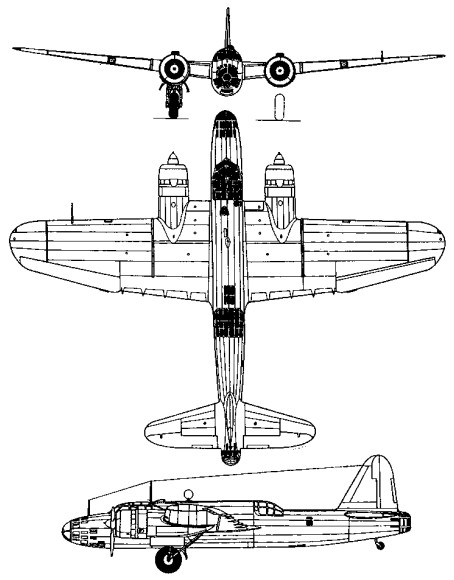
Span: 20.42 m (67ft)
Length: 16.5m (54 ft 2 in)
Height: 4.25m
Wing Area: 69.05 sq.m
Empty Weight: 6,540 kg
Gross weight: 10680 kg (23550 lb)
Maxi¬mum speed: 492 km/h (306 mph)
Crew: 7-8
Armament: 5 x 7.92mm Machine Gun, 1 x 20mm Ho1 Machine Gun
Bombload: 1,000Kg max
Ki-49-IIa / Army Type 100 Heavy Bomber Model 2A
Engines: 2 x Nakajima Ha-109 radial, 1450 hp / 1119kW
Wingspan: 20.42 m / 67 ft 0 in
Length: 16.5 m / 54 ft 2 in
Height: 4.25 m / 13 ft 11 in
Wing area: 69.05 sq.m / 743.25 sq ft
Empty weight: 6530 kg / 14396 lb
Max take-off weight: 11400 kg / 25133 lb
Max. speed: 492 km/h / 306 mph
Ceiling: 9300 m / 30500 ft
Range w/max. fuel: 2950 km / 1833 miles
Armament: 1 x 20mm cannon, 5 x 7.7mm machine-guns, 1000kg of bombs
Crew: 8
Ki 49 IIb
Armament: 1 x 20mm cannon, 5 x 12.7 mm (0.5 in) Ho 103 machine-guns, 1000kg of bombs
Ki 49-III
Engines: 2 x Nakajima Ha 117 radials, 1805kW / 2420 hp.
 All Aero