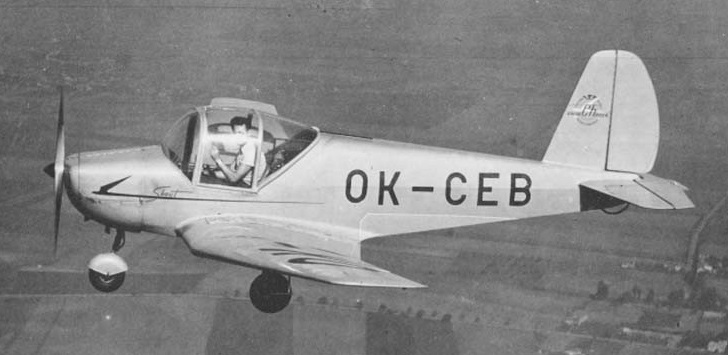
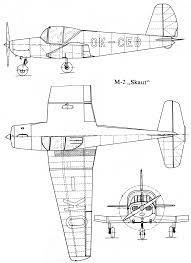
The Czechoslovak aircraft factory Mráz introduced several new sport aircraft after World War II. One of them was the M-2 Skaut, designed by Zdeněk Rublič. His aim was to design an easily flyable and reliable aircraft for basic club pilot training, with moderate operating costs and requiring little maintenance.
The Mráz M-2 Skaut was a wooden two-seat, single engine, low wing aircraft.
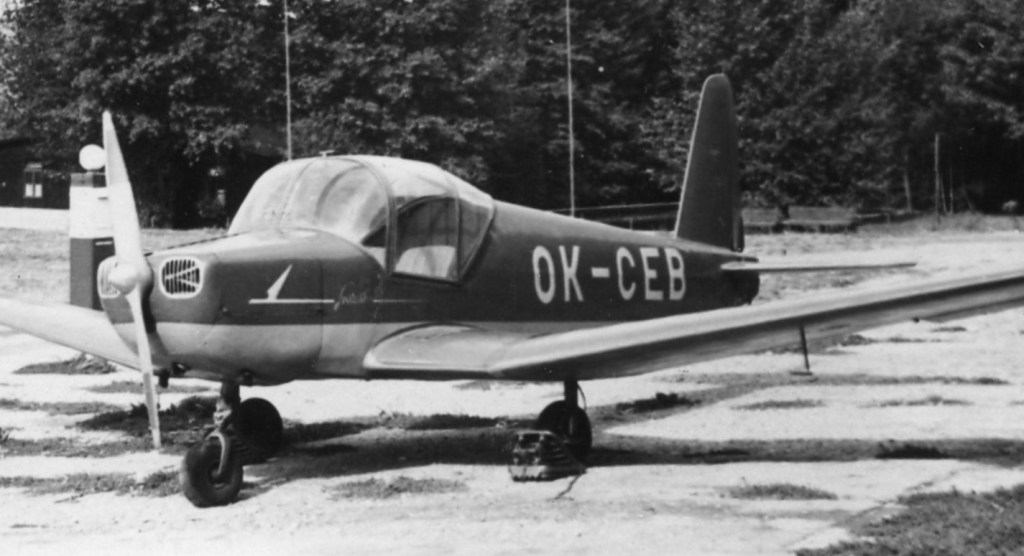
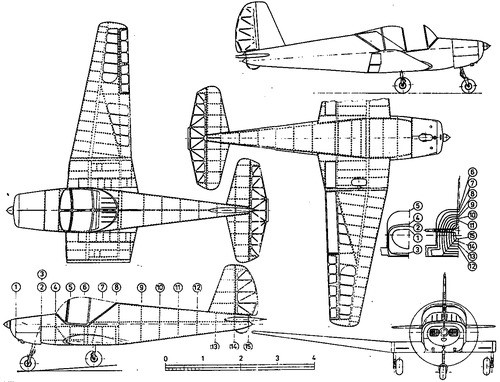
To simplify production, the wing and tail from his earlier, successful M-1C Sokol design was used. Like the Sokol, the Skaut was a wood framed, fabric covered aircraft. Their shared straight tapered wing had a swept leading edge but no sweep on the trailing edge They had marked dihedral beyond a very short centre section. The fin also had a swept leading edge and carried a rounded rudder. The tailplane was set well to the rear and near the top of the fuselage with a single piece elevator; the rudder moved above it. The Skaut had fixed tricycle landing gear.
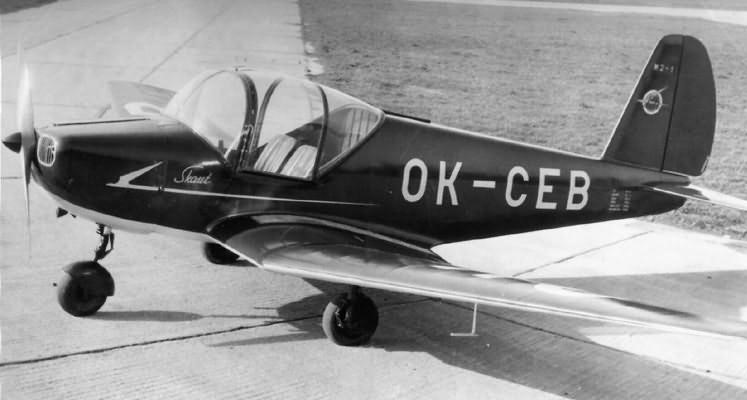
The prototype, first flown in mid-1948, showed that the Skaut was a stable and safe aircraft, pleasantly controllable and with a good field of view. These characteristics together with a side-by-side cockpit and a tricycle landing gear made it a promising civil trainer aircraft. However, the new communist government nationalised the Mráz factory and directed it to produce military aircraft, so only the prototype Skaut was completed in the 20th century.
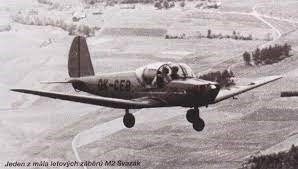
The only wooden prototype Skaut, OK-CEB Svazák, served at several flying clubs, mostly in Vrchlabí, and became very popular. There are rumours that it was flown solo by glider pilots without any previous experience of powered aircraft. In the early 1960s it was damaged during an emergency landing after an engine failure and was scrapped.
In 2005 the design was revisited, resulting in the metal framed, modernised Kubicek M-2 Scout which first flew in 2009 with plans for production and first deliveries in 2011.
Variation: Kubicek M-2 Scout
Powerplant: 1 × Praga D, 56 kW (75 hp)
Propeller: 2-bladed fixed pitch
Wingspan: 10 m (32 ft 10 in)
Wing area: 13.8 m2 (149 sq ft)
Length: 6.75 m (22 ft 2 in)
Height: 1.9 m (6 ft 3 in)
Empty weight: 370 kg (816 lb)
Gross weight: 660 kg (1,455 lb)
Fuel capacity: 70 L (18 US gal; 15 imp gal)
Maximum speed: 185 km/h (115 mph, 100 kn)
Cruise speed: 150 km/h (93 mph, 81 kn)
Range: 700 km (430 mi, 380 nmi)
Service ceiling: 4,200 m (13,800 ft)
Rate of climb: 2.7 m/s (530 ft/min)
Crew: 2
 All Aero