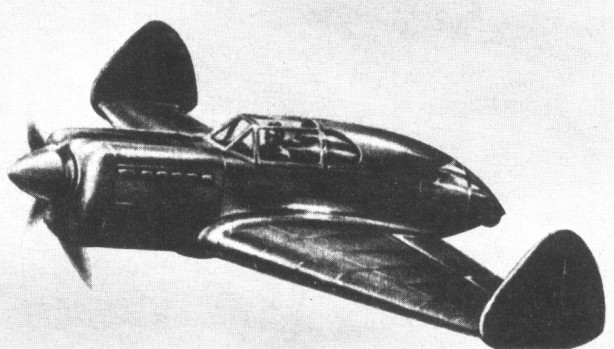
As part of the “Sigma Project” about 1934 Moscaliov began work on the development of a new model of unconventional design designated SAM-7 “Sigma” (Russian: Москалёв САМ-7 «Сигма»). with M-34 engine. The work in the RDD delayed a little the projection work of the model. This was the main task of the OKB of Factory No.18 at that time. The SAM-7 was designed as a two-seat escort fighter designed in a tailless configuration.
The SAM-7 was constructed entirely in metal. The steel structure was covered by thin sheets of 1.5 – 2.5 mm.
The aircraft featured a relatively short fuselage with swept wings terminating vertical surfaces, operated as rudders. The entire wing trailing edge featured control surfaces that were used as elevators. The outer sections additionally operated as conventional ailerons. The selected wing profile was the R-11a with a thickness of 12% at the root and 10% at the wingtips.
The fuselage ended in a cockpit for the gunner, who operated two machine guns located in a mobile turret. Under normal conditions this cabin remained closed in order to improve aerodynamics. During combat the cover was opened and the turret moved to the rear, allowing an excellent firing range. Two ShKAS synchronized machine guns were located in the engine.
The cockpit was located just behind the M-34R 850 hp V-12 linear engine. With this powerplant the expected speed for the SAM-7 at 4,000 meters was 600 km/h. The absence of a reducer in the M-34 engine made it necessary to use a 4-blade wooden propeller. The SAM-7 had the center of gravity at 13 – 15% of the chord, but tests showed excellent stability.
The cooling system included evaporative radiators located in the wings, plus a conventional type retractable auxiliary radiator, located behind the downward opening pilot seat, to be used in low speed operations (landings, takeoffs and taxiing). on the track).
The landing gear was of the conventional type, retractable towards the inside of the wing by turning it and with hydraulic shock absorbers. Landers were attached to the forward spar of the wing. The tail skid was practically hidden in the fuselage.
The prototype was built between 1934 and 1935 at Factory No.18 Voronezh and the factory tests were carried out successfully, although for precautionary reasons they only included tests of taxiing and small flights in a straight line.
At the same time that Moscaliev was developing the SAM-7, at the Kharkov Aviation Factory KA Kalinin was developing the K-12 or VS-12 bomber, also known as “Zhar Ptitsa” or Firebird. This M-22 twin-engined medium bomber also featured a trapezoidal-shaped R-11a airfoil.
Taking advantage of the delay caused by the development of the RDD, the Kalinin K-12 was delivered to state tests some time before. The first flight carried out by the test pilot of the NII VVS P. M. Stefanovski, was a total failure, mainly due to the ignorance of the characteristics of an airplane with this scheme.
The SAM-7 was eventually found ready for state testing at the NII VVS, but GUAP’s decision to cancel all flights soon followed. The cause was the similarity to the unsuccessful K-12.
Despite the fact that the SAM-7 had a 20º wing camber on the leading edge, which should have eliminated the defect shown by the K-12, the evaluation of the latter’s flights concluded that the tailless scheme was unreliable and he had no prospects. However, flights by factory pilots in K-12 and SAM-7 aircraft showed that the tailless scheme was capable of flying and being controlled in flight.
SAM-7 “Sigma”
Engine: 1 × 750 hp M-34
Wingspan: 9.60 m
Wing area: 20.00 m²
Length: 7.00m
Empty weight: approx 1000 kg
Maximum takeoff weight: 1480 kg
Wing loading: 74 kg/m²
Power load: 2.0 kg/hp
Speed at sea level: 435 km/h
Maximum speed at altitude: 500 km/h
Landing speed: 138km/h
Practical range: 800 km
Practical ceiling: 9200 m
Armament: Four 7.62 mm ShKAS machine guns.
Accommodation: 2

 All Aero