
This design was conceived with the OKB from the beginning as a military aircraft and, despite the low engine power, the project augured a good future due to the good performance obtained from the calculations and the low production cost.
The Moscaliev SAM-13 (Russian: Москалёв САМ-13) was designed around two 220 hp Renault MV-6 engines fore and aft and armed with four Ultra-ShKAS machine guns.
After submitting the conceptual designs, the NKAP department 7 decided to approve its inclusion in the group of experimental developments, since the MV-6 engine was not intended for military use. The evaluating commission decided that the design was novel and presented interesting solutions that could later be used in real fighters with high-powered engines.
The configuration selected for the SAM-13 comprised a low wing-set fuselage entirely in wood with a plywood covering.
The wing had a trapezoidal shape in plan, with rounded ends. The wing mechanization included offset ailerons. From the forward wing spar two bars extended backwards which joined behind the propeller cone in an oval stabilizer in which the elevators were located and from whose center the empennage rose.
The SAM-l3 was fitted with a retractable tricycle undercarriage, the forward unit was stowed aft, while the main units, attached to the forward spar of the wing at the tail cone area, were retracted into the fuselage.
The cockpit was located between both engines. Behind the engine were also located the fuel tank and the flight equipment. The rear propeller featured a mechanism that allowed it to be stopped in a horizontal position in emergencies, to allow the pilot to leave the plane.
In general, the Moscaliov SAM-13 was characterized by its small size and its clean lines.
By the end of 1939, the evaluation commission led by Colonel Kvitko met and the main topic of discussion revolved around the high value of the speed obtained as a result of the calculations. This speed of 700 km/h was considered not very objective for an airplane powered by 220 hp engines. Actually the calculations were made based not on the MV-6 engines, but on the French Renault Bengali 6 with Ratier metallic variable pitch propellers. Finally, after not a few discussions, the model of the SAM-13 was approved and the construction of the prototype began at Factory No.18.

The armament comprised two synchronised 7,62-mm guns in the forward fuselage and a similar weapon in the forward end of each tailboom.
By the end of 1939 the prototype was finished, which was delivered in the spring of 1940 to carry out factory flight tests. ND Fikson was selected as test pilot, V. Galitski was singled out for the TsAGI, and engineer Pushkin for the leadership of the NKAP.
Factory tests went smoothly. After the period of runs and jumps the flights began. The pilot Fikson was satisfied with the results, assessing the stability and control very positively. The speed at sea level was established with the gear extended and reached 560 km/h. Problems with the retraction of the forward landing gear prevented it from obtaining the expected speed, reaching only 607 km/h. These results made it possible to think that with the gear collected and at the optimal working height of the engine, the goal of the calculated 700 km/h could be achieved.
These flights also evidenced the need for long takeoff and landing runs due to the small wing area and low payload capacity.
The tests were not completed. After the seventh flight, the instruction was received from Moscow to suspend them until the wings and tail were tested in the TsAGI , with the aim of verifying the possible appearance of Flutter. It was also decided that the rest of the plane’s tests would be carried out at the TsAGI, so the plane had to be sent to that institution, together with a group of OKB-31 specialists.
In the TsAGI a new commission for the evaluation of flights was created. As test pilot ML Galai was selected. The OKB-31 group of workers was led by LB Polukarov and included NA Morietski, SA Zabyalov and Dovgi.
The results of the tests of the Flutter in the TsAGI T-101 tunnel showed that the design was capable of withstanding speeds of up to 800 km/h and were followed by a new period of taxiing and runway tests, carried out by Galai.
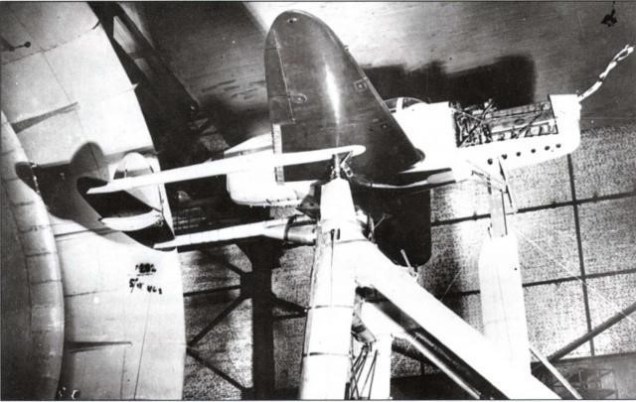
By that time, the TsAGI had finished installing a new high-speed wind tunnel model T-104. It was proposed to test there in a plane with a pilot and the engines working, with the aim of establishing the effectiveness of the model. These tests were completed in the spring of 1941 and the results were considered so secret that they were not even communicated to their designers.
A short time later Moscaliov was called to the office of AS Yakovlev, where he was informed that by government decision the tests of the model would be cancelled. The weak armament and the little capacity of the plane to increase it were argued. Then the war started.
All materials and documentation linked to this model were destroyed.
SAM-13
Powerplant: 2 × 220 hp Renault Bengali 6
Span. 23 ft 11 1/3 in (7,30 m)
Wing area, 96.88 sq ft (9.00m sq.m)
Length, 25 ft 4 in (7,68 m)
Empty weight: 745 kg
Maximum takeoff weight: 1183 kg
Wing loading: 131 kg/m²
Power load: 7 kg/hp
Max speed reported: 323 mph (520 km/h) at 11,485 ft (3 500 m)
Maximum speed at 5000 m est: 680 km/h
Maximum speed at sea level est: 463 km/h
Landing speed: 125 km/h
Practical range: 850 km
Service ceiling: 10000 m
Accommodation: 1
Armament: Four 7.62 mm Ultra-ShKAS machine guns.

 All Aero