
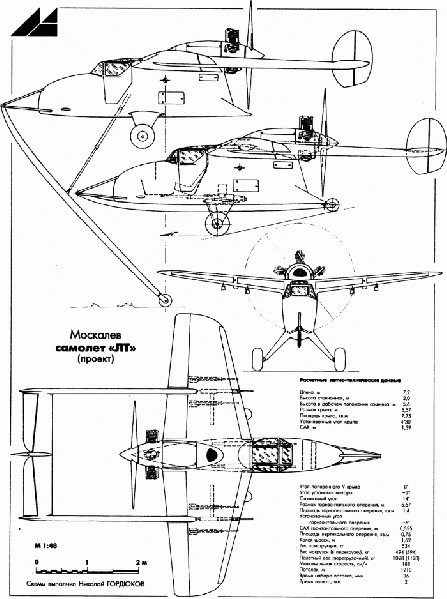
During the Great Patriotic War A. Moscaliov developed more than landing gliders. In the archives of the TsAGI branch of Novosibirsk, a project of an attack aircraft known as the flying tank or LT (according to the initials of Letayushaya Tanquietka, in Russian: ЛТ) with an M-11 engine. Sometimes called “Bloja” (Fly). In the records of the Moscaliov OKB this aircraft was known as SAM-23 (in Russian: САМ-23), a name that would later be used for a landing troop transport glider.
The development of this aircraft was carried out at Factory No.499 by the constructor Nekrasov.
The project was ready by the end of May 1942 and on September 14 it was handed over to the TsAGI for evaluation. In the project’s descriptive memory, “the behavior of the plane on the ground… ” was written, which has allowed speculation that a prototype had been built.
This airplane was designed with the objective of destroying armor and forces, as well as the destruction of ground defences.
The LT was designed as a 6.8 meter long, twin-fuselage, high-wing monoplane single-seat airplane. The fuselage was built on a structure of welded tubes with a duralumin coating.
The wing featured an RP profile with a single spar and was made of wood, covered with plywood and fabric. The wing featured flaps on the leading edge and the full span of the trailing edge to facilitate take-off on short runways.
The LT was powered by an M-11 radial engine located in the upper rear of the fuselage, driving a driving propeller.
The pilot was located in a cockpit at the front of the nacelle, which allowed excellent visibility. The entire cabin was armored with 3mm plates on the sides and 4.5mm on the front. The pilot’s seat featured armor similar to that of the Ilyushin Il-2. The cockpit windshield also featured transparent shielding. Access to the cabin was through a car-type door located on the left side.
At the end of each tail cone, it was joined by the horizontal stabilizer in the center of which the oval-shaped empennage was located with the rudder.
The landing gear was fixed and of the conventional type, with a tail skid. The wheels of the main landers were inflatable with dimensions 470 x 210 mm.
The armament consisted of two ShVAK 20 mm cannons, located in the fuselage on both sides of the cockpit and 200 shots per muzzle (500 in the overloaded version). Two ShKAS machine guns with 1500 (2000) rounds and 4-6 RS-82 reactive rockets located on external supports under the wings or 400 kg of bombs. With full load the takeoff weight reached 1128 kg. By calculations, with a more powerful engine like the M-34. The armor, the offensive load, could be increased, raising the takeoff weight to 1500 kg.

The tactics for using the LT included flight following the terrain at a height of 4-5 meters. This was accomplished through the use of a pole attached to the nose. The end of this structure traveled brushing against the irregularities of the terrain.
It was considered that flying at that height, at a speed of 150 – 180 km / h it would be quite difficult for the enemy to shoot down. The ground troops could do little due to the high speed and for the fighters it would be at a height where they were ineffective. On the other hand, the small dimensions of the LT allowed it to operate from highways or roads, even moving along them until approaching the target.
The SAM-23 could be used to carry out attacks on defensive ground positions following normal dive methods from heights of 1000 – 1200 meters.
Designed to work in large formations the LT had to be characterized by its low price, the use of a cheap engine and large productions and the simplicity of the piloting, to be able to prepare large numbers of pilots.
The project did not receive the approval of the TsAGI, fundamentally considering that the pilot was poorly defended by the thin armor. It was also alleged that flying at such a low altitude required too much stress on the pilot to avoid the unevenness of the terrain and keep the plane from crashing.
SAM-23 or LK
Engine: M-11, 100 hp
Wingspan: 5.57 m
Wing area: 7.75 m²
Length: 6.8 m
Height: 2.00 m
Empty weight: 534 kg
Maximum takeoff weight: 1128 kg
Top speed: 188 km / h
Endurance: 2 hours
ROC: 34 m / sec
Ceiling: 1210 m
Accommodation: 1
Armament: two ShVAK cannons and two ShKAS machine guns
Bombload: 400 kg
 All Aero